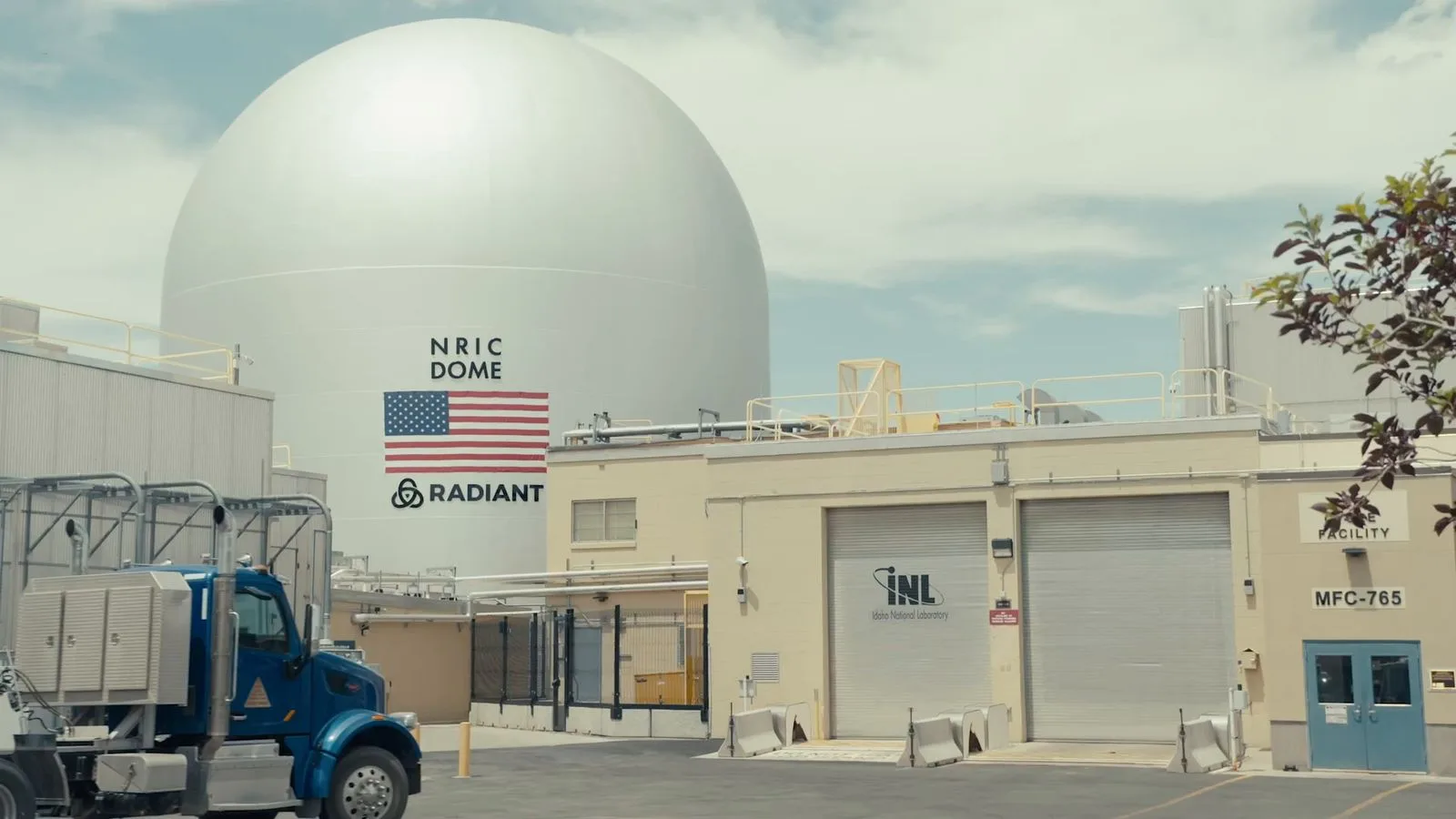
A Nuclear Reactor That Fits in a Shipping Container Just Got the OK to Run at Full Power for 60 Days
On Oct. 29, 2026, Radiant said the Department of Energy approved the final safety analysis for its Kaleidos microreactor, clearing the way for a full-power test at Idaho National Laboratory that ends with at least 150 hours of nonstop operation without anyone touching the controls.
So basically: A company called Radiant built a nuclear reactor small enough to fit inside a shipping container. Now the U.S. Department of Energy has signed off on the safety plan to actually run it at full power, for weeks, at a national lab in Idaho.
Radiant announced the approval on Oct. 29, 2026.
What Kaleidos is
The reactor is called Kaleidos. It’s what people call a microreactor, a tiny nuclear power plant built in a factory and hauled to wherever it’s needed on a truck.
Here’s the basic idea, from Radiant and Nuclear News Network:
- It makes about 1 megawatt of electricity, from about 3 megawatts of heat
- It’s cooled with helium gas instead of water
- It uses TRISO fuel, tiny fuel pellets each wrapped in layers of tough coating
- The whole thing fits in a single shipping container
One megawatt isn’t a lot compared to a big power plant. But it’s enough to run a military base, a remote town or a data center without hooking up to the grid, which is exactly who Radiant is selling to.
What got approved
DOE approved Kaleidos’ Documented Safety Analysis. That’s the last big safety document a reactor needs before it can run inside a DOE facility.
The key part is that it covers running the reactor at power, not just turning it on. A lot of the small reactors that made news in 2026 only did zero power tests. Those prove the nuclear chain reaction works, but they don’t make any real heat or electricity. Nuclear News Network says this is the first approval that lets a commercial microreactor design try an extended full power run at the lab.
The test plan
Radiant’s reactor is already sitting in Idaho. It was built in El Segundo, California, and shipped to Idaho National Laboratory in August 2026. Its fuel got there in July.
The test happens inside a facility called DOME, which is a repurposed containment dome from an old experimental reactor. Here’s the plan:
- Five phases, going from first startup to higher and higher power
- 60 effective full power days in total, spread over several months
- It ends with at least 150 hours of continuous full power running without any operator stepping in
That last one is the big deal. That’s more than six days of a reactor running itself. Radiant’s customers want something they can drop off and leave alone, not something that needs a crew watching it every minute.
Who wants one
Radiant already has some big customers lined up:
- The U.S. Army picked Radiant for up to 15 Kaleidos units through its Janus program, according to Nuclear News Network
- The U.S. Navy picked it for Naval Weapons Station Crane in Indiana earlier this month
- Radiant plans to deliver its first commercial units to Buckley Space Force Base and Fort Benning in 2028
It plans to build them at a factory called R-50 in Oak Ridge, Tennessee.
What’s still in the way
There’s one more step. DOE still has to do a Readiness Review, which checks that the reactor and the team running it are ready to start. No date has been given for that.
Nuclear News Network also pointed out a delay. Back in February, Radiant said it was on track to start its reactor “this summer.” Summer came and went. And DOME only runs one experiment at a time, so other companies waiting in line are stuck behind Kaleidos. DOME’s next open slot is listed for July 2027.
Radiant also calls Kaleidos “the only microreactor design” with this kind of approval. That’s the company’s claim, not DOE’s.
My take
I like that this test is about running for a long time, not just flipping it on for a photo op. A reactor that can sit in a container and run by itself for a week straight is the whole pitch. If Kaleidos makes it through 60 days at full power, the conversation about small nuclear changes from “someday” to “where do we put them.” I just wouldn’t bet on that happening before next summer.
So basically — pass it on.
Daily Updates
Get new stories in your inbox
Near-future tech when it moves. Robots, space, EVs, AI. No spam.