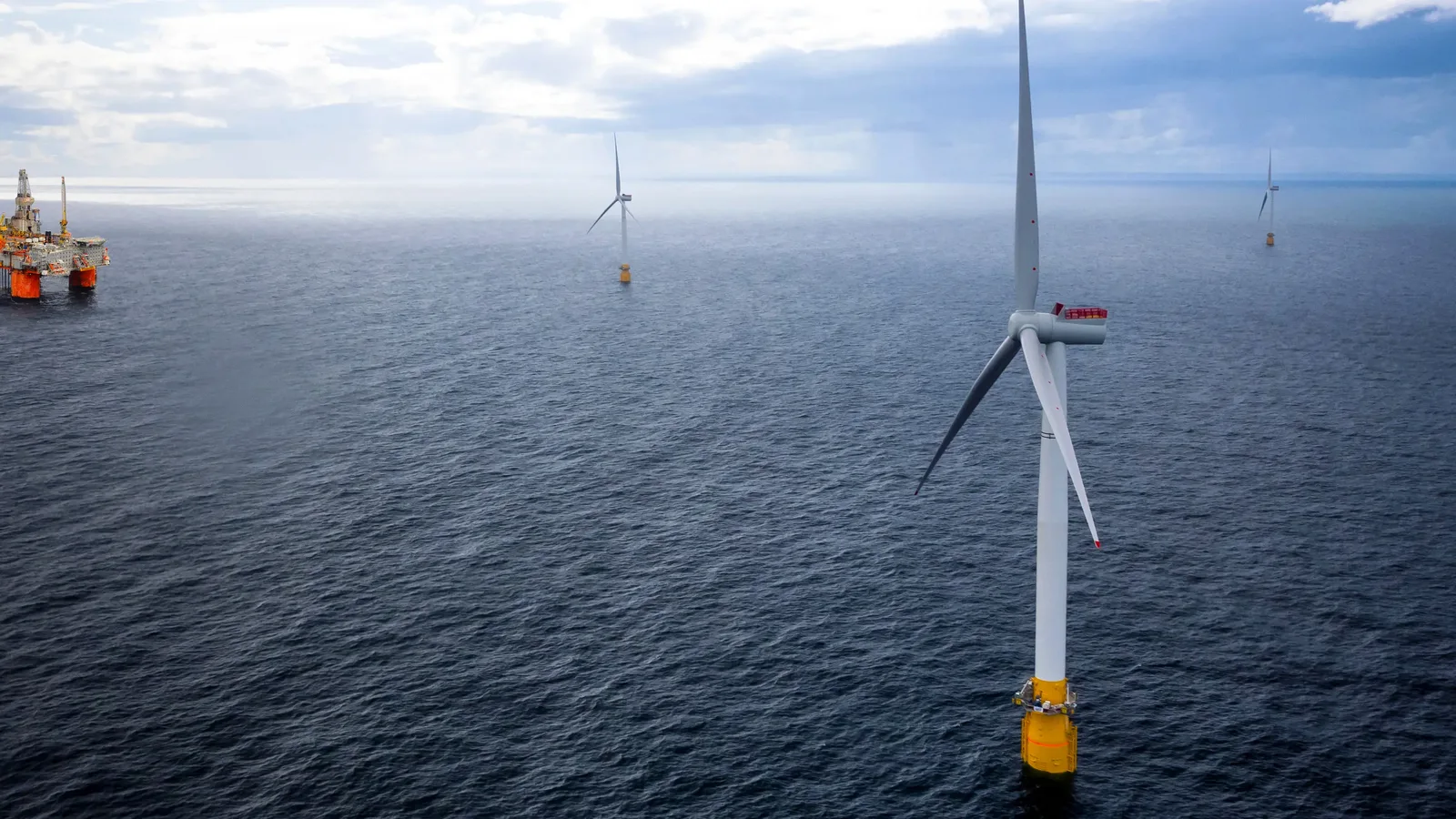
Norway Is Paying $428 Million for Four Giant Floating Wind Turbines
Norway's state energy agency Enova awarded NOK 3.94 billion on Oct. 30, 2026 to two floating offshore wind projects off Karmøy. Each will put two 18.5 MW turbines on floating foundations in the North Sea within five years, making about 300 million kWh a year.
So basically: Norway is putting up NOK 3.94 billion, about $428 million, to build four wind turbines that float. Not wind turbines on poles stuck into the seabed. Turbines sitting on floating platforms, held in place with mooring lines, out in the North Sea.
The money comes from Enova, a Norwegian state agency that funds clean energy. It announced the winners on Oct. 30, 2026.
Who won
Two projects split the money:
- Fortius Offshore Wind gets NOK 2 billion
- Fram Wind Solutions gets NOK 1.94 billion
Each one will put up two turbines over the next five years. Both will go at METCentre, a test site for floating wind off the island of Karmøy on Norway’s west coast. And the money only gets paid out if the projects actually get built.
This was a real competition. Five companies applied, asking for a combined NOK 9 billion. Each project could get up to NOK 2 billion. Enova picked based mostly on how much energy each project would make per krone of support. That counted for 70 percent of the score. The other 30 percent was about innovation and how much the rest of the industry could learn from it.
How big these things are
Every one of the four turbines is rated at 18.5 megawatts. That’s huge. Enova says the four of them together equal about 20 average onshore wind turbines.
Combined, they should make about 300 million kilowatt hours a year. Enova says that matches what about 15,000 households use in a year. Each project is about 37 MW, so roughly 74 MW total.
The head of the industry group Norwegian Offshore Wind, Arvid Nesse, said Europe’s floating demo turbines so far have been up to 10 MW. So these are close to double that size, on floating foundations. That’s the jump they’re paying for.
Why float a wind turbine
Normal offshore turbines are planted in the seabed. That works in shallow water. In deep water, it gets too expensive or flat out impossible. Floating turbines can go way out where the water’s deep and the wind is stronger.
The problem is cost. Floating wind still costs too much to compete on its own. So these projects are about testing the expensive parts:
- Floating foundations big enough for giant turbines
- Mooring systems, the lines that hold them in place
- Better ways to build, install, run and repair them
Enova says a successful global rollout could bring floating wind costs down to as little as NOK 1 per kilowatt hour.
The test site is ready
METCentre has been doing full scale floating wind tests for 17 years. Its license allows up to six floating turbines with a total of 82.7 MW, on top of a small 2.3 MW turbine already there. It also has power grid capacity reserved and plans for a new 66 kV export cable to send the power ashore.
Norway’s not alone
Other countries are spending big on this too. Enova pointed out that France set aside EUR 63 billion this summer for floating and fixed offshore wind over the next 25 years. The UK is investing heavily too.
What we don’t know
Neither Enova nor the industry group said exactly what year the turbines will start spinning, just that it’s within five years. They also didn’t name the turbine maker.
My take
What gets me is the size. An 18.5 MW turbine floating in the North Sea, tied down with cables, getting hit by those waves. That’s an engineering flex. But I like that Norway is paying for the boring stuff here, foundations and mooring lines and maintenance. That’s where the cost actually is. Four turbines won’t power a country, but if they figure out how to make these cheaper, the next ones could be whole farms.
So basically — pass it on.
Daily Updates
Get new stories in your inbox
Near-future tech when it moves. Robots, space, EVs, AI. No spam.