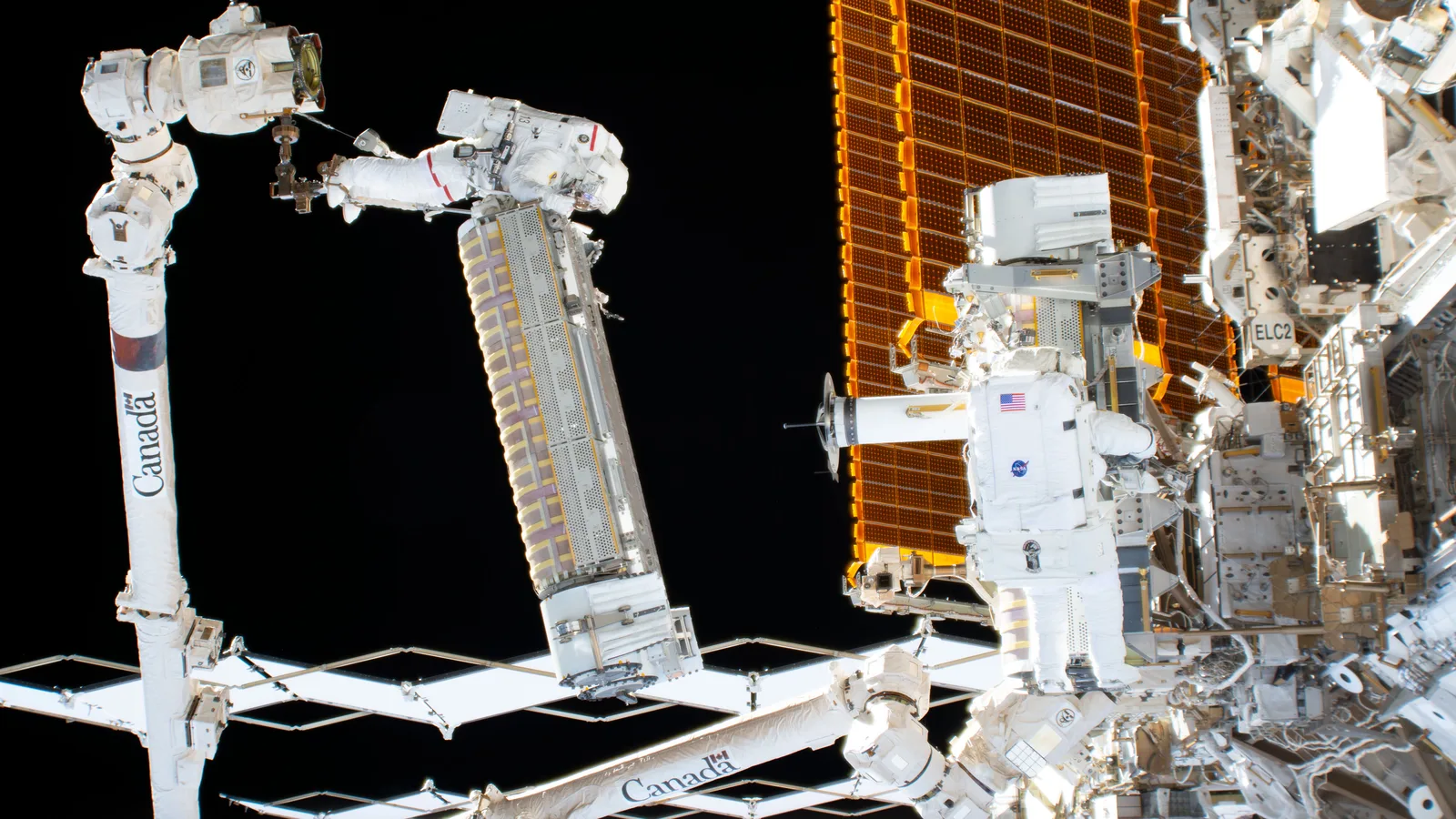
NASA's Spacewalk 100 Is Thursday, and the Job Is Unrolling a Solar Panel That Springs Open Like a Tape Measure
On Oct. 29, 2026, NASA astronaut Anil Menon and Canadian astronaut Joshua Kutryk will step outside the International Space Station to install the seventh of eight roll-out solar arrays. When the last one goes up Nov. 5, the station's power capacity climbs from 160 kilowatts to about 215.
So basically: Tomorrow morning, Thursday, Oct. 29, two astronauts are going outside the International Space Station to bolt on a new solar panel. NASA calls it U.S. spacewalk 100. The panel they’re installing doesn’t fold out like the old ones. It comes up there rolled up like a carpet, and once it’s let loose it springs open on its own. This is the seventh of eight of these new panels, and when the last one goes up next week, the station will have about a third more power than it used to.
Who’s going out there
The two spacewalkers are Anil Menon from NASA and Joshua Kutryk from the Canadian Space Agency. It will be Menon’s fourth spacewalk and Kutryk’s first. Kutryk will be only the fifth Canadian astronaut ever to do a spacewalk outside the station, after Chris Hadfield, Steve MacLean, Dave Williams and David Saint-Jacques.
They’re scheduled to start at 8 a.m. Eastern, and NASA+ coverage starts at 6:30 a.m. if you want to watch.
Two more astronauts, Jessica Watkins and Luke Delaney, will stay inside. They’ll help the guys into and out of their suits, and they’ll drive the station’s big robot arm, Canadarm2. The Canadian Space Agency says the arm will act as a base for one of the spacewalkers to stand on while they work.
One small detail I liked: on Tuesday, Menon and Kutryk printed out their step by step instructions and put them in a little checklist book that they wear on the cuff of their spacesuits. Even in space, the paper cheat sheet still wins.
What the new solar panels actually do
The station already has its big original solar wings. Those are the long gold colored panels you see in every photo of it. The problem is they’re old, and solar panels wear down over time.
So instead of replacing them, NASA has been adding newer, smaller panels called roll-out solar arrays right in front of them. Each new one is about half the size of an old wing, so the parts of the old wing that aren’t covered keep making power too.
Here’s the clever part. The panel is a thin, flexible blanket of solar cells rolled around a tube. On each side there’s a long composite boom that’s been flattened and rolled up with it. When it’s released, those booms want to snap back into shape, kind of like a metal tape measure, and that pulls the whole blanket out flat. There’s no motor doing the unrolling, which means fewer things that can jam.
The first two of these went up in June 2021. The same design has also been used on NASA’s DART spacecraft, the one that smashed into an asteroid on purpose.
The numbers
Thursday’s panel goes on the port side of the station, on what NASA calls the 2A power channel. Then on Nov. 5, the same two astronauts go back out for spacewalk 101 and install the eighth and final one on the starboard side.
When all eight are up, NASA says the station’s power goes from 160 kilowatts to roughly 215 kilowatts, an increase of up to 30 percent. These two trips will be the 285th and 286th spacewalks done to build, fix and upgrade the station since it started.
NASA also said something kind of wild in its announcement. Part of the reason for the extra power is to support the station’s safe and controlled deorbit. In other words, they’re upgrading the house partly so it has enough juice to take itself down safely at the end of its life.
My take
I think this is one of those stories that gets skipped because it isn’t a rocket launch. But putting a 100th spacewalk on the calendar to unroll a solar panel that opens itself like a tape measure is pretty cool to me. What gets me is that they’re still upgrading a station that’s going to be retired, and part of the reason is so it can come down the right way. That’s like putting new tires on your truck before you drive it to the junkyard, except the junkyard is the middle of the ocean. I’ll be watching Thursday morning, and I want to see Kutryk’s face after his first time out there.
So basically — pass it on.
Daily Updates
Get new stories in your inbox
Near-future tech when it moves. Robots, space, EVs, AI. No spam.