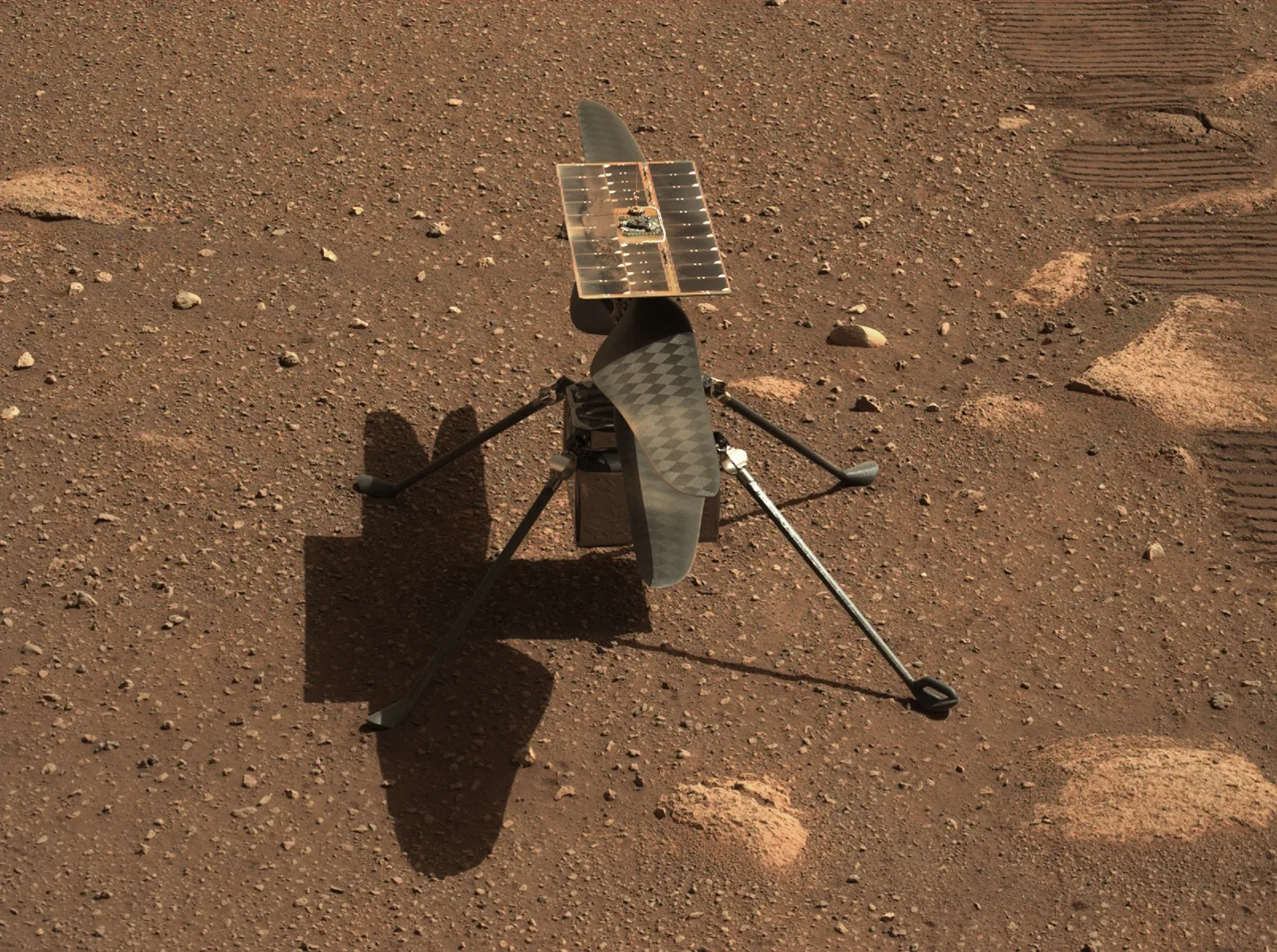
NASA's New Mars Helicopter Blades Could Fly 26 Times Farther Than Ingenuity
Ingenuity's longest single flight on Mars was 0.7 km. NASA simulations say a thinner new blade called roamx-0201 could stretch that to 18.7 km while carrying science gear.
So basically: NASA has been testing a new kind of helicopter blade for Mars, and the numbers are wild. Ingenuity, the little helicopter that flew on Mars, could go about 0.7 kilometers in one flight. NASA’s simulations say the new blade could push that to 18.7 kilometers, while carrying science gear. That’s about 26 times farther.
It’s not ready to go to Mars yet. But it’s a big step toward helicopters that can actually cover ground up there.
Why flying on Mars is so hard
The air on Mars is super thin, about 1% as thick as the air on Earth. There’s barely anything for a blade to push against. That’s why Ingenuity’s blades had to spin really fast just to get it off the ground.
Spinning fast causes its own problem. When blade tips get close to the speed of sound, they suddenly lose a lot of their lift. Engineers call that drag divergence. And here’s the odd part. The speed of sound on Mars is lower than on Earth, so blades there hit that wall sooner.
What’s different about the new blade
The new blade shape is called roamx-0201. It came out of a team at NASA’s Ames Research Center in California working with Imperial College London and Nagoya University in Japan.
They used computer programs tuned to Mars conditions to find the best shape, and it pointed them to something thinner, sharper, and lopsided compared to Ingenuity’s rounder blades. Then they tested it in wind tunnels.
A few things stood out:
- It can spin faster before it hits that speed of sound problem.
- It does better when the angle of the air changes suddenly. That’s called stall, and Ingenuity’s blades lost a lot of lift when it happened. The new blade handles it much better, so a future helicopter could fly safely at more angles.
- It messes with the air on purpose. Right at the front edge, the blade disturbs the thin layer of air flowing over it. You’d think that would hurt, but it actually helps pull the blade up.
The results were published in a paper on Sept. 22 in the journal of the American Institute of Aeronautics and Astronautics.
Where this fits
Ingenuity was supposed to make five test flights. It ended up flying more than 70 before a broken blade grounded it in 2024.
Next up is NASA’s SkyFall mission, planned to launch in 2028. It’s going to drop three helicopters into the Mars sky to map buried ice. Those helicopters use a blade design that builds on what Ingenuity flew.
The roamx-0201 blade is aimed at the missions after SkyFall. NASA says it’s still working out the differences between what the computer predicts and what happens in real tests. So no promises yet. But the goal is helicopters that fly farther, carry more, and do real science instead of short hops.
What 18.7 km would mean
For a rover, 18.7 km is a huge distance. Perseverance has spent years driving around its area of Mars. A helicopter that could cover that much ground in one flight could scout a whole region in an afternoon, check out cliffs and canyons rovers can’t reach, and come back with pictures and readings.
That changes how you’d plan a mission. Instead of the rover crawling everywhere, a helicopter could find the good spots first.
My take
What gets me is that a big part of this comes down to the shape of a blade. Not a bigger motor or a fancy new battery. Just a thinner, sharper edge that messes with the air in the right way. Ingenuity proved you could fly on Mars at all, and that was only a few years ago. Now NASA’s talking about flights 26 times longer. If even half of that works out on the real planet, Mars helicopters stop being a cool demo and start being the main way we explore.
So basically — pass it on.
Daily Updates
Get new stories in your inbox
Near-future tech when it moves. Robots, space, EVs, AI. No spam.