NASA Is Going to Drop Three Helicopters Into the Mars Sky and Let Them Land Themselves
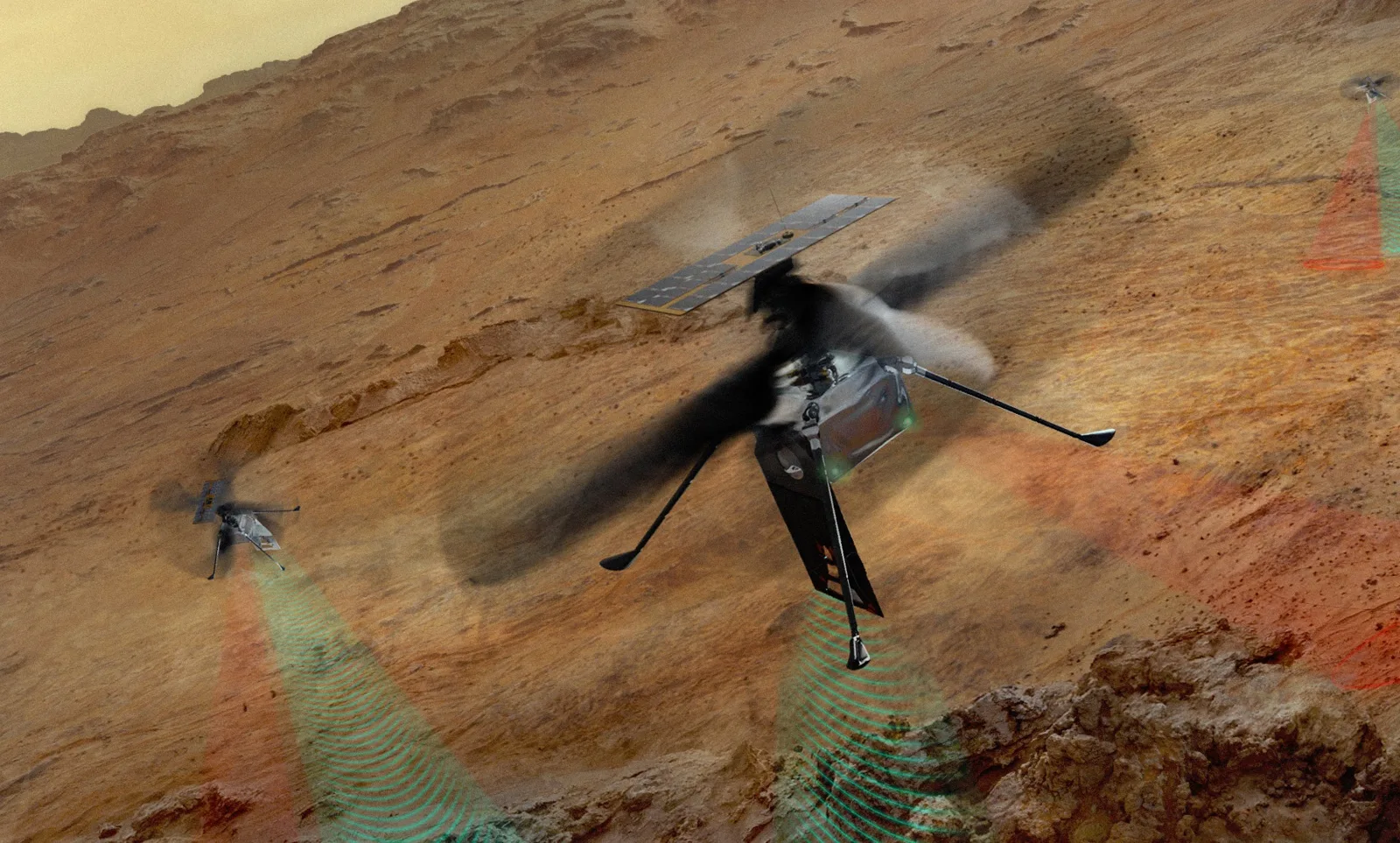
SkyFall will release three Ingenuity style helicopters about 1,000 meters above Mars, then map buried ice with radar. Launch is planned for late 2028 on NASA's nuclear powered SR-1 Freedom.
So basically: NASA’s next Mars helicopters are not riding down on a rover. The plan is to drop three of them straight out of an entry capsule while it is still falling through the Martian sky, about 1,000 meters up, and have each one fly itself to the ground. Then they spend months mapping ice that is hiding under the dirt.
The mission is called SkyFall. NASA first announced it in March, and this week Space.com got new details from the team at JPL about where the helicopters might go and how far they can fly.
The drop
Here is the wild part. Ingenuity rode to Mars bolted under the belly of Perseverance. SkyFall skips the rover completely.
The three helicopters ride inside an entry capsule. Once that capsule is in the atmosphere, roughly under a mile (about 3,300 feet) above the surface, it lets them go. Each helicopter separates, unfolds, spins up, and lands under its own power. NASA calls it the “SkyFall maneuver.”
If one of them botches that, you still have two. That is the whole point of sending three identical ones.
The ride there is nuclear
The helicopters are hitching a ride on Space Reactor-1 Freedom, which NASA says will be the first fission powered interplanetary spacecraft. Launch is planned for late 2028.
It does not go straight in. NASA’s mission page says it flies past Mars in 2029 and then lands the helicopters after a second approach in fall 2030. The trajectory puts them in the northern hemisphere during Martian spring, which helps dodge the dust storm season.
The numbers on the helicopters
From NASA’s own spec sheet:
- Mass: 11 pounds (5 kilograms) each
- Height: 20.5 inches
- Rotors: two counter rotating blades, each 4.4 feet across
- Cameras: 13 megapixel color plus near infrared
- Also onboard: ground penetrating radar, air temperature sensors, a small radiation monitor
For comparison, Ingenuity weighed about 4 pounds. These are bigger, but JPL project scientist Matthew Golombek told Space.com they are designed to operate “in exactly the same way,” so everything learned flying Ingenuity carries over.
How far they can go
Golombek said each helicopter can fly one to two kilometers every other sol (a Mars day). They are built to last six months, with a goal of one Earth year. Add that up and each one could cover roughly 200 to 300 kilometers, which is about 125 to 185 miles.
Perseverance just set a Mars driving record and that took years. These little guys could match that kind of distance in a season.
There is no wind sensor on board, but the team has a trick for that too. A helicopter can go into what they call “Balloon Mode” and just drift with the wind, so its own movement tells you how hard it is blowing.
Why they want the radar
The radar is the real job. Each helicopter carries ground penetrating radar that can see layers just under the surface, shallower than what orbiting radar can pick out. Those layers might be rock, buried ice, or both.
Buried ice is a big deal for science and for anybody who wants to send people. It is water you could dig up instead of hauling from Earth. The team says its reference landing site targets ice deposits with glacier style terrain.
The actual landing site is not picked yet. NASA plans a first landing site workshop early next year and a second one in late 2027.
The Ingenuity legacy
Ingenuity was supposed to fly five times. It flew more than 70 before a broken rotor grounded it in 2024. That little 4 pound test project turned into the reason NASA is now sending a whole squad.
My take
Dropping three helicopters out of a falling capsule on another planet sounds like something from a movie pitch, and NASA is just casually putting it on the schedule. I love that they are sending three instead of one fancy one.
The 2028 date on a brand new nuclear spacecraft is the part I would bet slips. But if it works, we get flying scouts mapping ice where future crews might actually land, and that is a lot more useful than another pretty orbit photo.
So basically — pass it on.
Daily Updates
Get new stories in your inbox
Near-future tech when it moves. Robots, space, EVs, AI. No spam.