Four People Just Spent a Full Year on Fake Mars in Houston. They Only Talked to Family by Email
NASA's CHAPEA Mission 2 crew hit one year inside a 1,700 square foot 3D printed Mars habitat at Johnson Space Center on Oct. 19. They grow food, do suited spacewalks in red sand, and come out on Oct. 31.
So basically: Four people have now lived for a full year inside a fake Mars base at NASA’s Johnson Space Center in Houston. They’ve been sealed inside since Oct. 19, 2025. They grow some of their own food, go on suited spacewalks in red sand, and the only way they’ve talked to their families this whole time is email, with a delay built in like it’s coming from Mars.
NASA marked the one year point on Oct. 19. The crew still has a little under two weeks to go. They walk out on Saturday, Oct. 31, which is Halloween.
What this is
The program is called CHAPEA, short for Crew Health and Performance Exploration Analog. That’s a mouthful, but the idea is simple. Before NASA sends people to Mars for real, it wants to know what a year of living in a small box far from home does to a crew. How they eat, how they sleep, how they work together, and how well they can still do hard jobs when supplies are limited and nobody can help them right away.
So NASA built a practice Mars base and locked volunteers inside it.
This is the second mission. The crew is Ross Elder as commander, Ellen Ellis as medical officer, Matthew Montgomery as science officer, and James Spicer as flight engineer. Their whole mission runs 378 days.
The house is 3D printed
The habitat is about 1,700 square feet, which is roughly the size of a normal three bedroom house. It was 3D printed by ICON, a Texas construction company, using a concrete like material called lavacrete.
Inside, each person gets a small private room. There’s a kitchen, a lounge, work stations, a medical station, and spots for growing crops. NASA went with 3D printing because on a real trip, you can’t haul a bunch of lumber and drywall to Mars. The plan is to print buildings on site.
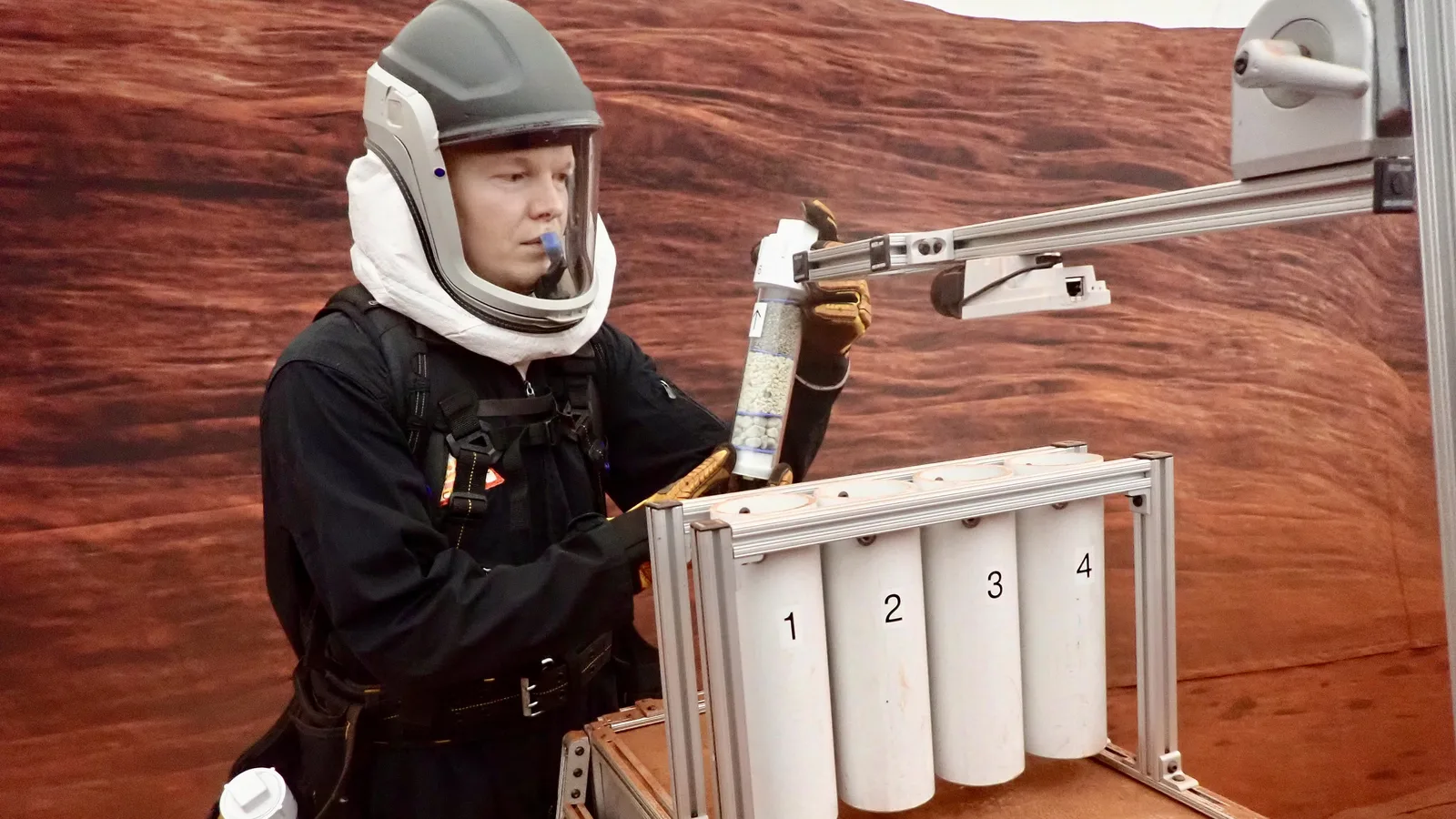
Attached to the house is a big room filled with red sand and painted walls that look like the Martian desert. That’s where the crew suits up and does their “spacewalks,” collecting rock samples and fixing gear like they would on the real surface.
What a year in there looks like
According to NASA, the crew has spent the year acting like they’re actually on Mars. That means growing crops, stretching limited supplies, doing suited outside work, and dealing with slow communication back home.
That last part is the one that gets me. On Mars, a message to Earth takes minutes to arrive, so you can’t just call someone. The crew has only talked with their families by email the entire year, with that delay added in.
There are a couple small human details in NASA’s photos too. The crew got a personal item allowance, and they used it to bring musical instruments, including a keyboard and a banjo. Another photo shows a set of pictures they laid out in a circle around a boot print in the fake Martian sand.
Why NASA cares
When they walk out on Oct. 31, the crew goes straight into two weeks of tests and debriefs. NASA says the data will help it figure out things like how limited food and exercise gear affect a crew’s ability to do spacewalks on Mars, and how to help astronauts make decisions on their own when Mission Control can’t answer quickly.
This isn’t the first run, either. The first CHAPEA crew lived in the same habitat from June 25, 2023 to July 6, 2024. NASA has planned three of these missions total, so there’s one more to go after this.
My take
I think this is one of the most underrated things NASA does. Everybody talks about rockets, but the hard part of Mars might be the people. A year with the same three faces, no phone calls home, and food you have to ration is rough. I work long overnight shifts myself, and even that messes with your head after a while. The fact that these four volunteers made it a full year and are still smiling in the photos says a lot. I’d watch that Halloween walkout just to see their faces when the door opens.
So basically — pass it on.
Daily Updates
Get new stories in your inbox
Near-future tech when it moves. Robots, space, EVs, AI. No spam.