Japan Just Gave a Fusion Startup $126 Million to Build a Twisted Magnet Reactor
Helical Fusion was picked for a Japanese government grant worth up to 19.2 billion yen, about $126 million, through February 2029. The money goes to its Helix HARUKA demo device, whose superconducting coils get their first power tests in 2027, and the design of its first fusion power plant.
So basically: Japan’s government just picked a fusion startup called Helical Fusion for a grant worth up to 19.2 billion yen, about $126 million. The company is building a type of fusion machine called a stellarator, which holds superhot plasma inside a set of twisted magnets. The money runs through February 2029, and the first big test, powering up its superconducting magnets, is set for 2027.
What a stellarator is
Fusion is the same process that powers the Sun. You heat hydrogen fuel to well over 100 million degrees until the atoms smash together and give off energy. Nothing solid can touch stuff that hot, so you hold it in place with magnets.
Most fusion machines you hear about are tokamaks, which are shaped like a donut. They push a big electric current through the plasma itself to help hold it together, and that current is part of why they tend to run in pulses.
A stellarator does the holding with the magnets alone. The coils are twisted into a weird corkscrew shape, so the magnetic field wraps the plasma in a spiral. They’re really hard to design and build. But the big upside is they can, in theory, run nonstop, which is what you want from a power plant.
Japan has been doing this for decades
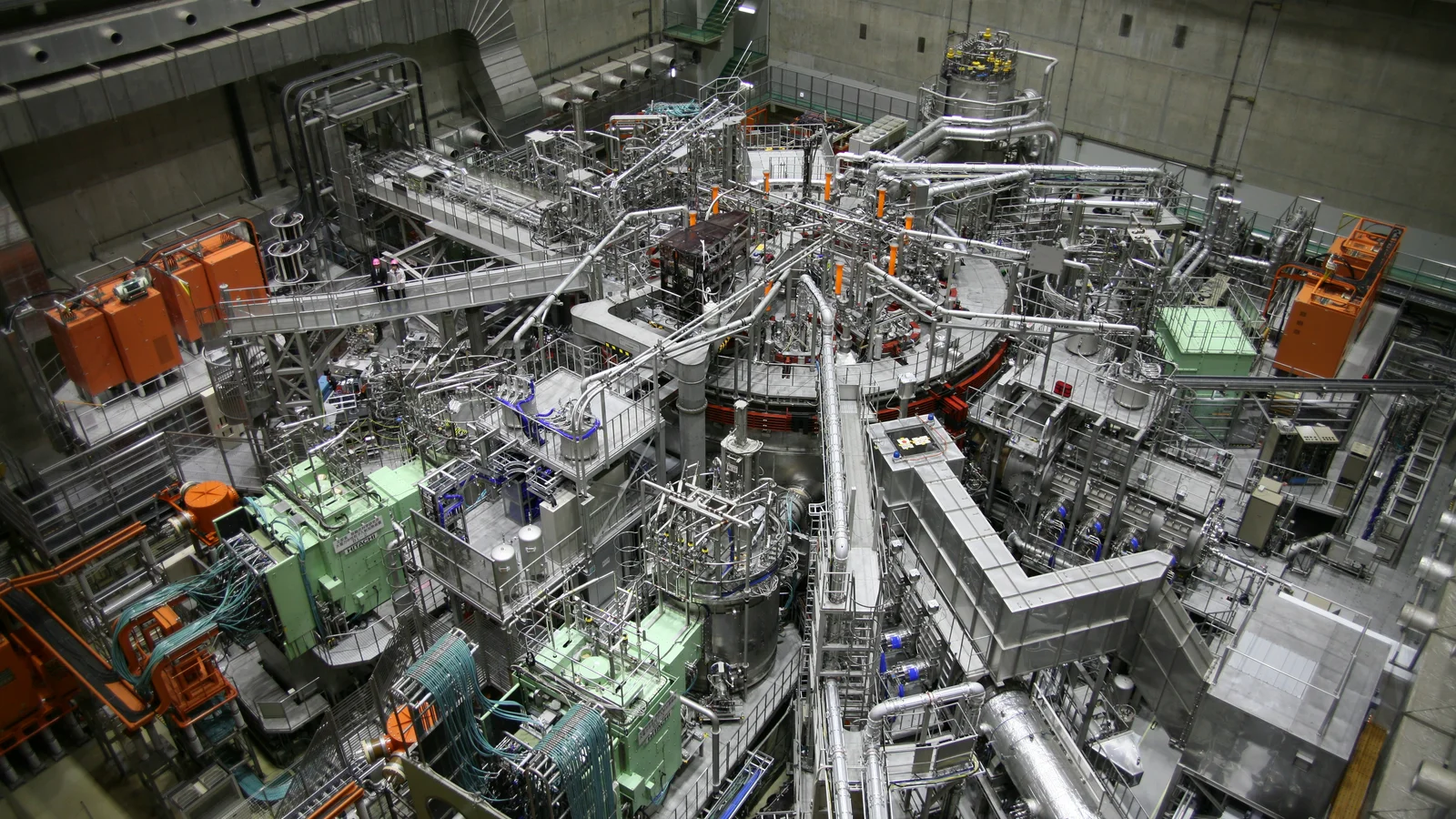
Helical Fusion was founded in 2021 as a spinout from Japan’s National Institute for Fusion Science, or NIFS. That lab runs the Large Helical Device, the machine in the photo up top, and it’s one of the biggest of its kind in the world.
The company says the Large Helical Device has held plasma for 3,268 seconds. That’s about 54 minutes straight. For fusion, where a lot of experiments last seconds, that’s a long time, and it’s exactly the kind of steady running a stellarator is good at.
Where the money goes
The grant comes from Japan’s trade and industry ministry, and it covers three things:
- Helix HARUKA: building and assembling a demo machine that tests the key fusion parts working together
- Helix KANATA: the basic engineering design of the company’s first actual fusion power plant
- Core tech: the critical parts a commercial plant will need
HARUKA is already being put together on the NIFS campus in Toki. The company says one of its helical coils is almost done. Phase 1, in 2027, is powering up the high temperature superconducting coils. In the early 2030s, Phase 2 will test the coils together with the blanket, the layer that would catch the energy and turn it into heat for power.
With this grant, Helical Fusion says its total funding and financing commitments come to about 33.2 billion yen, or around $218 million. It’s working with about 40 Japanese companies to build the coils, blanket parts, power systems and everything else.
How this fits the bigger fusion picture
The timing lines up with a new report from the International Atomic Energy Agency. It found private fusion companies pulled in a record $4.5 billion in new money in the year to July 2026. But it also estimated the industry needs about $80 billion more over the next two decades before the first commercial plants come online.
So $126 million is a real chunk of money for one startup, but it’s a small piece of what fusion needs overall. Helical Fusion says it’s aiming for commercial fusion power in the 2030s, and its three goals are making more power than the plant uses, running around the clock and being easy to maintain.
My take
I like this one because it’s about hardware, not slides. They’re building a real coil on a real campus, with a power test next year. Stellarators are the long shot that might make the most sense for a power plant, since nobody wants a power plant that only works in pulses. The 54 minute plasma run from the Large Helical Device tells me Japan knows how to do the steady part. The hard part is still getting more energy out than you put in, and nobody has done that in a stellarator yet. The 2027 coil test is the first checkpoint to watch.
So basically — pass it on.
Daily Updates
Get new stories in your inbox
Near-future tech when it moves. Robots, space, EVs, AI. No spam.