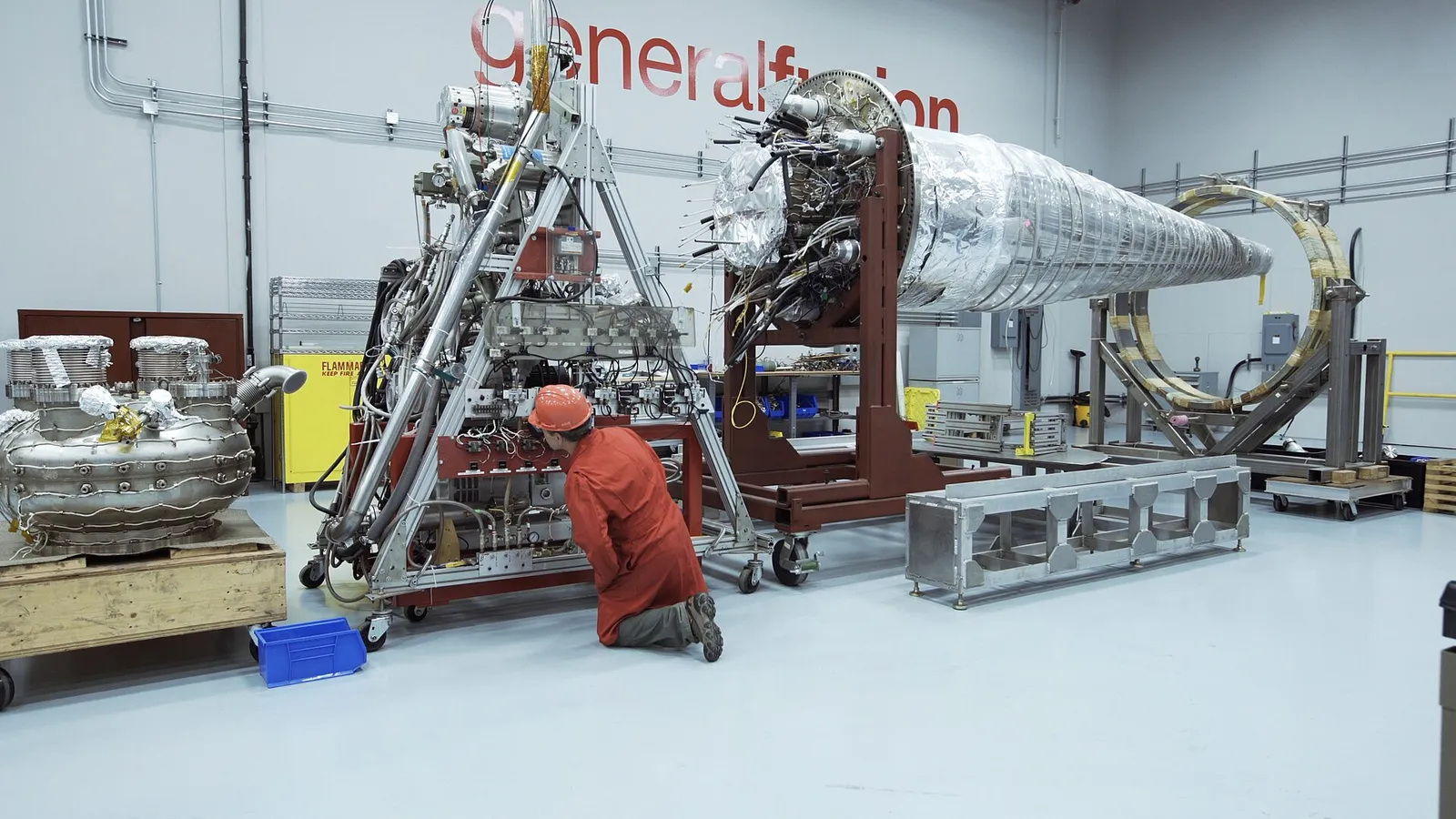
General Fusion Hit 12 Million Degrees by Squeezing Plasma With a Metal Wall
On Oct. 8, General Fusion and the UK Atomic Energy Authority said its LM26 machine heated plasma electrons past 1 keV, about 12.6 million degrees Celsius, using slow compression from a metal liner. Next up is 10 keV, then the Lawson criterion, targeted by the end of 2028.
So basically: A Canadian fusion company heated plasma to more than 12 million degrees Celsius by slowly squeezing it with a metal wall. That is a first for its style of fusion. It is still far from a power plant, but the measurement was done with the UK’s national fusion lab, which makes it more than just a company claim.
Who this is
General Fusion has been working on fusion in Canada for more than two decades.
Its machine for this phase is called LM26, short for Lawson Machine 26. It is the company’s biggest and most realistic demo machine yet.
The big idea
Fusion needs fuel that is insanely hot and packed tight. Most big efforts do that in one of two ways.
- Magnets: Huge superconducting magnets hold plasma in a donut shape. That is a tokamak, like ITER.
- Lasers: Giant lasers blast a tiny fuel pellet in billionths of a second.
General Fusion does neither. Its approach is called Magnetized Target Fusion.
It makes a ball of magnetized plasma, then crushes it with a metal wall. The squeeze takes milliseconds, which is slow by fusion standards. Lasers do it in nanoseconds.
The company’s pitch is that slow is cheaper. Slow means less power, simpler gear, and no exotic magnets or lasers. In a future power plant, the wall would be liquid metal. That wall would also absorb neutrons, help make more fuel, and carry heat to a turbine.
What they just did
General Fusion and the UK Atomic Energy Authority announced the result on Thursday, Oct. 8.
- LM26 heated plasma electrons past 1 keV
- The exact reading was 1.1 keV, about 12.6 million degrees Celsius
- It was measured just before peak compression
- The ions heated up meaningfully too
- Temperature, density, and magnetic field all rose as expected
1 keV is a well known milestone in fusion. Only a few fusion companies have passed it, all using other methods. This is the first time anyone has done it with slow compression like this.
CEO Greg Twinney described it plainly: “we squeezed a plasma shaped like a cored apple, and it stayed alive while we squeezed it and heated up.”
Why the UK lab matters
Measuring the temperature of a plasma crushed inside a metal shell is very hard. You can barely see in.
So UKAEA and General Fusion built a system using Thomson scattering. You shine a laser through the plasma and study how the light bounces off. It tells you the temperature without touching anything.
UKAEA built a key part of that system at its Culham campus in England. General Fusion also used a second method, and the two readings agreed.
UKAEA chief executive Dennis Whyte said hot electrons are “a necessary step for proving fusion confinement concepts.”
What comes next
General Fusion laid out the road ahead:
- 10 keV: about 100 million degrees, the next target. Upgrades to LM26 are already under way to squeeze harder.
- Lawson criterion: the mix of heat, density, and confinement time needed for net fusion energy in the plasma. Targeted by the end of 2028.
- A first power plant: around 2035.
Some perspective
12 million degrees sounds wild. But big tokamaks have gone much hotter for years. Real power plants need around 100 million degrees or more.
Also, the technical paper has been submitted for peer review but is not published yet.
So this is a solid first step for one approach. It is not a fusion breakthrough for the whole field.
My take
I respect how specific this is. One number, measured by an outside lab, with the next target spelled out.
General Fusion has been promising for a long time, so a verified result matters.
The jump from 1 keV to 10 keV is the real test. Squeezing harder without the plasma falling apart is where a lot of fusion ideas die.
If they hit 10 keV on this machine, I will start taking that 2035 plant date a lot more seriously.
So basically — pass it on.
Daily Updates
Get new stories in your inbox
Near-future tech when it moves. Robots, space, EVs, AI. No spam.