A Silicon Battery Just Lasted 1,000 Charges in Testing, and It Could Give EVs About a Third More Range at the Same Weight
Researchers at Germany's Fraunhofer ISE ran a battery cell with a silicon-rich anode through more than 1,000 full charge cycles and it kept over 83% of its capacity. That's the bar for real-world use, and the tech could push a typical EV from around 450 km of range to well over 600 km.
So basically: Researchers at the Fraunhofer Institute for Solar Energy Systems (ISE) in Germany built a battery cell that uses a lot of silicon in place of some of the usual graphite, and it made it through more than 1,000 full charges. After all that, it still held over 83% of its original capacity. That matters because 1,000 cycles while keeping at least 80% is basically the bar for a battery to be used in real products. If this kind of battery makes it into cars, an EV could carry about a third more energy without getting any heavier.
Why silicon is a big deal
Almost every lithium ion battery today uses graphite for one side of the battery, called the anode. That’s where the lithium gets stored when you charge it. Fraunhofer says silicon can hold about ten times as much lithium as graphite in theory. More lithium stored in the same space means more energy.
So why isn’t everybody using it? Because silicon swells up like crazy. electrive reports silicon can expand by up to 300% when it charges, so it gets about four times bigger, then shrinks back when it discharges. Graphite only grows about 10 to 12%. All that swelling and shrinking breaks the connections inside the battery, and the cell wears out way too fast. That’s been the wall for years.
How they got it to last
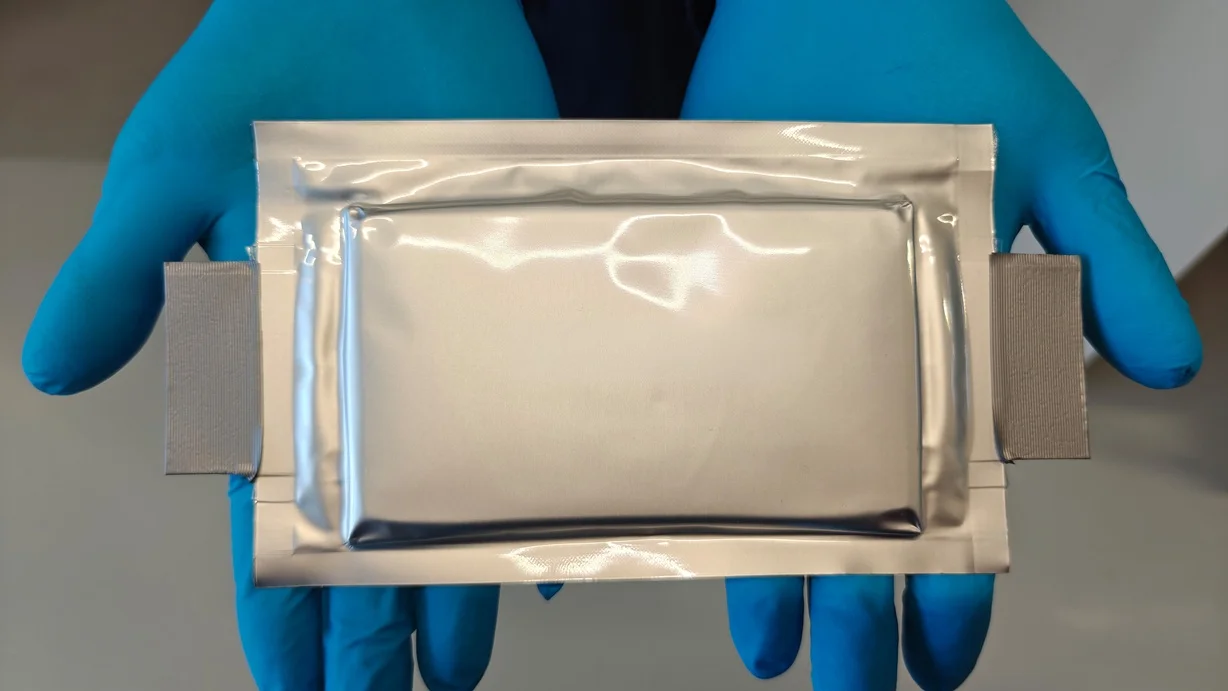
The team mixed silicon with carbon into a composite, which made up 51% of the anode’s active material. They paired it with a nickel rich cathode, which is the other side of the battery. The cells were real sized pouch cells, 25 amp hours with 40 layers inside, made on a pilot production line in Fraunhofer’s cleanroom.
The surprising part to me was how much squeezing the battery mattered. They tested cells under two different amounts of outside pressure. At the higher pressure, about 10 bar, the cell kept over 83% after 1,000 cycles. At the lower pressure, about 3 bar, it lost usable capacity a lot faster.
”Mechanical cell pressure is therefore an important parameter for the stable operation of silicon-rich pouch cells,” said Marc Kissling, a group leader at Fraunhofer ISE.
They also found the cells lost capacity faster when they were worked hard at high power than during gentle lab tests. electrive says that’s something future EV battery systems will have to plan around.
What it could mean for your car
The test cells stored 280 Wh/kg, which is how much energy the battery holds for its weight. Fraunhofer says a cell built for real mass production should hit around 330 Wh/kg.
electrive breaks down what that means. At 330 Wh/kg, it’s about 20 to 35% better than the nickel based cells in a lot of EVs today and almost double the energy of the cheaper LFP cells. In a car, that could mean carrying nearly 100 kWh of battery instead of about 75 kWh at the same weight. electrive says that would take a midsize EV’s real world range from around 450 km (about 280 miles) to well over 600 km (about 373 miles).
There’s a supply angle too. Most graphite comes from outside Europe right now, and Fraunhofer says silicon composites could let more of that material be made in the EU.
The fine print
This is still lab research, not a product you can buy. There’s no carmaker attached and no date for when it might show up in a car. It’s one research project, called StrOboBatt, showing that a big hurdle can be cleared.
My take
Range anxiety is still the number one thing I hear from people around here who won’t buy an EV. Out here in Southwest Virginia, chargers aren’t on every corner. A battery that gives you a third more range without making the car heavier would change that conversation fast. I like that this one passed the boring but important test, actually lasting. Now somebody needs to build it in a factory.
So basically — pass it on.
Daily Updates
Get new stories in your inbox
Near-future tech when it moves. Robots, space, EVs, AI. No spam.