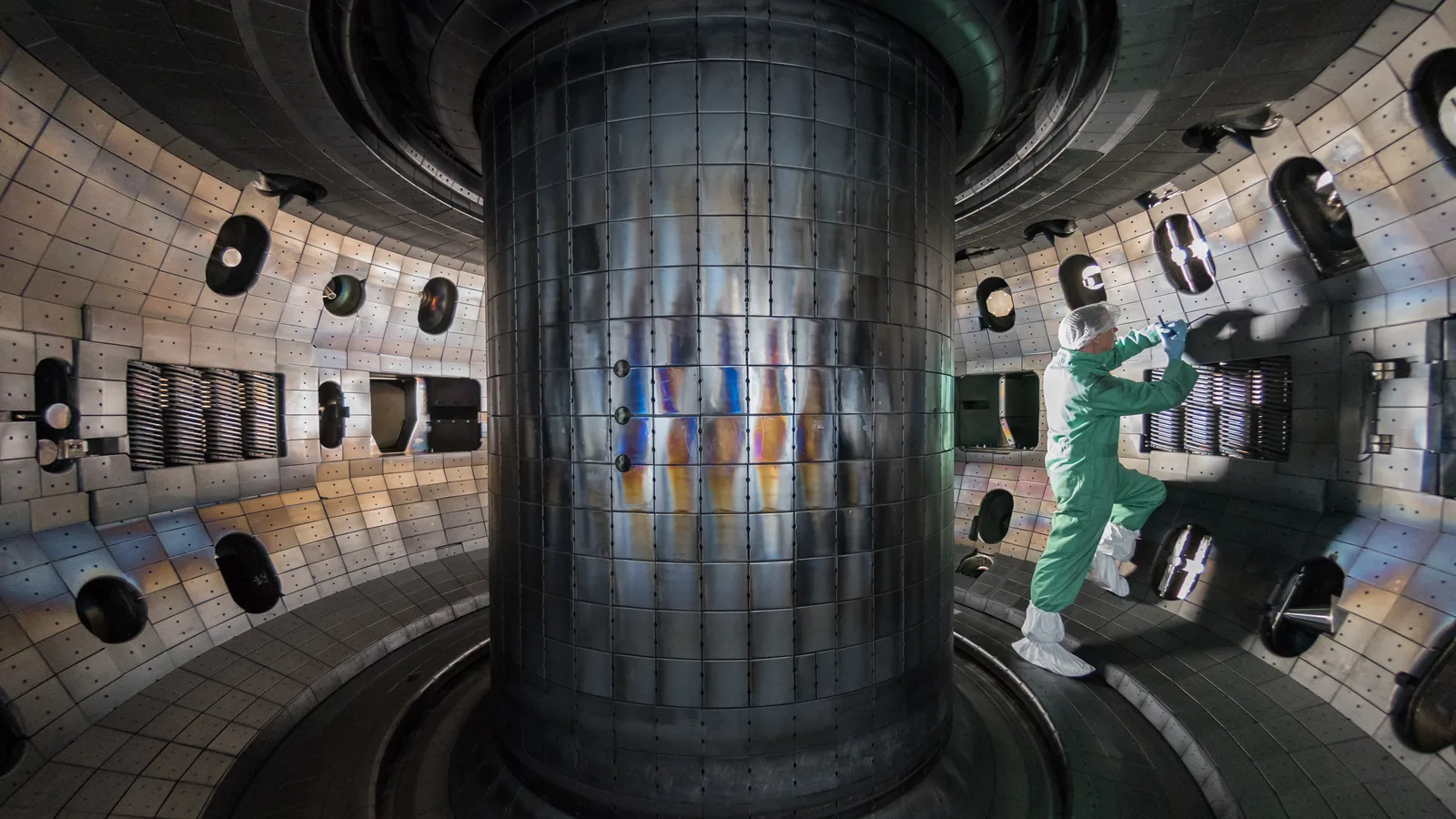
Physicists Tried This Fusion Trick in the 1980s and It Never Worked. A San Diego Reactor Just Made It Work
Scientists at General Atomics' DIII-D fusion reactor in San Diego have shown the first clear proof of helicon current drive, using radio waves to push electric current through hot plasma. It could help future fusion plants run nonstop instead of in short pulses.
So basically: Fusion scientists have been trying to pull off a specific trick since the 1980s. Every attempt failed. Now a team at the DIII-D fusion reactor in San Diego says they finally did it, and it could help future fusion power plants run nonstop instead of in short bursts.
The trick is called helicon current drive. It uses radio waves to keep electric current flowing through the super hot plasma inside a reactor.
The results were published in the journal Physical Review Letters, and the news has been making the rounds over the last week.
The problem it solves
Most fusion reactors being built today are tokamaks. Picture a giant hollow donut. Inside, plasma hotter than the Sun gets held in place by powerful magnets.
To keep that plasma in shape, you need a big electric current running around the donut. Right now, most tokamaks get that current from a huge magnet coil in the middle that works like a transformer.
Here’s the catch. A transformer can only push current while its magnetic field is changing. Eventually it runs out of room, and the reactor has to stop and reset.
According to Bob Pinsker, a General Atomics scientist on the team:
- DIII-D’s pulses are limited to about 10 seconds
- ITER, the giant reactor being built in France, will be limited to under about 1,000 seconds in normal operation
That’s fine for experiments. It’s not great for a power plant that’s supposed to keep the lights on. Starting and stopping also heats and cools the reactor walls over and over, which wears them out.
How the radio wave version works
Instead of the transformer, you beam radio waves into the plasma that push electrons in one direction around the donut. The electrons basically surf the waves, and that keeps the current going.
This team used a special antenna called a comb-line. Here’s what the paper says it’s made of:
- 30 modules lined up along the inside wall, about 1.5 meters (5 feet) long
- Radio waves at 476 MHz
- Fed by a 1.2 megawatt power source
- Up to 700 kilowatts sent into the plasma so far
In the key test, they sent in about 370 kilowatts and measured roughly 20,000 amps of current driven right in the core of the plasma. That lined up closely with what their computer models predicted.
Why it took 40 years
Pinsker actually tried this for his own thesis in the 1980s. It didn’t work then either.
He told the American Nuclear Society that the waves are “just the thing that you would want in a reactor plasma.” The problem was that nobody had a reactor-like plasma to test them in. Older machines just weren’t hot or dense enough, so the waves passed right through without doing much.
A scientist named Victor Vdovin at the Kurchatov Institute in Moscow kept pitching the idea to projects around the world for years. DIII-D finally took him up on it, because by then it could make plasma close to reactor conditions, had the new antenna, and had better tools to measure tiny currents inside the plasma.
What’s still left
This is a first step, not a finished product. The team only tested it in the center of the plasma and in a lower performance mode. Next they need a lot more power, and that’s not easy.
Pinsker said it’s “too early to tell” if this will be the method that future power plants use. Other reactors use different approaches. South Korea’s KSTAR tokamak has already installed its own helicon antenna and started testing.
My take
I respect a 40 year grudge match. The same guy who couldn’t make this work as a student in the 1980s is one of the people who finally pulled it off. Fusion still has a long road before it’s plugging into the grid, but “the reactor has to keep stopping” is one of the big boring problems that has to get solved first. Radio waves doing that job instead of a giant magnet coil sounds like the kind of fix that could actually make fusion plants practical.
So basically — pass it on.
Daily Updates
Get new stories in your inbox
Near-future tech when it moves. Robots, space, EVs, AI. No spam.