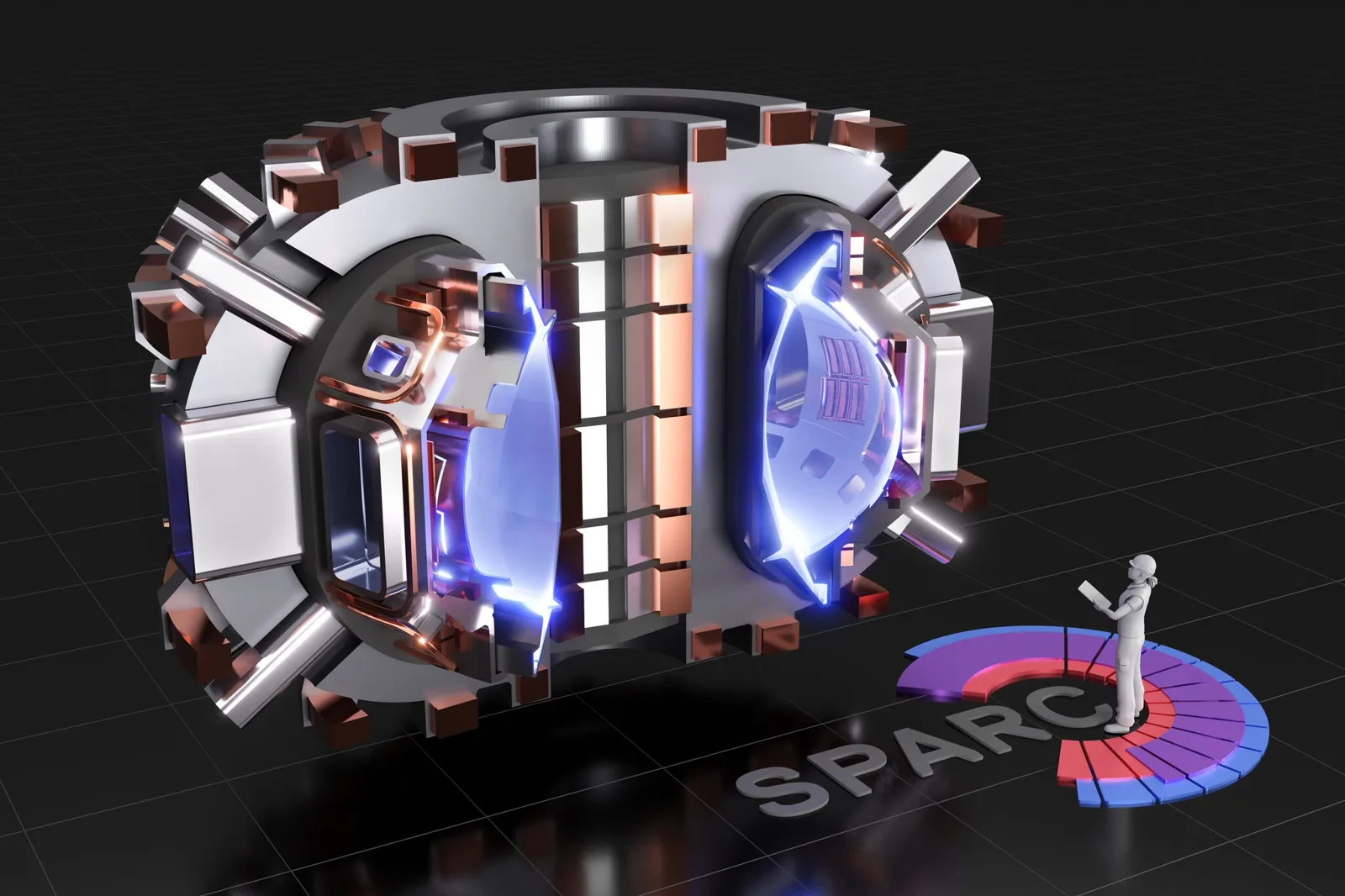
Commonwealth Fusion Is Building a Digital Copy of Its Fusion Machine to Speed Things Up
The Department of Energy picked Commonwealth Fusion Systems to lead a project building a digital twin of SPARC, its fusion machine in Massachusetts. Google DeepMind, NVIDIA and four national labs are on the team.
So basically: Commonwealth Fusion Systems is building a digital copy of its fusion machine, SPARC, that runs on a computer and stays hooked up to the real thing. The Department of Energy picked CFS to lead the project on Oct. 8. The team includes Google DeepMind, NVIDIA, four national labs, MIT and Carnegie Mellon. The goal is to predict a full fusion run in under 20 minutes so they can learn faster between tests.
Quick background on CFS
CFS came out of MIT and is based in Massachusetts. It’s building SPARC in Devens, which is a test fusion machine called a tokamak. Picture a donut shaped chamber with insanely strong magnets that squeeze super hot gas, called plasma, until atoms fuse and give off energy. That’s how the sun works.
SPARC is supposed to be the first fusion machine to put out more energy than it takes to run the plasma. After that comes ARC, their actual power plant, planned for Chesterfield County, Virginia, in the early 2030s.
What’s a digital twin?
It’s a computer version of a real machine. Not just a simulation you run once. It’s connected to the real SPARC and keeps updating itself with real data. So every time SPARC runs, the digital twin gets a little smarter about how the real one behaves.
Why does that matter? Fusion experiments are slow. You do a run, look at the data, figure out what to change, then do another one. If the digital twin can predict how a run will go in under 20 minutes, the team can test ideas on the computer first and only try the good ones on the real machine. That saves a lot of time.
What they’re actually building
According to CFS, the project will:
- Hook into DOE supercomputers and feed them decades of fusion data
- Build AI models trained on that data that can stand in for slow physics math
- Train an AI “co-pilot” to help the people running SPARC in the control room
- Build better ways to see what’s going on inside the machine
Princeton’s lab is chipping in its simulation software and data from its own fusion machine. Lawrence Livermore, Oak Ridge and SLAC are in too. General Atomics and Synopsys round it out.
The Genesis Mission part
This is part of something the government calls the Genesis Mission. It’s a big push to use AI to speed up science. The DOE announced 12 new projects in this round worth $159 million total. CFS is the only private company leading one and the only fusion project in the group. They didn’t say how much CFS specifically gets, and the projects are still in negotiation, so the money isn’t locked in yet.
Why it matters
Fusion has been “30 years away” for like 70 years. A lot of that is because every experiment takes forever to set up and learn from. Anything that makes that loop faster helps.
And it’s not just CFS. If this works, the tools and some of the data get shared, which helps other fusion companies too.
My take
Normally when I see “AI” slapped onto something I roll my eyes. This one actually makes sense. Fusion is a problem where you’ve got tons of data, super expensive test runs, and a machine you can’t afford to break. That’s exactly where a good computer copy pays off.
The real test is still SPARC turning on and working. A digital twin doesn’t help much if the real machine has problems. But if SPARC fires up on schedule and this thing helps them dial it in faster, ARC in Virginia starts looking a lot more real.
So basically — pass it on.
Daily Updates
Get new stories in your inbox
Near-future tech when it moves. Robots, space, EVs, AI. No spam.