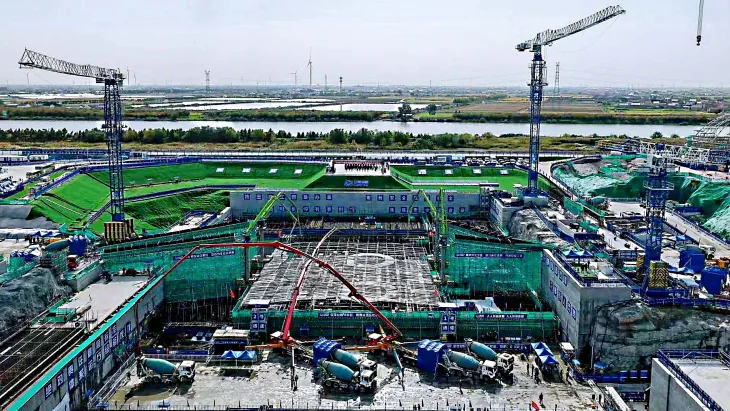
China Poured First Concrete for a 660 MW High Temperature Reactor Meant to Feed a Petrochemical Park
CNNC said on Nov. 6, 2026 that first concrete was poured for unit 3 at Jiangsu Xuwei, a 660 MWe Chilong One HTGR paired with two Hualong One reactors. The plant is designed to make industrial steam for a nearby petrochemical park and more than 11.5 billion kWh a year.
So basically: China just started building a new kind of commercial nuclear reactor that is meant to make industrial steam for a petrochemical park, not only electricity. China National Nuclear Corporation (CNNC) said on Nov. 6, 2026, that workers poured the first concrete for the nuclear island of unit 3 at the Jiangsu Xuwei plant.
What they are building
Xuwei Phase I sits in Lianyungang, Jiangsu province, right next to CNNC’s existing Tianwan plant. The plan is three units:
- Two Hualong One pressurised water reactors, each about 1,208 MWe net
- One Chilong One high temperature gas cooled reactor (HTGR), rated at 660 MWe, designed for a 60 year life
The HTGR is jointly developed by CNNC and Tsinghua University. First concrete for the unit 1 Hualong One nuclear island was poured in January 2026. Now unit 3, the HTGR, has started too.
Why steam matters
Most nuclear plants sell power. Xuwei is built to sell heat and power.
CNNC says demineralised water will be heated by steam from the Hualong One units, then heated again by the hotter steam from the HTGR. The goal is three grades of high quality industrial steam for the nearby petrochemical park, plus electricity when that is useful.
Once Phase I is running, CNNC projects about 32.5 million tonnes of industrial steam a year and more than 11.5 billion kilowatt-hours of power. It also claims cuts of about 7.26 million tonnes of standard coal and 19.6 million tonnes of CO2 a year versus the fossil alternative.
The “firsts” CNNC is claiming
CNNC is not shy about the marketing. It calls Xuwei:
- The world’s first large coupling of nuclear energy and petrochemicals
- The first project that pairs a pressurised water reactor with an HTGR
- The first commercial application of this HTGR design at this scale
Take the slogans with a grain of salt, but the engineering idea is clear. High temperature gas cooled reactors run hotter than regular water reactors, so they are better at making the kind of heat heavy industry wants.
Who is building it
CNNC Energy Technology Company is handling HTGR design, equipment, and construction support. That same unit worked on the Shidaowan HTR-PM demonstration plant in Shandong. A consortium won a CNY 4.2 billion contract last year for the conventional islands of all three Xuwei units.
The State Council approved Xuwei among 11 reactors in August 2024. CNNC Suneng Nuclear Power Company owns and will operate the site.
How this compares to Shidaowan
China already ran a smaller high temperature gas cooled demo at Shidaowan in Shandong. That plant proved the pebble bed style reactor can make power. Xuwei is the jump to tying that heat into a real industrial customer next door.
Petrochemical plants need steam at specific temperatures and pressures around the clock. A regular light water reactor can make electricity that then makes steam, but that path wastes a lot of the reactor’s heat quality. An HTGR starts hotter, so more of the energy is useful for industry.
If the coupling works, other heavy industries could copy the model: steel, chemicals, hydrogen, anywhere a factory currently burns fuel just to get hot gas. That is why CNNC keeps calling this a template, not a one off.
My take
People argue about nuclear for the grid. This project is aimed at a harder problem: factories that need steady, high grade heat and currently burn a lot of coal or gas to get it.
If Xuwei actually delivers steam to a petrochemical park at commercial scale, that is a bigger deal than another power only reactor. The schedule will take years, and “world’s first” claims always need checking. Still, pouring concrete on a 660 MW HTGR built for industry is a real step past the demo plant stage.
So basically — pass it on.
Daily Updates
Get new stories in your inbox
Near-future tech when it moves. Robots, space, EVs, AI. No spam.