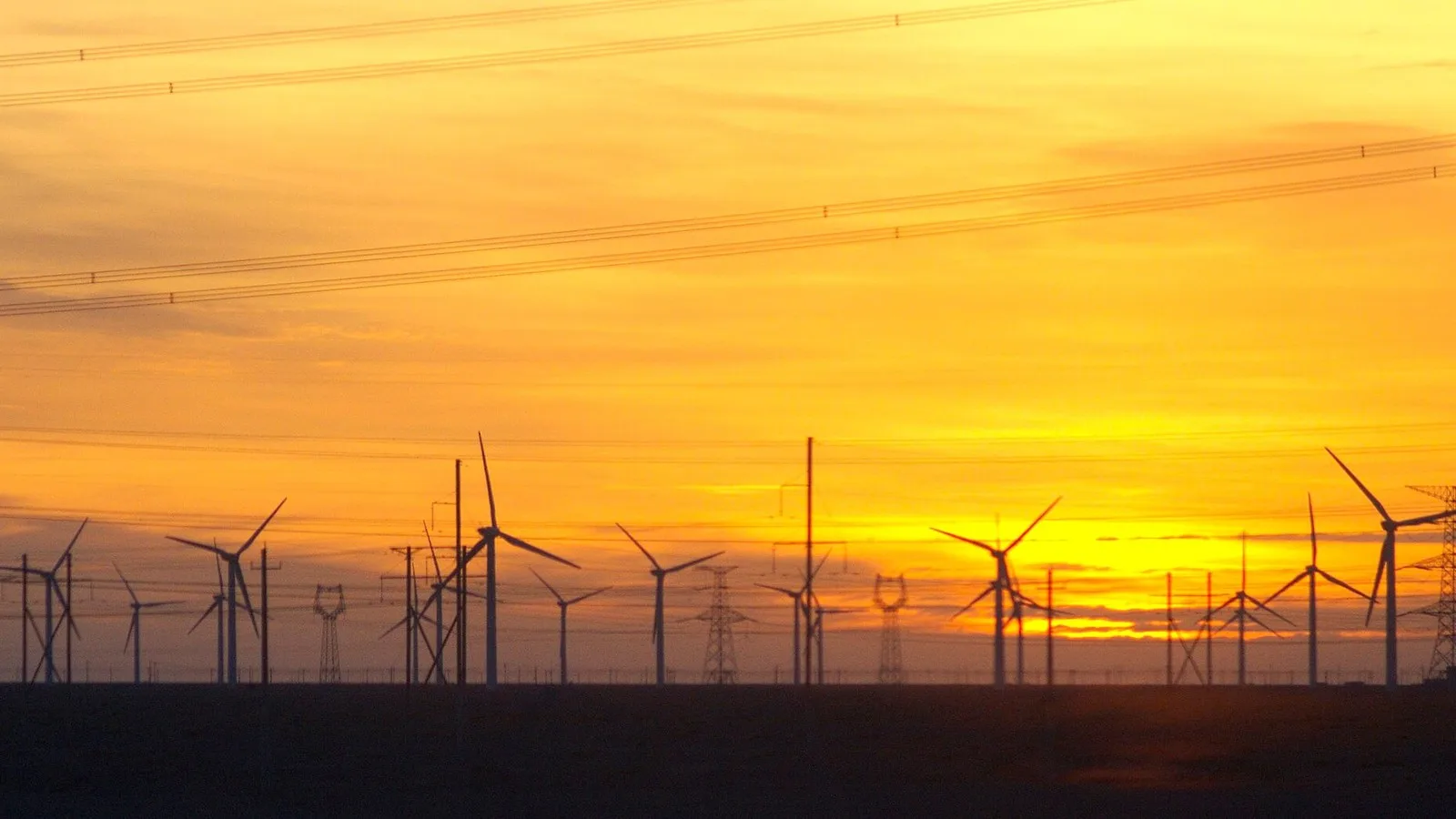
China Just Opened a Green Power Market That Traded 6.17 Billion kWh on Day One
China launched a joint green electricity market linking wind and solar farms in its northwest with factories and data centers in the east. The first session cleared 6.17 billion kilowatt hours at an average of 0.204 yuan per kWh.
So basically: China just hooked up the wind and solar farms in its far northwest with the factories and cities in its east under one market. On Thursday, Nov. 26, the first trading session cleared 6.17 billion kilowatt hours of green electricity. For a sense of size, that’s about what more than half a million American homes use in a whole year.
What actually launched
China’s National Energy Administration announced the launch at a meeting in Beijing. It’s called the Northwest to East China green power joint trade, and State Grid, the giant state power company, runs the platform. The agency’s deputy head, Song Hongkun, formally kicked it off, with State Grid’s general manager in the room.
Here’s the first session by the numbers, straight from the energy agency:
- 1,615 companies took part
- 1,188 of them were wind and solar producers
- 427 were buyers, like power retailers and big electricity users
- 10 provinces and cities: Shanghai, Jiangsu, Zhejiang, Anhui and Fujian in the east, plus Shaanxi, Gansu, Qinghai, Ningxia and Xinjiang in the northwest
- 6.17 billion kWh traded in total
- 1.95 billion kWh of that crossed between regions, and 4.22 billion kWh stayed inside provinces
- Average price: 0.204 yuan per kWh, which is roughly 3 U.S. cents
State Grid says replacing fossil fuel power with that much clean power cuts nearly 5 million tonnes of carbon dioxide.
Why they needed this
China’s best wind and sun are out west in places like Gansu, Qinghai and Xinjiang. Most of the people, factories and data centers are along the east coast. That mismatch has been a headache for years. Western wind and solar farms have had to throw away power they couldn’t sell, which is called curtailment.
Before this, green power trades between provinces and trades inside a province ran as two separate markets. A company had to bid in both, and the prices didn’t line up. The new setup lets everyone submit one bid, and the system matches it across both at the same time. The power moves east over China’s ultra high voltage direct current lines, which are built to carry huge amounts of electricity over very long distances.
Each trade also comes with a green certificate, so a factory buying the power can prove it’s really using renewable energy. That matters a lot to Chinese exporters selling to customers who want clean supply chains.
The data center angle
A big reason this is happening now is AI. An official at the energy agency, Tan Hongjiang, projected that power used by China’s computing infrastructure will grow by more than 100 billion kWh a year through 2030, hitting about 800 billion kWh, or around 6% of all the power China uses.
This launch is also part of a bigger plan. In February, China’s State Council set a goal of a basically unified national electricity market by 2030, with about 70% of all power use bought and sold through markets.
My take
This isn’t the flashiest story, but I think it’s one of the more important ones. Everybody talks about how much solar and wind China builds. What doesn’t get talked about is how much of it gets wasted because it’s in the wrong place.
Building power lines is one half of the fix. Making it easy and cheap to actually sell the power across provinces is the other half, and that’s what this does. Three cents a kilowatt hour for clean power is cheap. If AI data centers keep eating electricity at the rate everyone expects, the countries that can move cheap power to where it’s needed are going to have a real edge.
So basically — pass it on.
Daily Updates
Get new stories in your inbox
Near-future tech when it moves. Robots, space, EVs, AI. No spam.