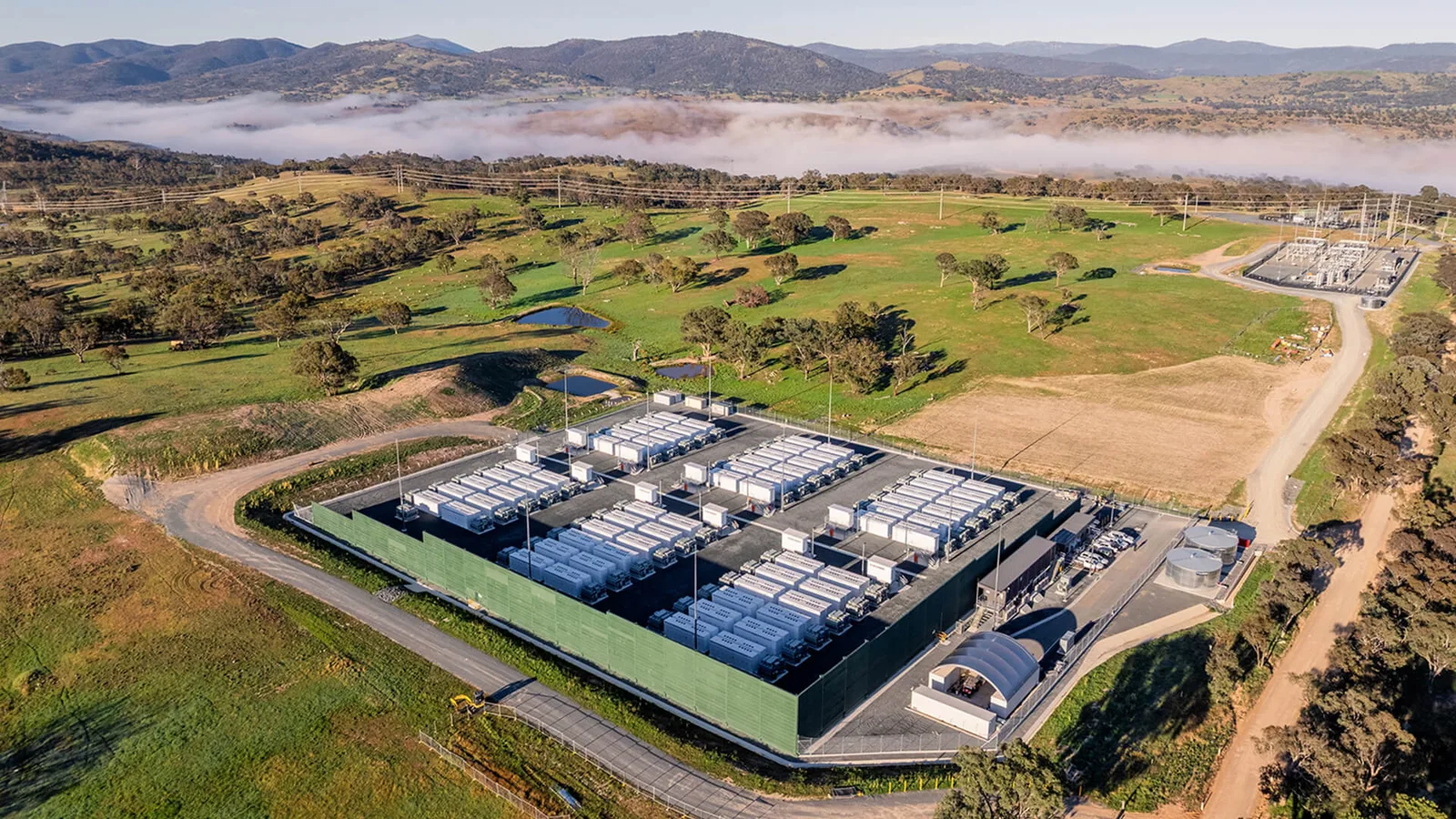
Australia's Grid Batteries Just Held a Record 20 GWh at Once, Triple What They Held a Year Ago
On Nov. 6, batteries across Australia's main power grid were holding a record 20.17 GWh of energy at one time, up 203% from the 6.66 GWh record a year earlier. The same day, 41 GWh of solar and wind still went to waste.
So basically: Australia’s giant grid batteries just set a huge record. At one moment on Nov. 6, batteries across the country’s main power grid were holding 20.17 GWh of energy. A year ago the record was 6.66 GWh. That’s a jump of 203%, so basically triple in one year.
What the number means
This is a snapshot record. It’s the most energy stored in all the grid batteries on Australia’s National Electricity Market at a single point in time. The NEM covers the east and south of the country, including New South Wales, Victoria, Queensland, South Australia, Tasmania and the ACT.
To put 20 GWh in perspective, a Tesla Model Y battery is around 75 kWh. 20.17 GWh is roughly enough to fill about 270,000 of them at once.
The record came from energy analyst Geoff Eldridge, who tracks the grid through a data platform called GPE NEMLog. Energy-Storage.News reported it on Nov. 9.
New South Wales also set its own state record of 8.36 GWh, up 188% from 2.90 GWh in October 2025.
Why it happened on that day
Sunny spring days in Australia make a ton of solar power. On the same day:
- Victoria’s big solar farms hit a record 1,588 MW, up 35% from a year earlier
- Solar across the whole grid peaked at 10,561 MW available
- Batteries soaked up the extra midday power so it could be used after sunset
That’s the whole idea with grid batteries. Charge up when solar is cheap and plentiful, then sell it back in the evening when everybody gets home and turns everything on.
The problem: power still going to waste
Here’s the catch. Even with all those batteries, Eldridge estimated that 41.36 GWh of renewable power was curtailed across the grid on Nov. 6. That means solar and wind farms were told to turn down because there was nowhere to send the power.
That broke down to about 26.67 GWh of solar and 14.69 GWh of wind. So more than twice as much clean power got wasted as the batteries were holding at their peak.
Eldridge said things like transmission lines, local grid limits and where batteries are built all affect how much power can actually get used. “The question is increasingly not just how much generation and storage capability we have, but how effectively the NEM can utilise it,” he wrote.
How fast Australia is building batteries
The growth is wild. According to Australia’s energy regulator, battery output on the grid went from 261 MW at the start of 2021 to 6.1 GW by the end of 2025. That’s more than 20 times bigger in five years.
The Clean Energy Council says Australia is now the third biggest market in the world for big grid batteries, behind only the US and China.
And there’s way more coming. Australia’s grid operator, AEMO, says batteries make up 52% of everything waiting in line to connect to the grid.
Are batteries making money?
Kind of. In the third quarter of 2026, 59 grid batteries earned about AU$88.91 million combined, according to NEMPulse. But it’s lumpy. Just five days made up 15% of that whole quarter’s money. Batteries cash in big on days when power prices spike.
My take
Tripling in one year is nuts. Australia is basically running the experiment the rest of the world is going to run next: tons of solar, tons of batteries, and a grid trying to keep up. The wasted power number is the part that jumps out to me though. They don’t need more solar right now. They need more batteries and more power lines to move it around. Whoever builds that is going to make a lot of money.
So basically — pass it on.
Daily Updates
Get new stories in your inbox
Near-future tech when it moves. Robots, space, EVs, AI. No spam.