XREAL's Android XR Glasses Start at $1,279, but Only Early Reservers Can Buy Today
On Oct. 7 XREAL priced Aura, the first see-through glasses on Google's Android XR, at $1,279 and $1,499. Pre-orders are open only to people who already paid a deposit. General orders open in the coming weeks.
So basically: XREAL finally put a price on Aura, the first see-through glasses built on Google’s Android XR. It starts at $1,279. Pre-orders opened Wednesday, Oct. 7, but only for people who already paid a reservation deposit. Everyone else has to wait a few more weeks.
What you actually get
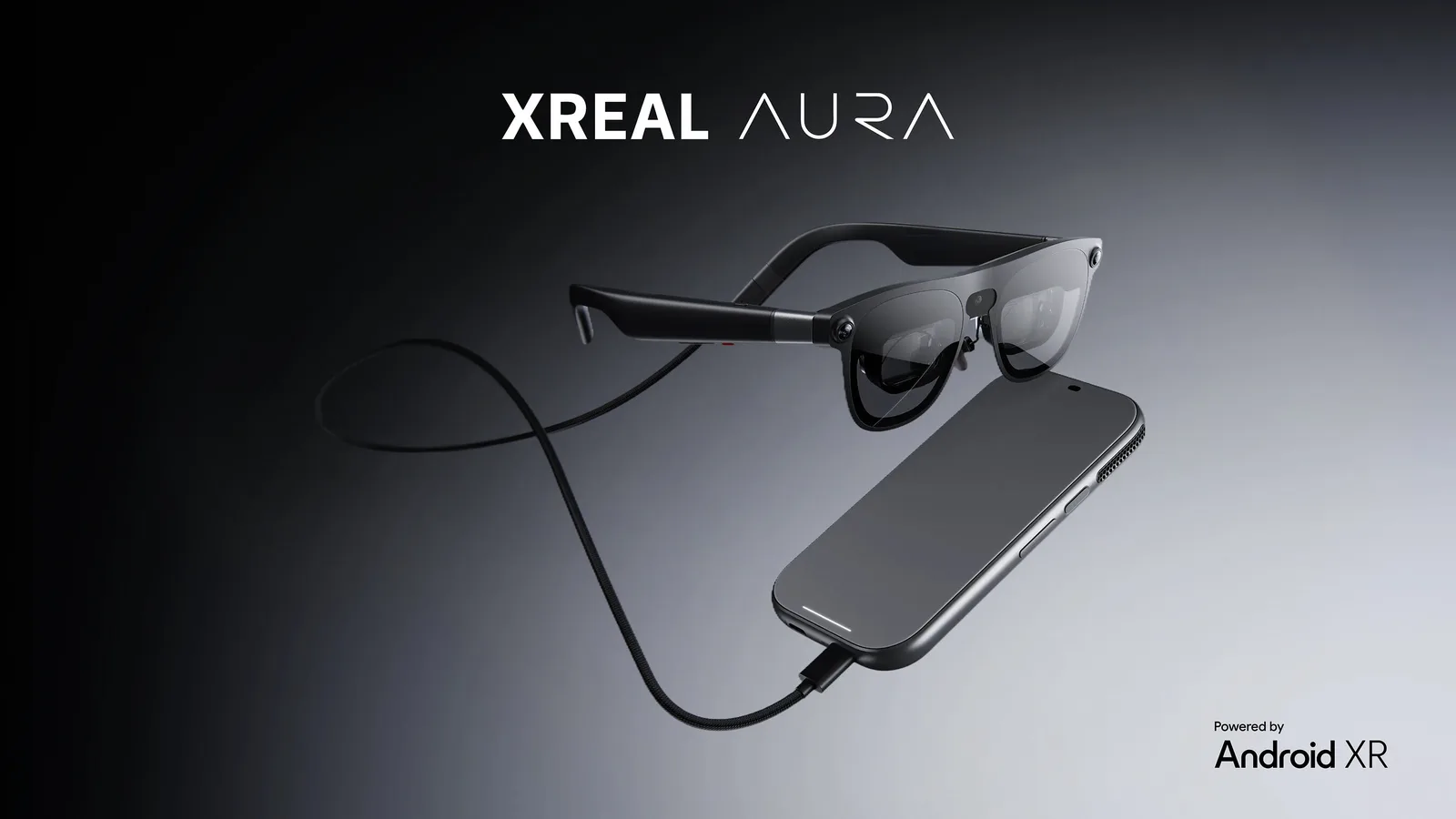
Aura is two pieces connected by a cable.
The first piece is the glasses. They weigh under 95 grams, and the lenses are clear. You see the real room, with apps and screens floating on top of it.
The second piece is a compute puck. It holds the battery and Qualcomm’s Snapdragon Reality Elite chip. It runs Android XR with the Google Play store and Google’s Gemini assistant built in.
The puck also works as a trackpad, and Engadget says it has a fingerprint sensor. You clip it to your shirt or hang it on a lanyard.
Other specs XREAL listed:
- A 70 degree field of view
- Hand tracking through cameras on the glasses
- Sound by Bose
- Two frame sizes, medium (60 to 66 mm) and large (66 to 72 mm)
Engadget also notes you can plug the glasses into a computer and use them as a giant external monitor.
The price
There are two versions, and the difference is all in the puck.
- 12 GB of memory and 256 GB of storage: $1,279
- 16 GB of memory and 512 GB of storage: $1,499
In Canada it’s $1,829 or $2,149.
Who can buy one right now
This is the fine print.
Only customers who reserved Aura before Oct. 7 can pre-order today. They are getting an email with next steps.
XREAL says orders open to the general public “in the coming weeks.” New buyers can still put down a deposit to get in line.
Shipping starts “soon” in the United States, Canada, Japan, and South Korea. More countries come in 2027.
The only hard number tied to a date came from XREAL CEO Chi Xu. He told The Verge the first 2,000 Founder’s Edition pairs will ship this year.
How we got here
XREAL built Aura with Google and Qualcomm. Engadget says it was first shown at Google I/O earlier this year, where its reviewers called the picture sharp and bright even outside in the sun.
Android XR has had a slow start. The only device that shipped on it so far is Samsung’s $1,799 Galaxy XR headset from last year, according to The Verge.
Samsung’s own Android XR glasses cleared the FCC last week, but those have no display at all. They are camera and audio glasses. Aura is the one that puts a real screen in front of your eyes.
The Meta matchup
The Verge points out Aura is $20 cheaper than Meta’s upcoming VR Glasses, which are $1,299.
On paper they look like twins: around 100 grams, with a Snapdragon Reality Elite chip in a puck on a cord.
The difference is how you see the world.
Aura’s lenses are transparent, so you are looking at the actual room. Meta’s glasses use passthrough, which means cameras film the room and show it to you on screens. That gives Meta more immersion and a wider view, but you are watching video of your surroundings.
Meta also has eye tracking, so you can pick things just by looking and pinching. Aura uses hand tracking and the touchpad on the puck instead.
Meta’s glasses are not due until spring 2027. XREAL gets a head start, at least with early buyers.
My take
$1,279 is a lot, but it is not Vision Pro money, and it is cheaper than Galaxy XR.
The bigger deal is the platform. Most glasses launch with a tiny app list. Aura gets the Play store on day one.
The catch is the cord. You are wearing a cable down to a puck in your pocket. That is fine on a plane or at a desk. It is less fine walking around a city.
I’d also watch the rollout. “Weeks away” plus 2,000 Founder’s Edition pairs this year sounds like a soft launch. The real test is when anybody can click buy and get a pair in a few days.
If the reviews say the 70 degree view and Android apps hold up, this is the first pair of glasses that could replace a laptop screen for some people.
So basically — pass it on.
Daily Updates
Get new stories in your inbox
Near-future tech when it moves. Robots, space, EVs, AI. No spam.