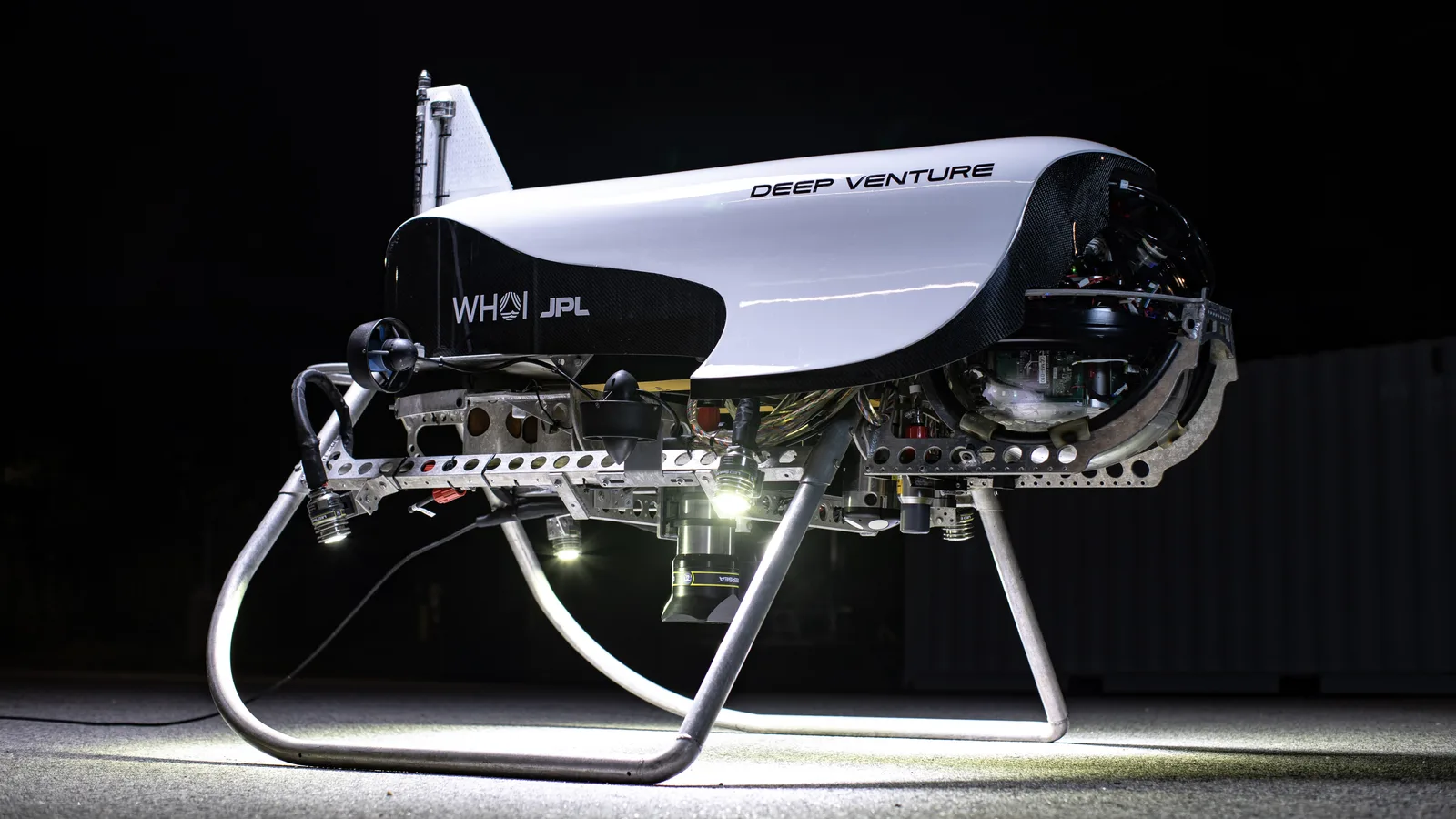
Woods Hole and NASA's JPL Built a 550 Pound Robot Sub That Can Dive to the Deepest Spot on Earth
Deep Venture is a new autonomous underwater vehicle from the Woods Hole Oceanographic Institution and NASA's Jet Propulsion Laboratory. It's rated for 11,000 meters, can land on the seafloor and grab samples, and a small crew can launch it from a regular research ship.
So basically: The Woods Hole Oceanographic Institution (WHOI) and NASA’s Jet Propulsion Laboratory (JPL) just showed off a robot submarine called Deep Venture. It drives itself, it’s rated to dive 11,000 meters, which is about 36,000 feet or 6.8 miles down, and that’s deep enough to reach the bottom of any ocean on Earth. It weighs about 250 kilograms, around 550 pounds, and it can land on the seafloor and pick up samples.
What it is
Deep Venture is an AUV, which stands for autonomous underwater vehicle. That means there’s no cable tying it to the ship and nobody inside steering it. Once it’s in the water, it runs on its own.
WHOI announced it on November 20. Here’s the spec list from the release:
- Depth rating: 11,000 meters, full ocean depth
- Weight: 250 kg, about 550 lb
- Size: about 72 inches long, 60 inches wide and 56 inches tall
- Seafloor work: it can land and take samples
- Cameras: high resolution imaging and photogrammetry, which is stitching a lot of photos into a 3D model of the seafloor
- Payload bay: swappable, so scientists can plug in different chemical and biological sensors
And one fun detail. WHOI says the design was inspired by the chimera, a weird looking deep sea fish sometimes called a ghost shark.
Why it’s different
The deep sea robots that exist now tend to be built for one specific type of mission. They need special equipment, a lot of support people, and only certain research ships can carry them.
Deep Venture is meant to fix that. WHOI research engineer Allisa Dalpe said it “can be deployed by a small team from a wide range of vessels.” Because it’s light, compact and modular, the team can reconfigure it for different jobs without changing much on the vehicle.
It already scouted for Alvin
This isn’t just a render. In June 2026, near Bermuda, Deep Venture worked alongside Alvin, the famous human-occupied submarine that carries scientists to the seafloor.
Before Alvin went down, Deep Venture dove about 6,000 meters, roughly 3.7 miles, and took high resolution pictures of the bottom. That helped the Alvin team figure out the best spots to dive.
Think of it like sending a drone ahead before you hike into the woods. Alvin dives are expensive and limited, so knowing exactly where to go saves a lot of wasted time.
Robin Littlefield, the senior engineer leading the program at WHOI, put it like this: the robot is meant to “complement, not replace” vehicles like Alvin.
Where it came from
Deep Venture builds on an earlier WHOI and JPL deep sea program. That program finished with 13 autonomous dives as deep as 5,000 meters in the Gulf of Alaska in 2024, also in support of Alvin.
So the jump here is from a research project to something WHOI says is ready for real operations, and rated for more than twice that depth.
Why NASA cares
JPL is the lab that builds Mars rovers, so it might seem odd to see it on an ocean robot. But WHOI says the tech that lets Deep Venture run on its own in harsh places with limited communication could help with exploring other extreme environments. A robot that can figure things out alone at the bottom of the ocean is solving a lot of the same problems as a robot far away in space.
What we don’t know yet
The release doesn’t say what Deep Venture cost, how long it can stay down on one dive, or when it’ll make its first full depth dive. WHOI says it hopes to build more of them so scientists can cover more ground or run different sensors at the same time.
My take
WHOI’s own chief scientist for deep submergence called the deep ocean one of the least explored places we have, and robots like this are how that changes. I like that it’s built to be easy to launch from a normal ship with a small crew. That’s the kind of thing that turns rare expeditions into regular trips. The Alvin scouting idea is smart too. Send the robot first, then send the people where it actually matters. If WHOI builds a few more of these, a lot of the deep sea is going to get mapped way faster than it would with one human sub doing all the work.
So basically — pass it on.
Daily Updates
Get new stories in your inbox
Near-future tech when it moves. Robots, space, EVs, AI. No spam.