Webb Found a Surprising Pile of Metals Around Our Galaxy's Black Hole, and It Makes One Mystery Even Weirder
The James Webb Space Telescope spotted gas full of heavy elements swirling near Sagittarius A*, the giant black hole at the center of the Milky Way. Scientists think it came from exploding stars, and it may help explain why our black hole is such a slow, picky eater.
So basically: The James Webb Space Telescope looked at the area right around Sagittarius A*, the supermassive black hole at the center of our galaxy, and found gas packed with heavy elements. Scientists think the stuff was blasted there by supernovas, which are giant exploding stars. The study was published Oct. 19 in The Astronomical Journal.
Wait, metals in space?
In astronomy, a “metal” isn’t just iron or gold. It’s any element heavier than hydrogen or helium, so oxygen and carbon count too. Those elements get made inside stars near the end of their lives, then sprayed into space when the stars die. New stars and planets, including Earth, are built from that leftover material.
The gas Webb found seems to have the same makeup as several stars nearby. That suggests the stars and the gas were born around the same time.
The mystery it touches
Our galaxy’s black hole is kind of a lazy eater. Compared to other supermassive black holes, it pulls in a lot less material, and more slowly.
”We know there’s a black hole at the centre of our galaxy pulling material into itself, but we see that it’s eating a lot less material than other supermassive black holes, and more slowly,” said Nicole Ford, the study’s first author and a PhD student at McGill University.
Here’s where the metals come in. McGill’s researchers say having metals in the gas changes how quickly it cools, and that changes how easily the gas falls into the black hole. So the team is trying to figure out exactly what’s on the menu. Live Science says the find could actually make the mystery harder to solve, not easier.
Meet Sagittarius A*
Sagittarius A* (people say “Sagittarius A-star”) sits at the very center of the Milky Way, about 27,000 light-years from us. It’s about 4 million times the mass of the Sun. In 2022 the Event Horizon Telescope team released the first picture of it, a glowing ring of gas around a dark middle. From Earth, the team said, it looks about as big in the sky as a donut sitting on the Moon. They had to link eight radio observatories around the world into one “Earth-sized” telescope to see it.
For a black hole that big, it’s surprisingly quiet. That’s the “slow eater” problem the McGill team is chasing.
Why the metals matter
The new paper builds on earlier work the team published in May in The Astrophysical Journal. By matching the gas to nearby stars, they can start tracing where the material near the black hole came from and how it got there.
That could help in two ways. It could show how metals spread around supermassive black holes in faraway galaxies, which we can’t see nearly as well. And McGill says it could shed light on the processes that gave Earth many of its elements in the first place.
How Webb saw it
Webb sits about 1 million miles from Earth and sees in infrared, which is basically heat. That lets it look through the dust that blocks our view of the galaxy’s center and pick up the heat signatures of specific gas clouds near the black hole, plus what they’re made of.
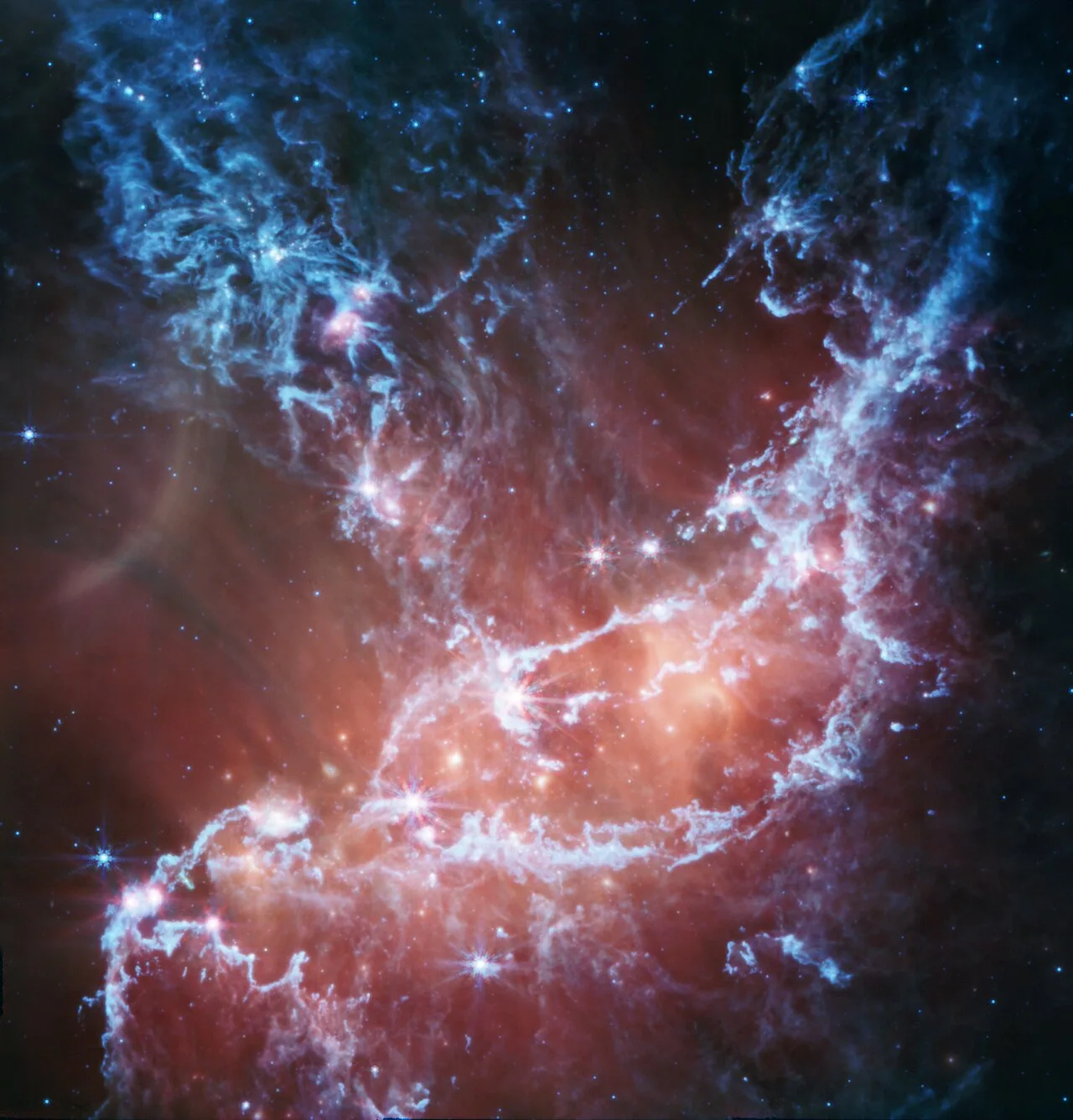
The picture at the top is an earlier Webb shot of the Sagittarius C region near the galaxy’s center, from 2023.
My take
I like stories like this because they connect something way out there to us. The same kind of exploding stars that dumped metals around our black hole are where the iron in your blood came from. And honestly, the fact that our galaxy’s black hole is a picky eater is kind of comforting. I’ll take a chill one.
So basically — pass it on.
Daily Updates
Get new stories in your inbox
Near-future tech when it moves. Robots, space, EVs, AI. No spam.