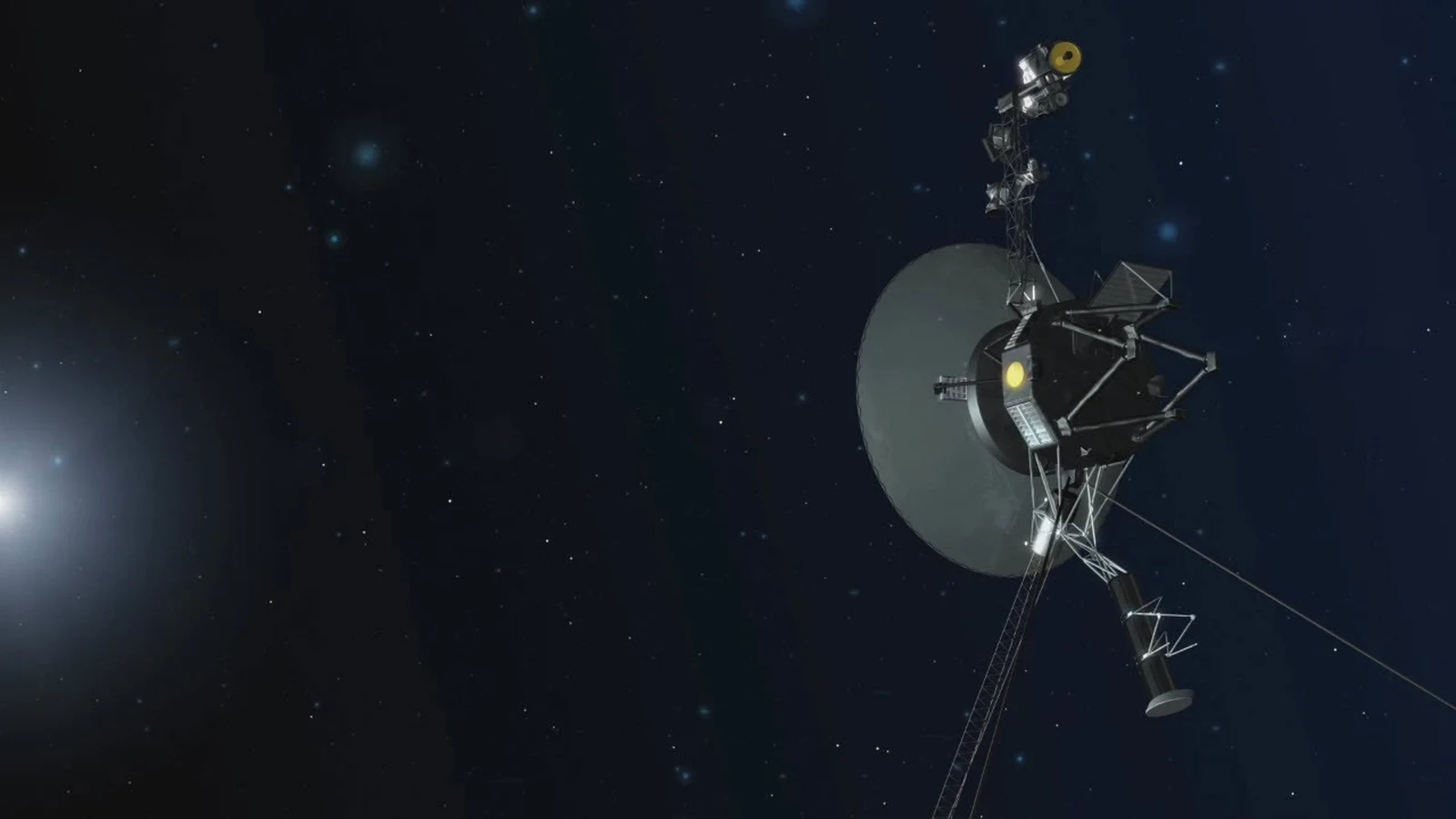
Voyager 1 Is Now So Far Away That Light Takes a Full Day to Reach It
NASA's Voyager 1 crossed one light-day from Earth on Nov. 18, 2026, about 16.1 billion miles out. It took the 1977 probe 49 years, two months and 11 days to get there, and a radio signal now needs 24 hours to reach it.
So basically: This morning at 5:16:07 a.m. Eastern, NASA’s Voyager 1 became the first thing humans ever built to get one light-day away from Earth. That’s about 16.1 billion miles. If you could shine a flashlight at it right now, the light would need a full 24 hours to get there. It took Voyager 1 49 years, two months and 11 days to cover that distance.
What a light-day actually means
A light-day sounds like a unit of time, but it’s a distance. It’s how far light travels in 24 hours. NASA puts the exact number at 16,094,799,096 miles, or about 25.9 billion kilometers.
Light moves about 186,000 miles every second, so it’s hard to picture anything being a whole day away. Here’s how NASA lays it out:
- Light gets from Earth to the Moon in about 1.3 seconds
- Sunlight takes about 8 minutes and 20 seconds to reach us
- Neptune, the farthest planet, is about 4 hours and 10 minutes away at light speed
- Voyager 1 is now 24 hours away
So the farthest planet is only about a sixth of the way to where Voyager 1 is sitting today.
Talking to it takes two days
This is the part that gets me. Radio waves move at the speed of light too. So when engineers at NASA’s Jet Propulsion Laboratory send Voyager 1 a command, it takes a full day to get there. Then the answer takes another full day to come back.
That means every time they ask the spacecraft to do something, they wait about two days to find out if it worked. And this is a machine built in the 1970s, still talking to us through NASA’s Deep Space Network of giant dish antennas.
How it got this far
Voyager 1 launched on Sept. 5, 1977, two weeks after its twin, Voyager 2. The pair launched during a planet lineup that only happens about once every 176 years, which let them swing past the outer planets.
Voyager 1 flew by Jupiter and Saturn, then in 1980 it headed up and away from the planets toward deep space. It crossed into interstellar space in August 2012, which means it left the bubble the Sun blows around our solar system. It’s still sending back science from out there.
Right now it’s cruising at nearly 38,000 mph. That sounds fast until you compare it to light, which is about 17,600 times faster.
Where it’s headed next
Voyager 1 is drifting toward a dim star called Gliese 445, which sits more than 17 light-years away in the Little Dipper. It’s expected to pass within about 1.7 light-years of that star. That happens in about 40,000 years.
Voyager 2 took a slower path so it could visit Uranus and Neptune. NASA says it should hit its own one light-day mark in November 2035.
What NASA is doing for it
Last night NASA asked people around the world to flash “VGR,” Voyager’s call sign, in Morse code with their phones and flashlights after sunset. On Thursday, Nov. 19, at noon Eastern, JPL is hosting a live talk with the Voyager team about how the probes are doing and how they keep machines this old running this far out. They’re also previewing a NASA+ Voyager documentary coming in 2027 for the mission’s 50th anniversary.
My take
I love this one because nothing about it is hype. It’s a real number you can check, and it’s almost impossible to wrap your head around. A spacecraft built with 1970s parts is so far away that light, the fastest thing there is, needs a whole day to catch up to it. And the team still waits two days for every reply and keeps it working anyway. Everybody’s excited about Starship and Moon landers right now, and they should be. But Voyager is the reminder that one good mission can keep paying off for 50 years. I don’t think anything else we’ve built is going to beat this record for a long time.
So basically — pass it on.
Daily Updates
Get new stories in your inbox
Near-future tech when it moves. Robots, space, EVs, AI. No spam.