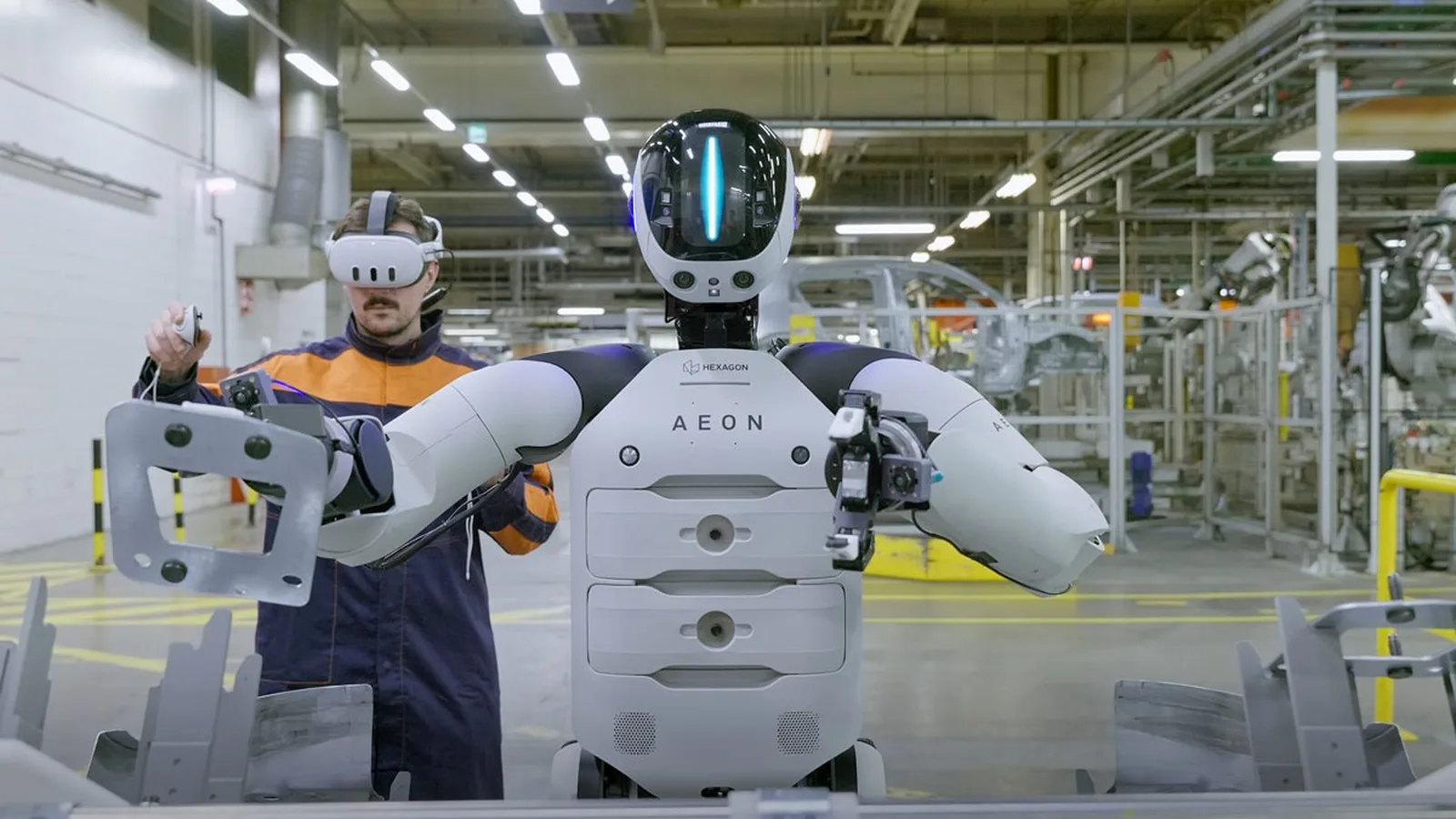
Volvo Is Training Humanoid Robots at Its Belgium Car Plant, With Real Production Work Set for Mid-2027
Volvo Cars brought Hexagon's AEON humanoid robots into its Ghent, Belgium factory. They're learning by copying workers, and Volvo wants them doing real production jobs by the middle of 2027.
So basically: Volvo Cars has humanoid robots inside one of its car factories now. The company announced on Nov. 26 that it’s training AEON robots from Hexagon, a Swedish tech company, at its plant in Ghent, Belgium. Right now they’re learning one simple job. The plan is a bigger factory pilot in the first half of 2027 and real production work starting in mid-2027.
What the robot is
AEON doesn’t walk the way people do. It has a human-shaped upper body with two arms and a head full of cameras, but where you’d expect feet, it has wheels, so it rolls across the floor.
Volvo gave out the specs:
- 1.65 meters tall, which is about 5 feet 5 inches
- 60 kilograms, about 132 pounds
- Top speed of 2.4 meters per second, roughly 5.4 mph, which Volvo compares to a light jog
- Can carry 10 kilograms, about 22 pounds
It uses cameras and sensors to see what’s around it and handle parts precisely. Hexagon built it as a general purpose machine, so the same robot can be trained for different jobs.
How Volvo is teaching it
Volvo’s own team is doing the training, working with Hexagon’s robotics division. They’re using something called imitation learning. A person does the task, and the robot learns by copying how it’s done. In Hexagon’s photo from the announcement, the operator is wearing a VR headset and holding controllers while the robot mirrors his arms.
The first job is about as basic as factory work gets. The robot picks up components and places them into two fixtures with high precision. Once that’s proven, Volvo plans to make it harder step by step:
- Handling more than one part at a time
- Moving around the production area
- Working with the plant’s existing automated systems
Ghent is the first Volvo Cars plant to try humanoid robots at all.
Why use a human shape
Car factories have used robot arms for decades. They’re great at doing the same motion in the same spot all day. The problem is some of the hardest jobs on the line need a worker who can move around, reach awkward spots and handle different parts.
Volvo’s chief manufacturing officer, Magnus Nilsson, said AEON’s human shape means it “can fit into our production as it is today, alongside our teams and existing automation.” He said the goal is for the robots to take on “some of the most physically demanding tasks” and make the work easier on employees’ bodies.
Arnaud Robert, president of Hexagon Robotics, said working with Volvo’s team makes sure AEON is doing real tasks and not just demos.
The timeline
- Now: a training phase in Ghent with one placement task
- First half of 2027: a factory pilot, with more AEON units arriving to take on more tasks
- Mid-2027: the target for robots working in real production
Volvo didn’t say how many robots are in Ghent now or how many it plans to buy. It also didn’t share a price. AEON has been getting around lately. Earlier this month we covered Pilatus in Switzerland putting one on inspection checks for its PC-24 business jets.
My take
I like that Volvo was honest about how small this starts. One robot job, placing parts into two fixtures. That’s not flashy, but that’s how this stuff actually gets into factories. You prove one task, then add another.
The wheels part is smart too. A car plant floor is flat, so there’s no reason to make a robot balance on feet, and rolling is a lot less likely to end with a robot tipping over next to a person. The real test is mid-2027. If AEON is doing actual production work at Volvo’s pace by then, more carmakers will follow. If the date slips, that tells you something too.
So basically — pass it on.
Daily Updates
Get new stories in your inbox
Near-future tech when it moves. Robots, space, EVs, AI. No spam.