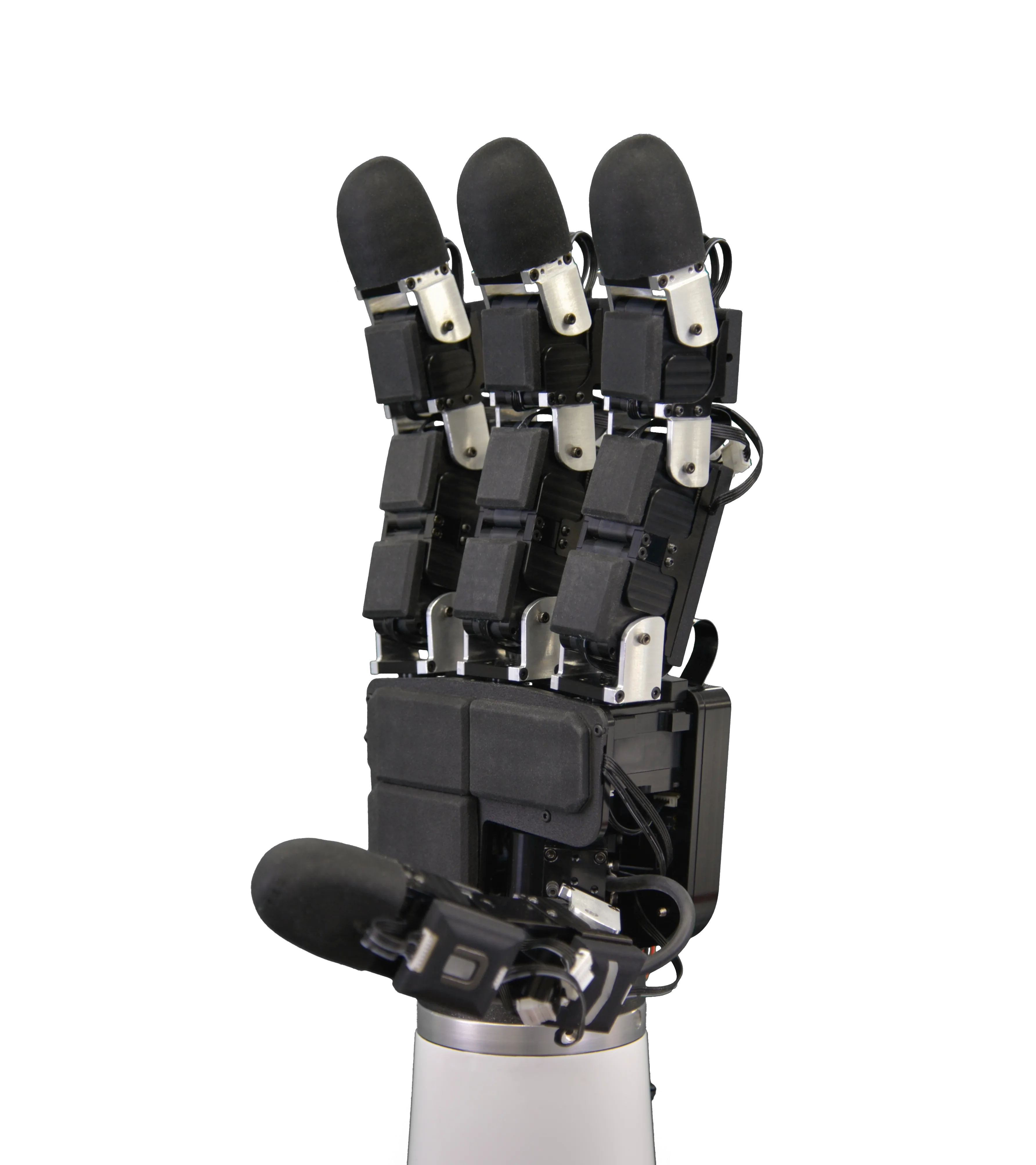
Tesla Patented Touch-Sensitive Skin for Robot Hands. Print Flat, Then Heat-Form
US patent app 2026/0310299 A1 describes moldable tactile skin for robot fingers and palms using capacitive and piezoresistive sensors built with screen printing and thermoforming.
So basically: Tesla filed a U.S. patent application for touch-sensitive “skin” you can mold around robot fingers and palms. The idea is print the sensors flat, then heat-form them into 3D shapes. It is not a finished Optimus feature drop. It is a manufacturing play for hands that can feel pressure, not just clamp down on stuff.
The application is US 2026/0310299 A1, published Oct. 8. Robotics & Automation News picked it up Oct. 16 after patent watchers at Patentlyze flagged it.
How the skin is supposed to work
Tesla describes two flexible substrate layers with conductive regions, plus a compressible layer in between. Where the conductive bits overlap, you get sensing points that react when something presses them.
The filing covers both capacitive and piezoresistive approaches. Material list includes TPU, PET, and polyimide. Process list is the interesting part: screen printing, laser cutting, conductive paste, thermoforming. That is factory language. Tesla is not describing a one-off lab glove. They are describing something you could stamp out.
The patent text says the 3D tactile sensors can conform to curved geometries and measure surface force, touch, and pressure.
What it does not say
A few honest gaps:
- It does not explicitly name Optimus
- It does not give sensitivity numbers
- It does not give resolution or durability figures
So we cannot score how good this skin would feel in a real hand. We only know Tesla wants fingertips, palms, and end-effectors that can sense contact at scale.
That still matters. Humanoid teams keep running into the same wall: grasping is the easy demo, feeling how hard you are holding is the hard part. Soft produce, tools, cables, human interaction. Without decent tactile feedback, a robot hand is mostly a claw with better PR.
Why the manufacturability angle is the story
A lot of tactile research looks cool in a paper and dies on the factory floor. Tesla’s filing leans into methods factories already know. Print flat. Cut. Paste. Thermoform over a finger shape. If that works, you get skin that wraps curved finger geometry without hand-building every sensor pad.
That matches how Tesla likes to talk about Optimus in general: design for volume, not museum pieces. Whether this patent becomes production hardware is a different question. Patents are aspirations with lawyers.
Where this sits with Optimus
Tesla has been showing Optimus walking, waving, and doing lightweight factory tasks. Hands are still the make-or-break. Magnets, actuators, and now this tactile skin filing all point at the same bottleneck: manipulation.
Optimus has already made news for supply chain audits and magnet limits. This patent is another hardware breadcrumb. Not a ship date. Not a sensitivity chart. Just Tesla saying robot hands should feel force the way people do, and that the skin should be moldable and printable.
The bigger robotics context
Tactile sensing is having a moment across humanoids for a reason. Vision gets you close. Force/torque at the wrist helps. Skin on the fingers is what lets a hand adjust mid-grasp when an object starts to slip or when you are packing something fragile next to something heavy.
Plenty of labs have demoed dense tactile arrays. The hard part is wrapping that tech around curved finger geometry without a custom science project for every digit. Tesla betting on flat print plus thermoform is them trying to skip that bottleneck.
If this ever ships on Optimus, the win is not a cooler teardown photo. It is fewer crushed parts and fewer dropped tools on a line.
What to watch
- Whether later Optimus demos show obvious finger or palm skins
- Follow-on patents with resolution or durability numbers
- If competitors push similar thermoformed tactile covers into production first
My take
Feeling how firmly you are holding something is the difference between a prop hand and a useful one. Tesla patenting printable, heat-formed tactile skin is a smart direction even if Optimus is not named in the filing.
I will get excited when a real hand on a real bot uses it on camera, not when the PDF drops. Until then, this is a useful clue: Tesla is thinking about touch as a manufacturing problem, not just a research flex.
So basically — pass it on.
Daily Updates
Get new stories in your inbox
Near-future tech when it moves. Robots, space, EVs, AI. No spam.