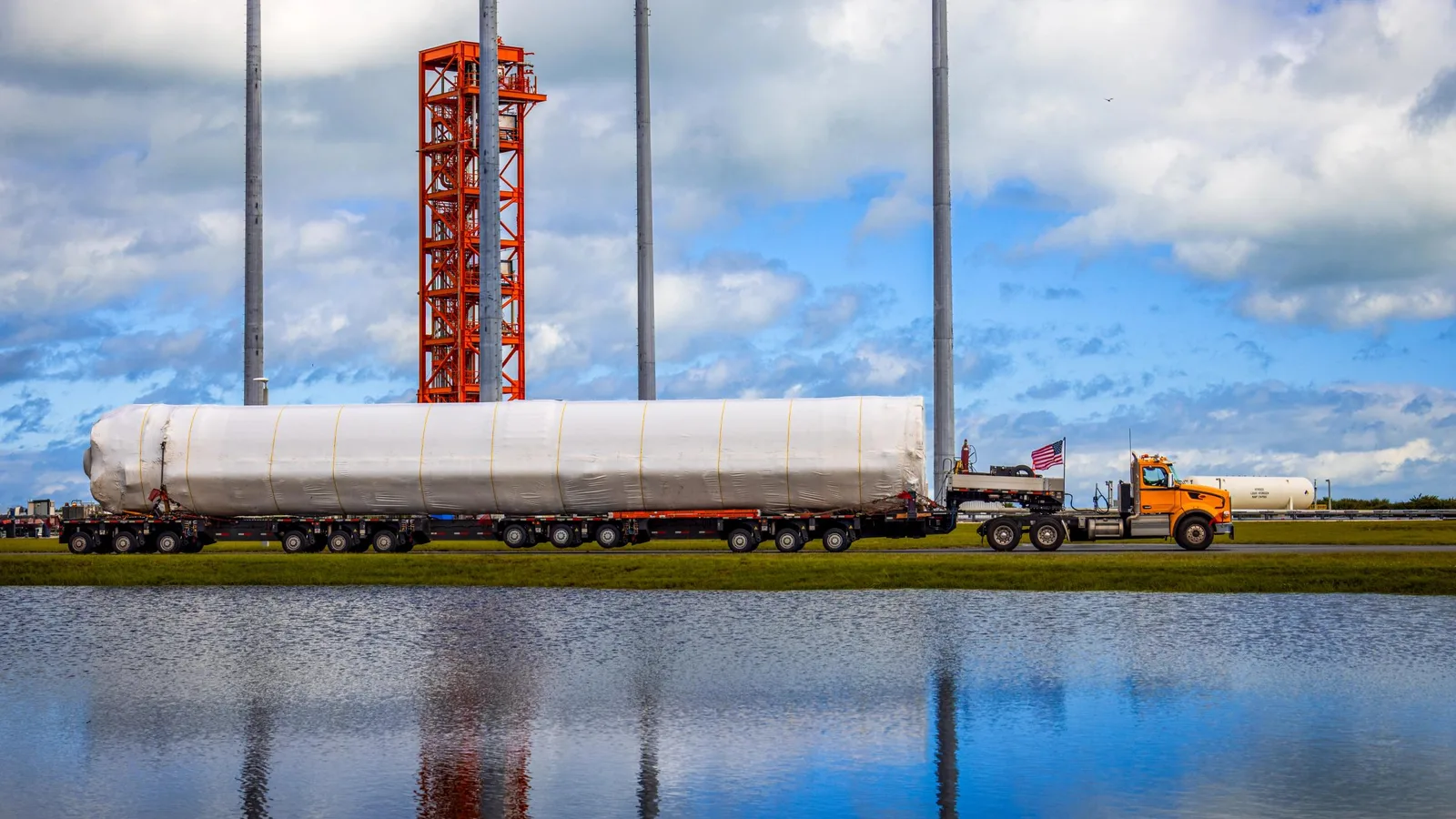
Stoke Drove Its Rocket Booster Across the Country to the Pad Where John Glenn Launched. It's the First Rocket There in 60 Years
Stoke Space's Nova Pathfinder first stage arrived at Space Launch Complex 14 at Cape Canaveral on Nov. 22 after a 17 day road trip from Washington state. It's the first rocket at the pad in 60 years. Stoke is aiming for a first launch in early 2027 with a rocket that's meant to be fully reusable.
So basically: Stoke Space just drove the first stage of its new rocket from Washington state to Florida on public highways. The trip took 17 days, 10 hours and 52 minutes. On Nov. 22 the booster rolled into Space Launch Complex 14 at Cape Canaveral, the same pad where John Glenn launched to orbit in 1962. Stoke says it’s the first rocket at that pad in 60 years. If testing goes well, the rocket, called Nova Pathfinder, could fly in early 2027.
Who Stoke is
Stoke is a rocket startup based in Kent, Washington. It’s building Nova, a medium size rocket that’s designed to be fully reusable. That’s the key part. SpaceX lands its Falcon 9 boosters, but the upper stage still gets thrown away every launch. Stoke wants to bring back both stages, which is what SpaceX is also chasing with Starship.
Pathfinder is the first version of Nova. A bigger version, called Block 2, comes later.
The road trip
Most rockets get built near where they launch, or they ride on a barge or a plane. Stoke designed Nova so it fits on regular highways. That means it can be built in one factory and launched from anywhere, without having to send it through the Panama Canal.
The catch is the rocket has to survive road bumps and highway loads on top of the stress of an actual launch. Stoke says the cross country drive “appears to have gone smoothly.”
Tested past its limits first
The booster that just showed up at the Cape isn’t a fresh one. It’s the same stage Stoke put through structural testing at its Moses Lake test site in May.
Over three weeks, Stoke ran 46 structural tests on it and loaded it to 115% of the forces it’s expected to see in flight. Hundreds of strain gauges checked how it held up. Stoke says inspections afterward found no damage.
The engines
The Pathfinder booster flies seven Zenith engines. Block 2 will fly 14. Zenith is a full flow staged combustion engine, which is a very efficient and very hard to build kind of engine. SpaceX’s Raptor is the best known example.
Stoke recently said it finished developing Zenith. Ars Technica reports the seven engines together make about 700,000 pounds of thrust at full throttle. Flight engines are shipping to Florida about once a week as they pass testing, and the first two had already reached the pad by Nov. 20, according to Florida Today.
The upper stage is its own wild thing. It uses a hydrogen engine called Andromeda and a metal heat shield that’s actively cooled so it can come back from orbit and be reused.
What happens next
The booster is now in the hangar at SLC-14. Here’s the plan Stoke laid out:
- Wet dress rehearsals, where the rocket gets loaded with propellant on the new pad
- Installing the rest of the Zenith engines
- A full static fire of the stage
- A static fire of the upper stage in Washington in December before it ships to Florida
Stoke hasn’t set a launch date. It says Pathfinder will fly multiple times in 2027 and 2028.
The pad itself is part of the story. SLC-14 sent up the Mercury astronauts, and the original blockhouse and historical markers are still there. Stoke finished building the new pad and tower there in February. NASA Administrator Jared Isaacman replied to Stoke’s arrival post with “Looking good.”
My take
The road trip is what got me. They built a rocket on purpose so they could drive it down the interstate. That’s a really smart way to save money, but it also means some trucker out there passed a rocket booster on the interstate and had no clue. I like that Stoke tested the actual flight booster to 115% before sending it, instead of hoping for the best. Fully reusable rockets are the whole game right now, and it would be good for everybody if SpaceX had real competition. Early 2027 is the target, and first launches almost always slip, so I’ll believe the date when they light it. Still, rockets flying from John Glenn’s old pad again is pretty cool.
So basically — pass it on.
Daily Updates
Get new stories in your inbox
Near-future tech when it moves. Robots, space, EVs, AI. No spam.