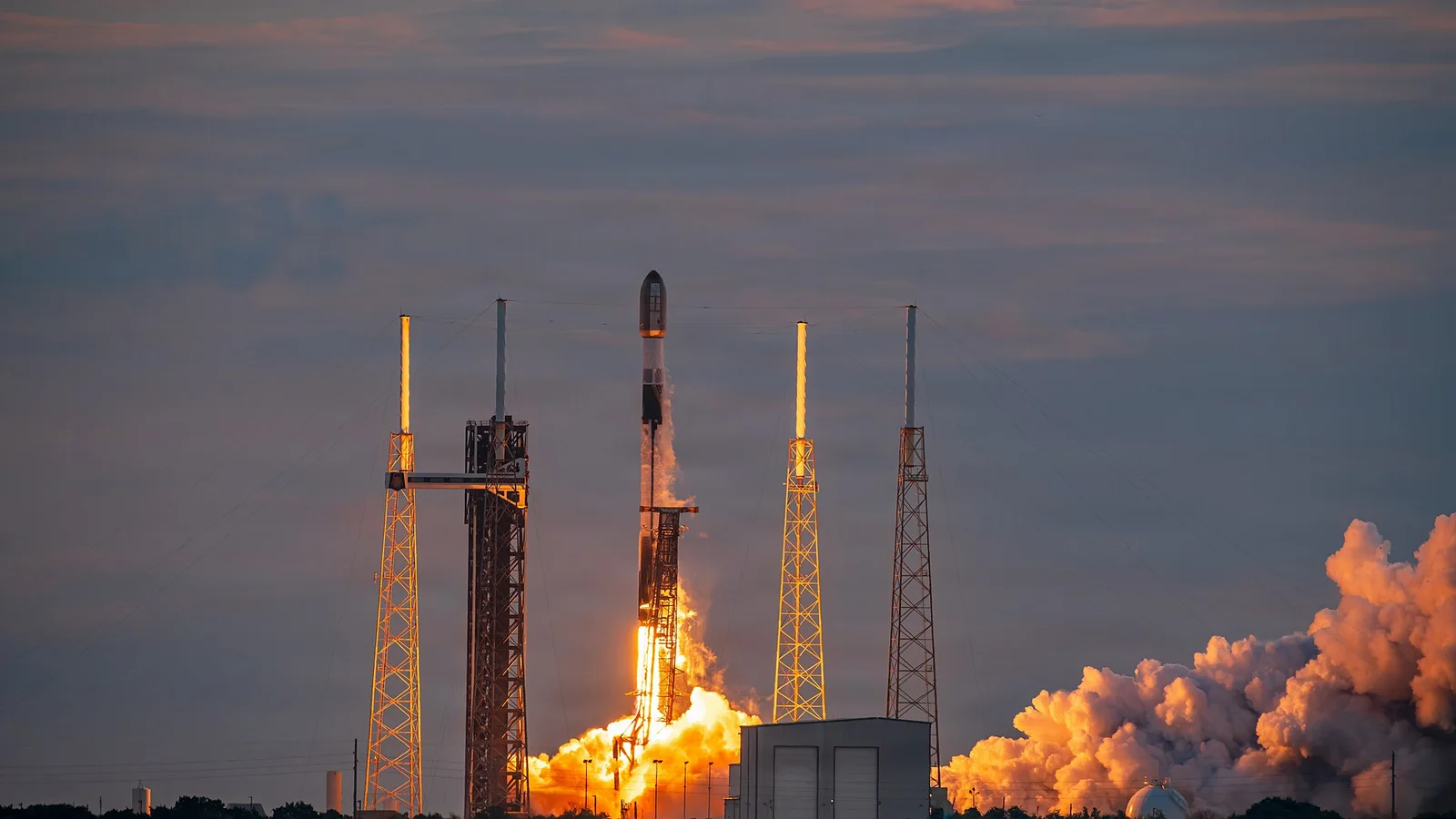
SpaceX Launched Its Second Starfall Capsule, a 10 Foot Disc That Brings Cargo Back From Space
SpaceX's second Starfall return capsule lifted off on the Bandwagon-5 rideshare at 7:04 a.m. ET on Oct. 20, and the booster landed on the droneship. Starfall is 10.2 feet wide and can carry about 2,200 pounds. The first one came home in June with brewing yeast inside.
So basically: SpaceX just flew its second Starfall capsule. Starfall is SpaceX’s own return capsule, shaped like a big flat disc, and its whole job is to go up to orbit and then come back down with stuff inside. It rode on a Falcon 9 rideshare mission called Bandwagon-5 out of Cape Canaveral.
The Falcon 9 lifted off at 7:04 a.m. ET on Tuesday, Oct. 20, one day late after bad weather out where the booster lands pushed it back from Monday. The booster landed on the droneship about nine minutes later. Starfall was the last thing to come off the rocket, about 2 hours and 48 minutes after liftoff, and SpaceX later said the whole deployment sequence was complete.
As of Tuesday evening, SpaceX hasn’t said whether this Starfall has come back down yet or where it will land.
What Starfall actually is
Most capsules you’ve seen look like a gumdrop. Starfall looks more like a giant hockey puck. According to an FAA environmental review, it’s about 10.2 feet wide and only 2.5 feet tall, and it weighs around 4,600 pounds empty. It can carry up to about 2,200 pounds of cargo.
On the way down, small nitrogen thrusters on top keep it pointed the right way. Near the end it drops its heat shield, opens a series of parachutes, and splashes down in the ocean. SpaceX boats pick up all the pieces.
SpaceX calls it a microgravity lab. The idea is that researchers and companies can send experiments up, or make things that come out better in zero gravity, like certain crystals and materials, and then actually get them back. SpaceX has also talked about using it to deliver cargo from one place on Earth to another.
The first one already worked
The first Starfall flew on June 23, and SpaceX kept it pretty quiet. It didn’t even say Starfall was on the rocket until close to launch. Two days later, on June 25, the capsule splashed down in the Pacific about 800 miles off the U.S. coast. A recovery ship named Shannon brought it into the Port of Long Beach.
The cargo on that first flight was brewing yeast. Yes, beer yeast went to space. It was a simple way to see how living things handle the ride up and the fall back down.
For this second flight, SpaceX hasn’t said what’s inside. This time, though, it did list Starfall on the official mission page and showed pictures of it for the first time.
The rest of the rocket was packed
Starfall didn’t fly alone. Bandwagon-5 carried 32 payloads in total. That includes radio tracking satellites from HawkEye 360, four satellites for ICEYE, and six navigation satellites from Xona Space Systems.
There’s even a second return capsule on the same rocket. Varda Space Industries, a company that runs experiments in orbit and brings them home, flew its W-7 capsule. It’s about three times smaller than Starfall. So two companies trying to be the delivery service from space shared a ride.
The booster was on its 19th flight. It had launched Crew-9 and Fram2 before, and it landed on the droneship A Shortfall of Gravitas about nine minutes after liftoff.
Why this matters
Getting stuff up to space is way cheaper than it used to be. A small satellite can ride on one of these SpaceX rideshares for about $350,000. Getting stuff back down is the hard part. Right now, if you want something back from orbit, you mostly wait for a Dragon to come home from the space station.
A reusable capsule that SpaceX can launch whenever it wants changes that. SpaceX also says Starfall will eventually fly on Starship, with a bunch of them going up at once.
My take
I think this is one of those quiet SpaceX projects that ends up being way bigger than it looks. Everyone watches the Starship catches, but a 10 foot disc full of cargo falling into the Pacific is how space turns into a normal business. If this one comes home as clean as the first one, I’d bet SpaceX starts flying these a lot.
So basically — pass it on.
Daily Updates
Get new stories in your inbox
Near-future tech when it moves. Robots, space, EVs, AI. No spam.