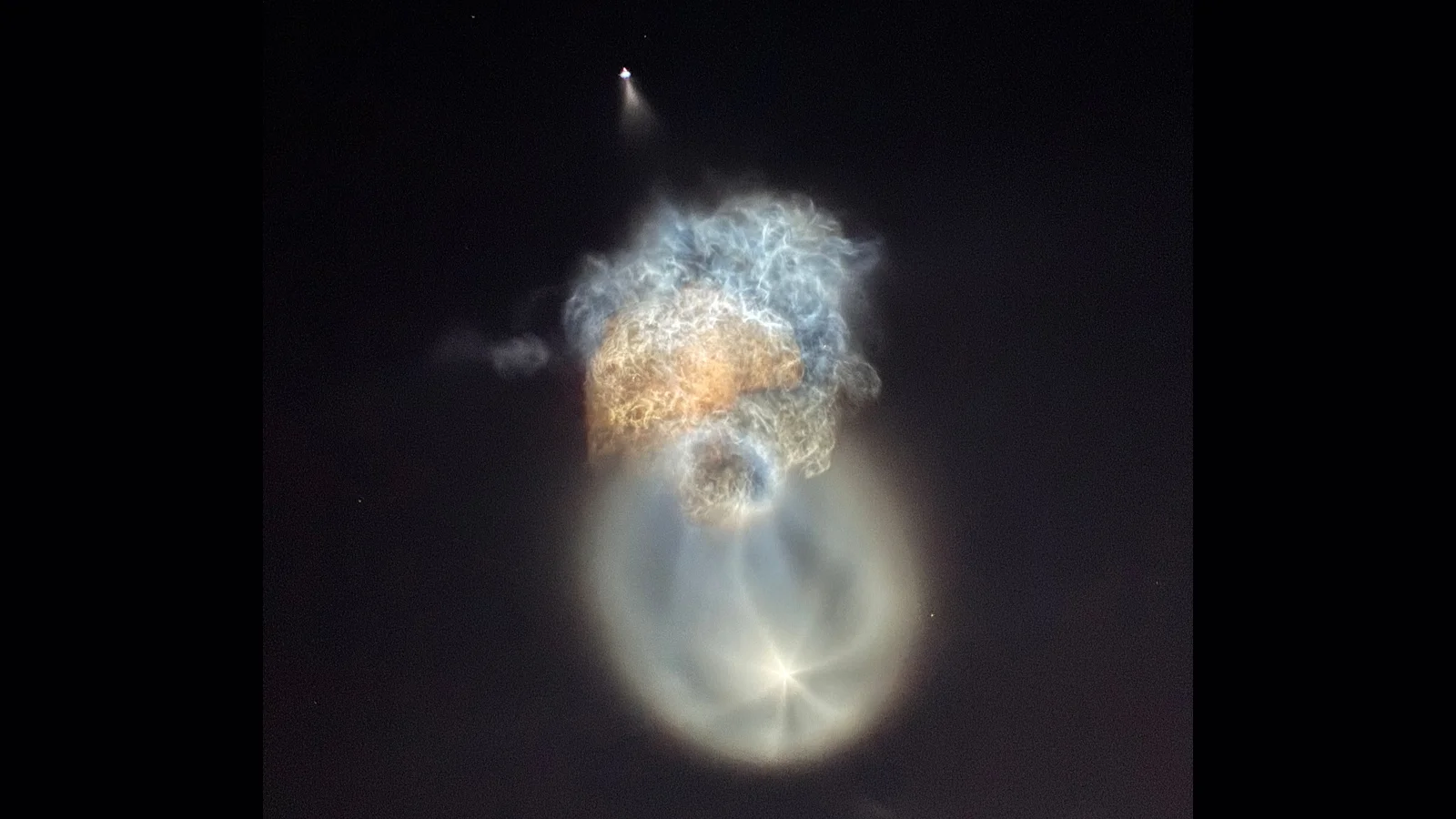
SpaceX Launch Creates Giant Jellyfish-Like Glow Over Florida
SpaceX's CRS-35 launch at 6:33 a.m. ET on Oct. 13 left a huge glowing jellyfish shaped plume in the dark sky. Here is why dawn launches do this and how far away people could see it.
So basically: When SpaceX launched its CRS-35 cargo mission before sunrise on Oct. 13, the rocket left a giant glowing jellyfish in the sky. It was still dark on the ground, but the rocket had climbed high enough to be hit by sunlight. That lit up its exhaust and turned it into a bright, see through blob with tentacles trailing under it. People saw it from hundreds of miles away, and the photos are still going around almost a week later.
What actually happened
The Falcon 9 lifted off from Cape Canaveral at 6:33 a.m. ET, carrying a cargo Dragon full of supplies and science for the International Space Station. That’s a normal launch. The timing is what made it special.
At 6:33 a.m. the sun hadn’t come up in Florida yet. The sky was black and the streetlights were still on. But a few minutes after liftoff, the rocket was so high that it could see the sun over the curve of the Earth, even though everyone on the ground couldn’t.
So you had a dark sky with one spot way up high that was lit up like daytime. That spot was the rocket and everything coming out of its engines.
Why it looks like a jellyfish
Rocket exhaust is mostly hot gas and water vapor. Down low, the air is thick, so the plume stays tight and you just see a bright streak.
Way up high, there’s almost no air left to hold it in. The exhaust puffs out in every direction into a huge round cloud. The water in it freezes into tiny ice crystals, and those crystals catch the sunlight and glow.
That gives you the bell of the jellyfish. The tentacles come from the stages separating, the engines shutting off and starting again, and the second stage pushing out its own plume as it keeps climbing. In the best photo from that morning you can see the rocket itself as a tiny bright dot at the top, with the glowing bell hanging below it.
It’s not smoke and it’s not a cloud you’d see on a normal day. It only lasts a few minutes before it spreads out and fades.
How far away people saw it
Because the plume sits so high up, it can be seen from really far away. Photos came in from all over Florida, and people farther up the East Coast shared it too. One shot that’s going around shows it hanging over a fruit stand and a Burger King along a regular Florida road, with a semi truck driving right under it. Nobody in that picture is at a launch site. They just looked up on their way to work.
Why you don’t see it every launch
SpaceX launches all the time, so you might wonder why this isn’t an everyday thing. It needs a very specific window.
The launch has to happen in the dark, close to sunrise or sunset. Too early or too late and there’s no sunlight to light the exhaust. Too close to sunrise and the sky is already too bright for the glow to stand out. The weather also has to be clear, because clouds will block the view.
That usually leaves a window of about half an hour on either side of sunrise or sunset. When a launch lands in that slot, you get a jellyfish.
Was anything wrong with the rocket?
No. This is totally normal. The launch went fine, the booster landed, and the Dragon docked itself to the space station on Oct. 15 with more than 6,300 pounds of cargo. The jellyfish is just physics and good timing.
My take
This is one of my favorite things rockets do. You don’t need to know anything about orbits or payloads to look up and go “what is that.” Half the people who posted it probably had no idea a launch was even happening.
It’s also a good reminder of how normal launches have gotten. A rocket headed for the space station flew over people buying oranges and grabbing breakfast, and the only reason anyone stopped was because the sky looked cool. If you live anywhere near Florida, look up the launch schedule and catch one of these dawn launches in person. It looks even crazier in real life.
So basically — pass it on.
Daily Updates
Get new stories in your inbox
Near-future tech when it moves. Robots, space, EVs, AI. No spam.