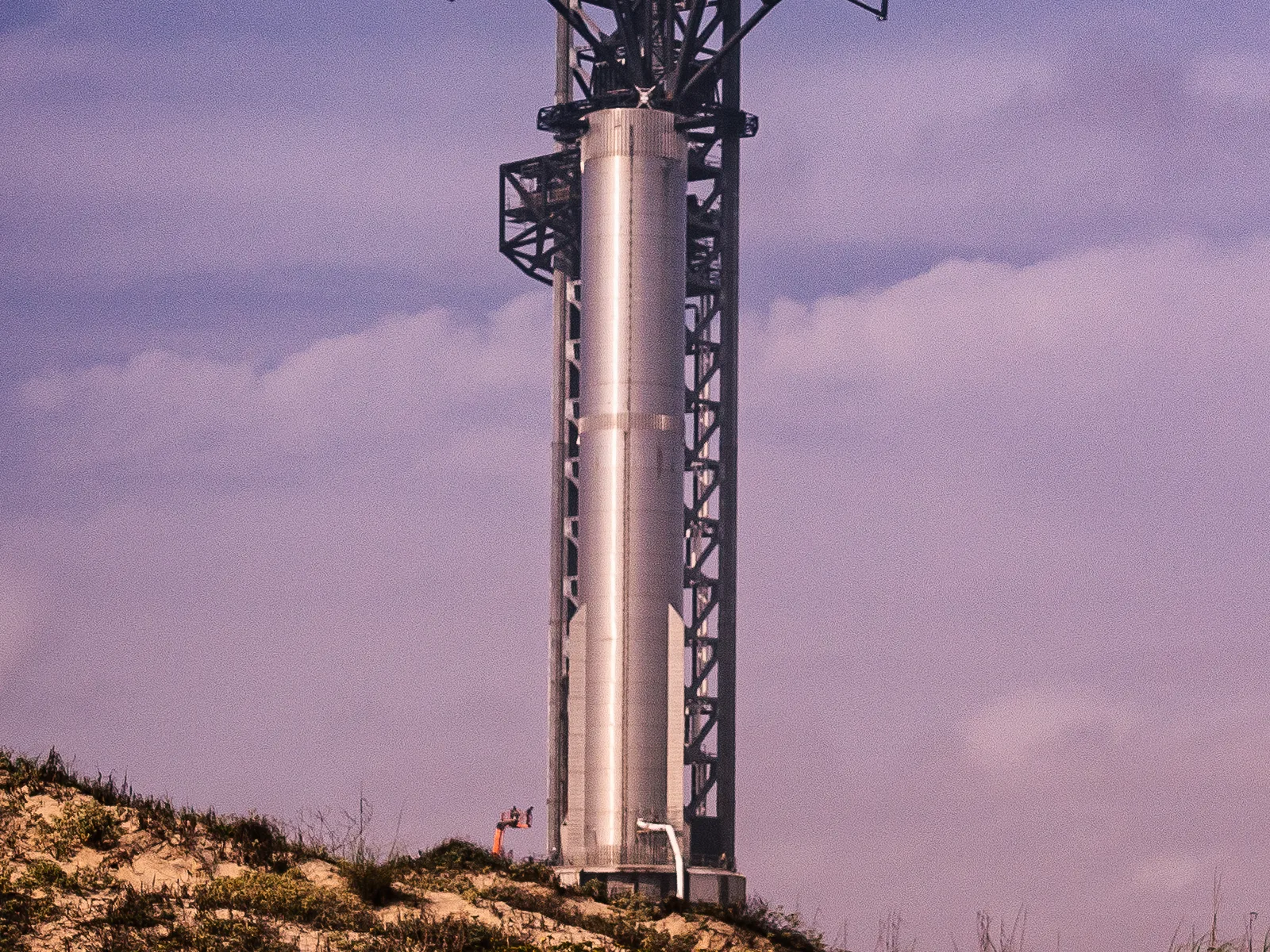
SpaceX Just Lit All 33 Engines on the Booster for Starship Flight 15 While It Was Bolted to the Ground
SpaceX ran a full duration static fire of Super Heavy Booster 22 at Starbase on Oct. 25, 2026, firing all 33 Raptor 3 engines on Pad 2. Flight 15 could fly as soon as Nov. 8 and may try to catch both the booster and the ship.
Update, Nov. 17: Flight 15 launched Nov. 13. Ship 42 came back from orbit and was caught by the tower on Nov. 14, a first for any rocket’s upper stage. Booster 22 aborted its catch and was lost in the Gulf. Full story.
So basically: On Sunday morning, Oct. 25, SpaceX fired all 33 Raptor engines on the Super Heavy booster that will fly Starship Flight 15, while the whole thing stayed clamped down to the launch mount at Starbase, Texas. SpaceX called it a full duration static fire. It’s one of the last big tests a booster goes through before it flies, and the last couple of times SpaceX did this, the launch came about two to four weeks later.
What a static fire actually is
Think of it like revving a truck engine in the driveway with the parking brake on before a long trip. The booster gets fueled up, the engines light, and giant clamps hold it to the pad so it doesn’t go anywhere. Engineers get to see how every engine behaves together without risking a flight.
This booster is called Booster 22. It rolled out from the factory overnight into Saturday, Oct. 24, and the tower’s “chopsticks” lifted it onto the launch mount at Pad 2 within a few hours. On Sunday the engines lit at 9:22 a.m. Eastern. SpaceX posted two videos of it on X that afternoon.
The city of Starbase closed Boca Chica Beach and Highway 4 for the day, with Monday held as a backup in case the test slipped. It didn’t need the backup.
The numbers on this thing
Booster 22 is a third generation Super Heavy, the version SpaceX first flew back in May. Each of its sea level Raptor 3 engines puts out about 551,000 pounds of thrust. That’s up from about 507,000 on the older engine. And the new engine actually weighs less, about 3,362 pounds compared to 3,594 before.
Multiply that by 33 and you get well over 18 million pounds of thrust coming out the bottom of one rocket. That’s why the clamps on that mount have to be so beefy.
SpaceX also changed a lot on this version. It has three grid fins instead of four, and each one is 50% bigger. The pipe that feeds fuel to all 33 engines got redesigned too, and it’s now about the size of a whole Falcon 9 first stage. SpaceX says that lets all the engines start at the same time and makes the flip after separation faster and more reliable.
Fixing the engines that wouldn’t relight
One thing that came out of NASA’s Artemis briefing on Oct. 23 is that some Raptors had trouble relighting during the boostback and landing burns on recent flights. NASA’s Artemis program manager, Jeremy Parsons, said SpaceX found the root cause, put in some quick fixes for Flights 13 and 14, and has permanent hardware improvements coming on Flight 15 with an improved version of the Raptor.
NASA cares a lot about this because Starship is going to be one of its Moon landers. The lander has to be refueled in orbit by tanker flights before it heads to the Moon. Parsons said NASA isn’t expecting anything close to 22 tanker launches and pointed to SpaceX’s estimate of about six to eight.
When does it fly?
SpaceX hasn’t announced a date. Aviation planning data point to no earlier than Nov. 8, according to NASASpaceflight. Parsons said NASA expects it probably in November, and that the flight could try to bring both the booster and the ship back to the launch site and catch them with the tower arms.
Catching the booster has worked a few times now. Catching the ship would be a first, and that would be a huge deal for making Starship fully reusable. The ship for this flight, Ship 42, still has to be stacked on top of Booster 22 before anything happens.
My take
I’ve seen a lot of rocket videos, and a static fire still gets me every time. You have a 20 story rocket screaming at full power and it just sits there. If SpaceX actually catches the ship this time, that’s the moment I think the cost of getting to space really starts to drop. That’s what makes a Moon base and all the stuff we keep writing about here possible. I’ll be watching in November, probably at 3 a.m. on a break at work.
So basically — pass it on.
Daily Updates
Get new stories in your inbox
Near-future tech when it moves. Robots, space, EVs, AI. No spam.