This Pilotless Cargo Drone Takes Off Like a Helicopter and Flies 1,300 Miles
Austin based Skyways just launched Skyreach, a self flying cargo aircraft that needs no runway, stays up for more than 18 hours and recharges its own batteries in the air. Customer flights start in December.
So basically: Skyways, a drone company from Austin, Texas, just launched Skyreach, a self flying cargo aircraft that takes off straight up like a helicopter, then flies like a plane. With a full tank it can go more than 1,300 miles and stay in the air for over 18 hours. It starts flying for customers in December 2026.
What it looks like
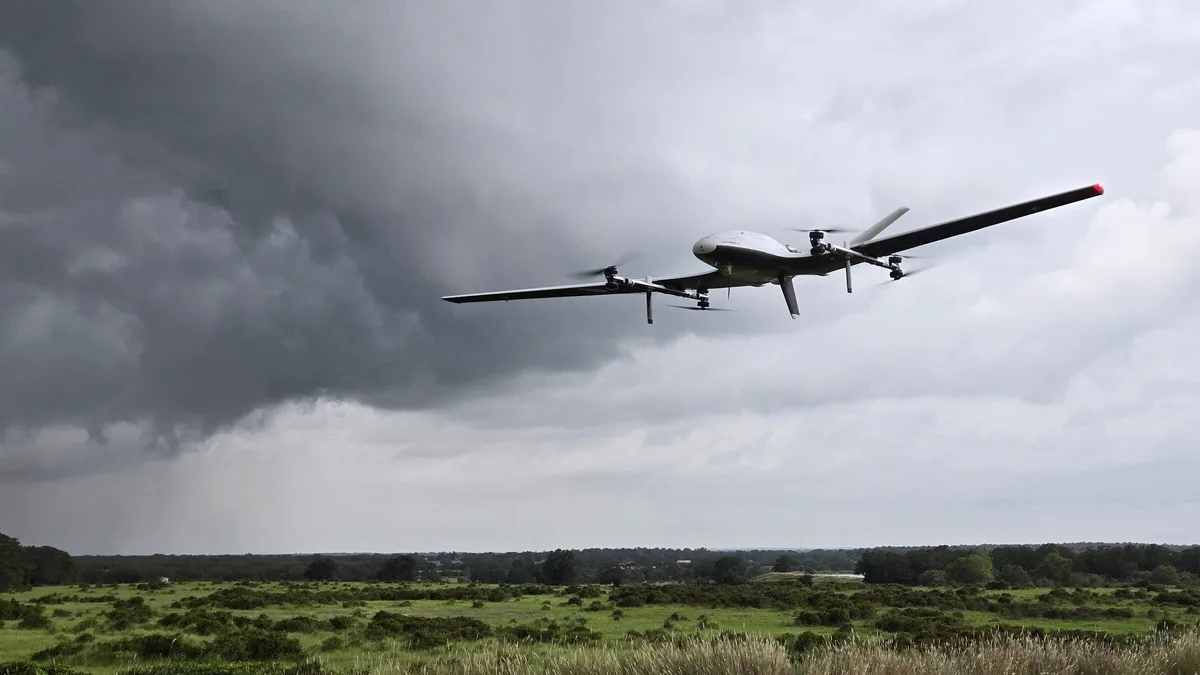
The photo up top is one of Skyways’ aircraft from the company’s website. It’s basically a small plane with long skinny wings and eight electric motors pointing up for takeoff and landing. Once it’s in the air, a fuel engine takes over for cruising.
That’s the trick that gives it so much range. Batteries handle the hard part, lifting off and landing vertically. Then the fuel engine flies it forward and runs a generator that recharges the batteries in flight, so nobody has to swap or plug in batteries on the ground.
It even runs on regular military jet fuel, JP-5 and Jet A-1, which matters a lot if you’re flying off a Navy ship.
The numbers
Here’s what Skyways says Skyreach can do:
- 1,300+ miles one way carrying 10 pounds of cargo
- 280+ miles one way carrying 80 pounds
- 18+ hours of flight time
- 100 pounds total for fuel plus cargo
- A 7 cubic foot cargo bay, which can even be kept cold
- Max takeoff weight of 360 pounds
- Handles winds up to 40 knots and temperatures from minus 5 to 120 degrees
The cargo bay loads from the top and opens from the bottom, so it can drop a package without landing at all.
Who it’s for
Mostly the military, at least at first. Skyways has flown missions for the Marine Corps, Navy and Air Force over the last eight years with its older V2 aircraft. Skyreach was originally called V3 Block 2, and it’s the production version behind a $37 million Air Force contract meant to get the company into full rate production.
Production has already started in Austin.
Jake Jacobson, a former deputy commander of Pacific Air Forces who now advises Skyways, put it pretty simply. He said it gives a commander an aircraft “with no runway, no aircrew and no waiting in line” for a cargo flight.
Skyways also wants commercial work, like moving cargo, carrying sensors and doing inspections.
Cheap compared to a helicopter
Skyways says Skyreach costs about one tenth as much as a helicopter. One person on the ground can also watch several of them at once through its SkyNav Mission Control software, so you don’t need a pilot for every aircraft.
CEO Charles Acknin says the goal is a network of more than 1,000 of these flying for customers within five years.
Why this matters
Think about how much stuff gets moved by helicopter or small plane just because there’s no road or runway. Island supply runs, ships at sea, remote job sites, disaster zones. A drone that can carry a small load hundreds of miles with nobody on board could do a lot of that for way less money.
The catch is size. Eighty pounds isn’t much, and 1,300 miles only works with a tiny 10 pound load. This isn’t replacing cargo planes. It’s more like a long range delivery van for the sky.
My take
I like that this isn’t a flashy concept. It’s a company with eight years of real flights behind it turning the thing into a product and selling it.
What gets me is the in flight charging. Battery life is the thing that kills most electric drones, and Skyways just sidesteps it by bringing a generator along. It’s not the cleanest solution, but it works, and it lets a small drone do things only helicopters used to do.
If they really get 1,000 of these flying in five years, a lot of small cargo flights are going to quietly stop needing a pilot.
So basically — pass it on.
Daily Updates
Get new stories in your inbox
Near-future tech when it moves. Robots, space, EVs, AI. No spam.