About 90 Robot Teams Raced Up a 3,000-Step Mountain in China, and Some Had to Carry Eggs
On Nov. 2, 2026, humanoid and four-legged robots from around 90 teams took on Mount Tai's stone stairs in the World Mountain Robot Challenge. A robot dog from a Unitree company finished the 2.4-mile climb in 43 minutes, way faster than most tourists.
So basically: China just made a bunch of robots climb a mountain. Not a lab ramp, not a treadmill. A real mountain, with more than 3,000 stone steps, and some of the robots had to carry eggs and watermelons to the top without breaking them.
It happened on Monday, Nov. 2, 2026, on Mount Tai, one of the most famous mountains in China.
The race
The event was called the World Mountain Robot Challenge, and it was organized by the state. Around 90 teams showed up with two kinds of robots:
- Humanoids, the two-legged kind that walk like people
- Quadrupeds, the four-legged robot dogs
Here’s what they were up against, according to CBS News and The Robotics Media:
- A route about 3.9 kilometers long, which is about 2.4 miles
- More than 600 meters of climbing, close to 2,000 feet straight up
- Over 3,000 cobbled stone steps, uneven and worn down
Chinese state TV said most tourists need at least two hours to do that climb.
Who won
A robot dog built by Beijing Lingyi Technology, a company owned by the big Chinese robot maker Unitree, won the four-legged speed race. It finished in 43 minutes and 41 seconds.
That’s not even half the time a normal person takes. Picture hiking up a mountain, out of breath, and a robot dog trots past you and is done before you’re halfway.
The humanoids had it harder. Their speed race used a shorter stretch of the course, and the winner, a team from Beijing called Zhishen Lingyue, finished it in 27 minutes and 26 seconds. Since the distance was different, you can’t really compare that time to the robot dog’s.
The egg and watermelon part
This is my favorite bit. Not every category was about speed.
Some teams had to haul fragile cargo up the mountain. Fresh eggs. Whole watermelons. The goal was to get them to the summit in one piece.
That sounds silly, but it’s actually a smart test. Going fast on stairs is one skill. Going up stairs while keeping your body steady enough not to crack an egg is a totally different skill. That second one is what you’d need for a robot that carries supplies, packages or tools in places with no elevator.
Why a mountain
Organizers called Mount Tai’s rocky ground a “natural extreme testing ground.” And honestly, they have a point.
Most robot demos happen on flat, clean floors. Real life is not flat or clean. Real stairs are uneven, some steps are taller than others, the stone is worn and slick in spots, and there’s no do-over if a foot lands wrong. A lab can fake a lot of things, but it’s hard to fake two hours of old mountain stairs.
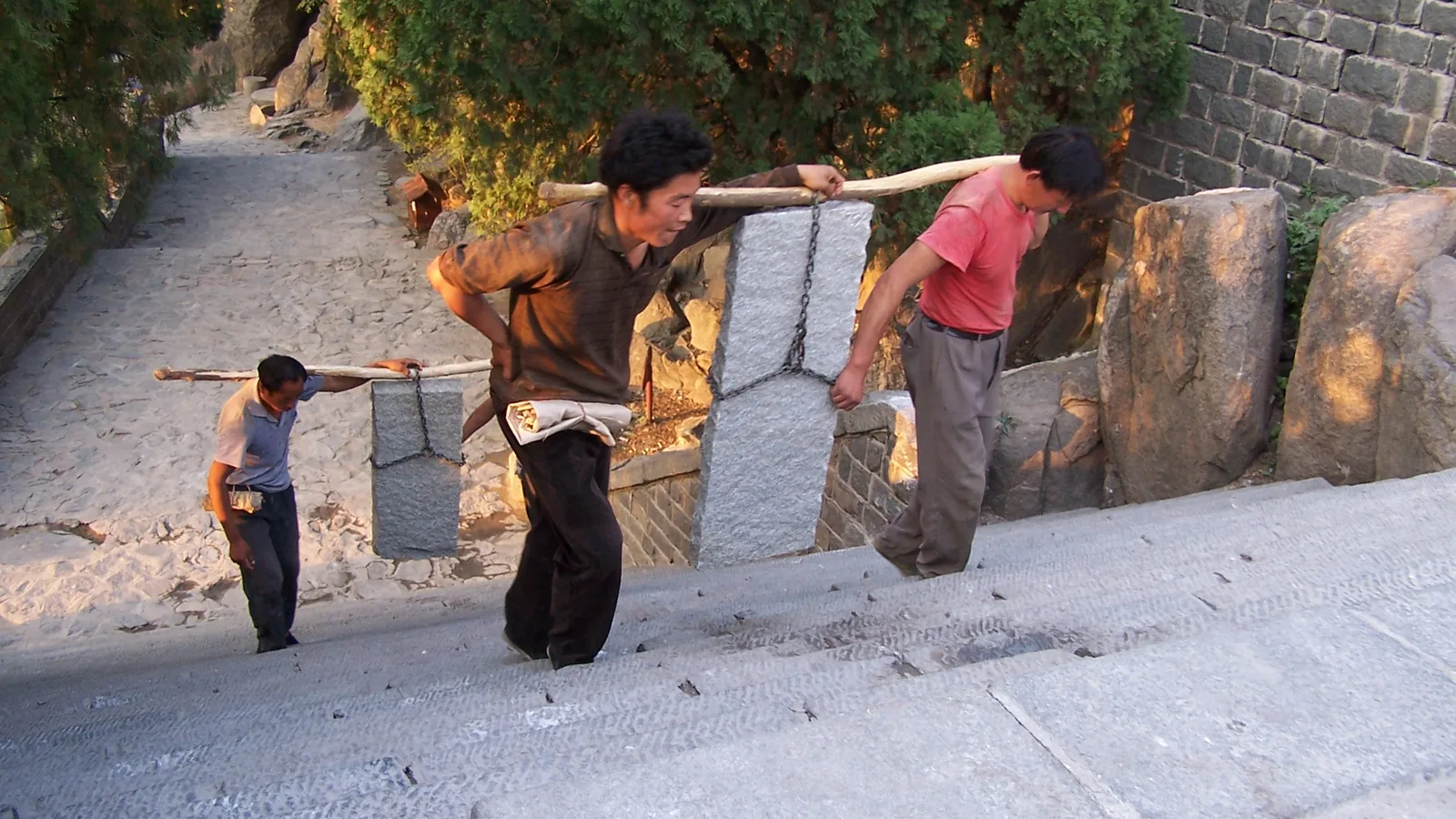
People have been carrying loads up those same steps by hand for a very long time. The photo at the top is of human porters on Mount Tai, hauling stuff up with poles on their shoulders. That’s the job these robots are basically auditioning for.
What we don’t know yet
There’s a lot the race doesn’t tell us:
- How many robots actually made it to the top, and how many fell or quit
- How many eggs and watermelons survived
- How much the teams helped their robots along the way
Most of the coverage so far comes from Chinese state media, so the full results and the bloopers might never come out.
My take
I love this kind of thing because it’s the opposite of a slick promo video. You can edit a video. You can’t edit a mountain. A robot dog beating tourists up 3,000 steps by more than an hour is wild, but the egg race is the one I’d really watch. When robots can carry a carton of eggs up a mountain without breaking one, they can carry just about anything for us. China keeps turning robot testing into public sports events, and I think that pushes these machines to get better faster than any lab test would.
So basically — pass it on.
Daily Updates
Get new stories in your inbox
Near-future tech when it moves. Robots, space, EVs, AI. No spam.