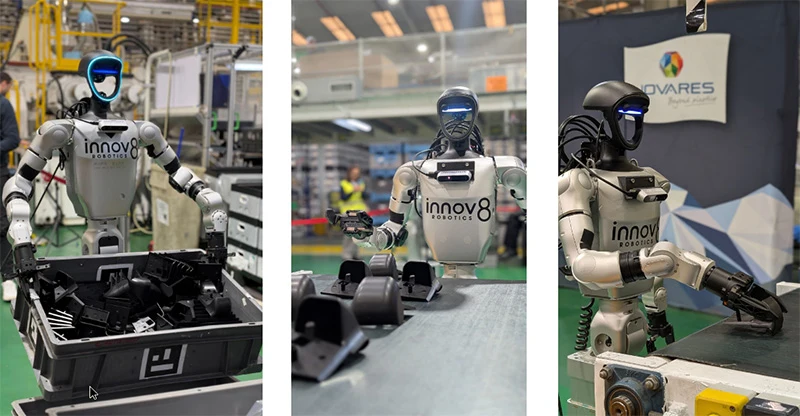
This Humanoid Robot Learned a Factory Job in 11 Minutes From Just 12 Demonstrations
At auto parts maker Novares' plant in Seseña, Spain, a Unitree humanoid running Bleu Robotics software learned a packing task from 12 operator demonstrations in 11 minutes, then picked parts with 99.5% success and ran 200 cycles on its own in an hour.
So basically: A humanoid robot working on a real car parts line in Spain learned its job in 11 minutes. A worker showed it the task 12 times, and that was it. No thousands of hours of training data. After that, it picked up parts correctly 99.5% of the time and ran 200 cycles on its own over an hour.
Where this happened
The plant belongs to Novares, a French company that makes plastic parts for cars. It’s not a household name, but it says its parts go into about one in four vehicles built worldwide. It runs 33 factories in 17 countries and brought in €1.1 billion last year.
The trial is at its plant in Seseña, Spain, and it started in early November. The robot is a Unitree humanoid, set up by a French company called Innov8, which distributes Unitree robots in Europe. The brains came from Bleu Robotics, a Paris startup that’s less than a year old.
They had already tried this at Novares’ research center in Lens, France. Four months later, they moved it onto an actual production floor next to real workers. Novares says it’s one of the first humanoid robot trials at a car production site in Europe.
What the robot actually does
Nothing flashy. It finds parts, picks them up, packs them and handles boxes. That’s the kind of repetitive job that wears people out, and it’s exactly where factories want help.
Here are the results they published on November 17:
- Finding the right part: 100%
- Picking up and placing parts: 99.5%
- Picking up and placing boxes: 95%
- Running on its own: 60 minutes and 200 cycles
- Moving around without help: 100%
200 cycles in 60 minutes works out to one every 18 seconds. And that’s after a training session shorter than most lunch breaks.
Why 12 demonstrations is the real story
Most robot companies train their machines on huge piles of data. Some pay people to wear motion capture suits and do the same chore hundreds or thousands of times. That takes weeks and costs a lot.
Bleu Robotics went the other way. A worker does the task in front of the robot a few times, right at the workstation, and the robot copies it. The company is aiming for 10 to 15 minutes of demonstrations for a simple task. The first one in Seseña took 11.
”The robot was not pre-trained on thousands of hours of data,” said Benoît Berkoukchi, Bleu’s co-founder and CEO. “It learned its task in just a few minutes, directly at the workstation, from only twelve demonstrations.”
Berkoukchi used to run an assembly line at Renault, so he knows what a factory actually needs. He started the company in December 2025 with two robot researchers from Inria, France’s national computer science lab. They raised €5 million in October, and they say the software works on any humanoid, not just Unitree.
The fine print
This is a proof of concept, which is a fancy way of saying a feasibility test. It’s one task, at one plant. One hour of running on its own is a good start, but a factory shift is eight hours or more, and a 95% success rate on boxes means it fumbles about one in 20. A person on the line still has to catch those.
Novares and Innov8 are being pretty upfront about that. They’re calling it a pragmatic approach, and the goal is to take the repetitive, physically tough jobs off workers, not to run a factory with no people in it.
My take
To me, the speed of teaching is the thing that matters most in humanoid robots right now, more than how many backflips they can do. Factories change jobs all the time. If it takes weeks and a data team to teach a robot something new, it’s not worth it. If a line worker can show it 12 times and walk away, now you’ve got something. The numbers here are from one test, so I want to see it hold up for a full shift and on a few more jobs. But 11 minutes from a standing start is a big deal.
So basically — pass it on.
Daily Updates
Get new stories in your inbox
Near-future tech when it moves. Robots, space, EVs, AI. No spam.