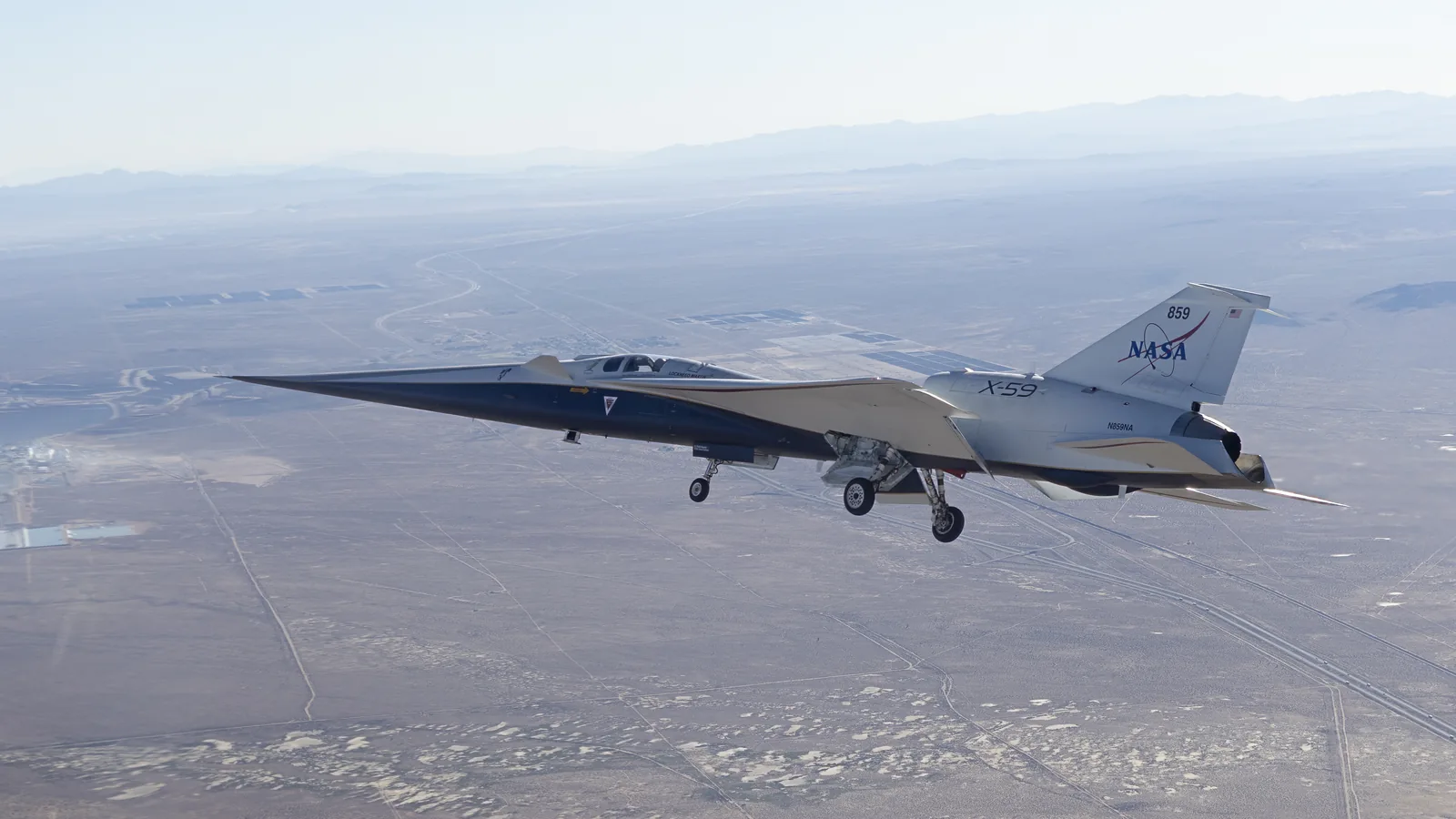
NASA's Quiet Supersonic Jet Has Flown 41 Times in Its First Year, Now It Has to Prove It's Quiet
One year after its first flight on Oct. 28, 2025, NASA's X-59 has flown 41 times, topped Mach 1.53 and climbed above 56,000 feet. Next up is acoustic testing to measure the soft sonic thump it's built to make instead of a boom.
So basically: NASA’s X-59, the weird looking jet with the super long nose that’s supposed to fly faster than sound without a loud sonic boom, just hit its one year anniversary. Since its first flight on Oct. 28, 2025, it’s flown 40 more times, gone as fast as Mach 1.53 and climbed past 56,000 feet.
Now comes the part that actually matters. NASA is moving into acoustic testing, which means finding out how loud this thing really is from the ground.
Why you can’t fly supersonic over your house
When a plane goes faster than the speed of sound, it pushes out shock waves that hit the ground as a sonic boom. It’s loud and startling, like an explosion going off overhead. That’s why the U.S. and other countries have banned commercial supersonic flights over land for about 50 years.
That’s a big reason the Concorde only really worked over the ocean, and why flying coast to coast still takes around five hours.
How the X-59 is supposed to fix that
The whole plane is shaped to break up those shock waves so they never pile up into one big boom. The X-59 is 99.7 feet long and 29.5 feet wide, and its thin, pointy nose makes up almost a third of that length.
The engine sits on top of the plane, and the bottom is kept smooth, both to stop the shock waves from merging behind it.
The goal is that when it’s cruising at Mach 1.4, which is around 925 mph, at 55,000 feet, people on the ground won’t hear a boom at all. NASA says they’ll hear a thump, about like a car door closing 20 feet away.
The pilot can’t see straight ahead
This is my favorite detail. Because the nose is so long, the cockpit sits almost halfway down the plane, and it has no front window. Instead, NASA built something called the eXternal Vision System, which is a set of high resolution cameras feeding a 4K screen in the cockpit.
So the pilot is flying a supersonic jet while looking forward through a TV. That’s wild to me.
What happened in year one
The first flight was low and slow, just checking that everything worked. Since then, the team has been pushing it to different speeds and heights so it’s ready for the real mission.
A few highlights:
- In late September it flew six times in one week, two each on Sept. 22, 24 and 25. That was a record for the program and brought it to 38 flights at the time.
- That same week it hit Mach 1.53, around 1,010 mph, which is faster than the Mach 1.4 it’ll normally cruise at.
- It has now topped 56,000 feet, above its planned 55,000 foot cruising height.
Lockheed Martin’s Skunk Works built it in Palmdale, California, and it flies out of NASA’s Armstrong Flight Research Center at Edwards, California.
What’s next
NASA is going to start recording the sound the X-59 makes when it goes supersonic, to see if the thump really is as soft as the computer models say. After that, the plan is to fly it over several U.S. cities and ask people what they heard. NASA will hand all of that to the FAA and international regulators so they can decide whether a new noise limit could replace the flat ban on supersonic flights over land. The mission runs through 2029.
One thing to know: the X-59 is not a prototype airliner. It’s a research plane. It only holds one pilot. Its job is to prove the shape works so companies can build quiet supersonic jets later.
My take
I’m genuinely rooting for this one. Forty one flights in a year with no big drama is solid for a brand new X plane. But the honest part is that none of it matters until the microphones say it’s quiet. If people on the ground really only hear a soft thump, the rule that’s been in place for 50 years could finally change, and coast to coast flights in a couple of hours stop being a fantasy. If it’s still loud, it’s a really cool looking dead end. We should find out over the next couple of years.
So basically — pass it on.
Daily Updates
Get new stories in your inbox
Near-future tech when it moves. Robots, space, EVs, AI. No spam.