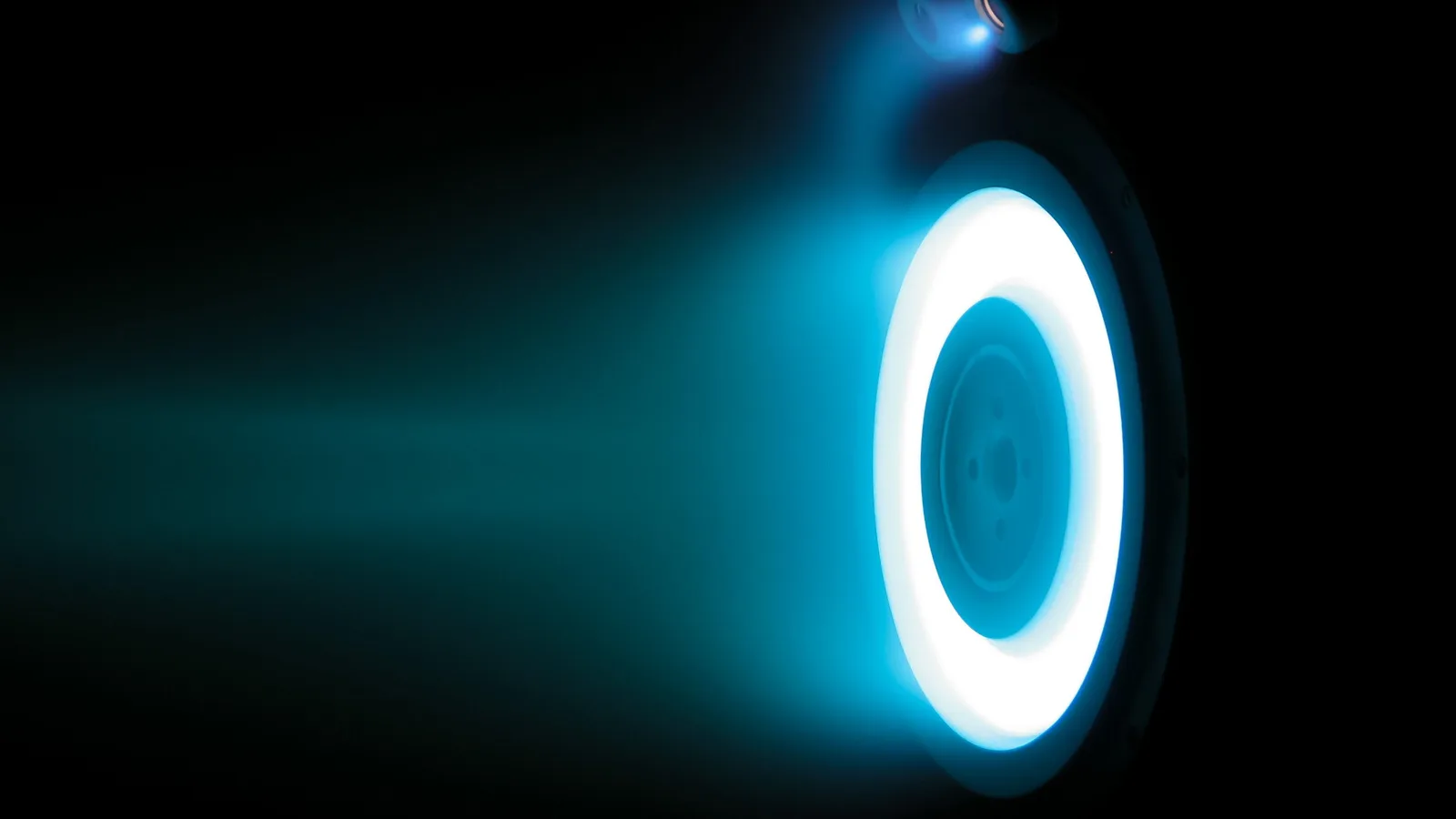
NASA's Psyche Is Now Thrusting Almost Nonstop to a Metal Asteroid, and Each Push Is About as Strong as Holding a AA Battery
NASA's Psyche spacecraft has switched its blue glowing xenon thrusters on for nearly 90% of the time until it reaches the metal-rich asteroid Psyche in summer 2029. The push is tiny, but it adds up to more than 100,000 mph.
So basically: NASA’s Psyche spacecraft just put its foot down. After swinging past Mars for a speed boost, it now has its thrusters running almost all the time, and NASA says they’ll stay on nearly 90% of the time until it reaches a strange metal-rich asteroid, also called Psyche, in the summer of 2029. The wild part is how weak each push is. NASA says it’s about the same force you’d feel holding one AA battery in your hand.
What changed
Psyche launched in October 2023. For the first part of the trip it only fired its engines here and there, mostly to line itself up for a flyby of Mars. That flyby happened on May 15, 2026, when it passed about 2,864 miles above the surface and used Mars’ gravity like a slingshot to pick up speed without burning fuel.
On Sept. 28, the team switched to nearly nonstop thrusting. Now it only takes a break once a week to check in with Earth.
”It’s now ‘pedal to the metal’ to the asteroid Psyche,” said Don Han, the mission’s navigation lead at NASA’s Jet Propulsion Laboratory.
A rocket that glows blue
Regular rocket engines burn a lot of fuel in big, fast bursts. Psyche doesn’t work like that. It uses solar power to run electric thrusters called Hall thrusters. They take xenon, which is a gas, give its atoms an electric charge, and fire them out the back using electric and magnetic fields. That creates a bright blue glow, which is what you’re seeing in the photo up top.
Each thruster pushes with up to 250 millinewtons of force. That’s the AA battery comparison. But in space there’s no air slowing you down, so a tiny push that never stops keeps adding speed day after day. NASA says at its fastest during the cruise, Psyche will be moving more than 100,000 mph compared to Earth.
It has four thrusters but only runs one at a time. The power comes from two big cross-shaped solar arrays with about 800 square feet of panels. Psyche left Earth with nearly 2,400 pounds of xenon in seven tanks, and after three years it has only used about a third of it.
There’s a catch with running on sunlight. The farther Psyche gets from the Sun, the less power its panels make. NASA says it will thrust at full power for about the next three months, then slowly throttle down to around half power.
The spin problem
When the xenon shoots out, the magnetic field makes it swirl a little. That swirl puts a tiny twisting force on the spacecraft. Left alone, Psyche would slowly drift off target.
So the spacecraft uses spinning reaction wheels inside to soak up that twist. Every few hours, it shuts off the thruster, turns, and runs a different thruster at low power for a few minutes to dump the built up spin.
”For a propulsion engineer, it’s a fun thing that you can only measure this torque in space and not on Earth, as it’s so small,” said Steve Snyder, the mission’s propulsion operations lead. NASA says this is the first time anyone has measured this effect on a Hall thruster at different power levels over this long a time in space.
Why go to a metal asteroid
The asteroid Psyche is about 173 miles across at its widest and sits in the main asteroid belt between Mars and Jupiter. Scientists think it might be part of the metal core of a baby planet that never finished forming. If that’s true, it’s about the closest we’ll get to seeing inside a rocky planet like ours.
When the spacecraft gets there in 2029, it’ll go into orbit and spend about two years mapping it.
My take
I love that the thing pushing this spacecraft to the asteroid belt is about as strong as a battery sitting in your palm. It’s the tortoise and the hare in space form. Slow and steady wins, it just takes a few years. And having to stop every few hours to fix a spin you can only measure in space is the kind of problem I’d never think of. When we finally see a metal world up close in 2029, I’ll be glued to it.
So basically — pass it on.
Daily Updates
Get new stories in your inbox
Near-future tech when it moves. Robots, space, EVs, AI. No spam.