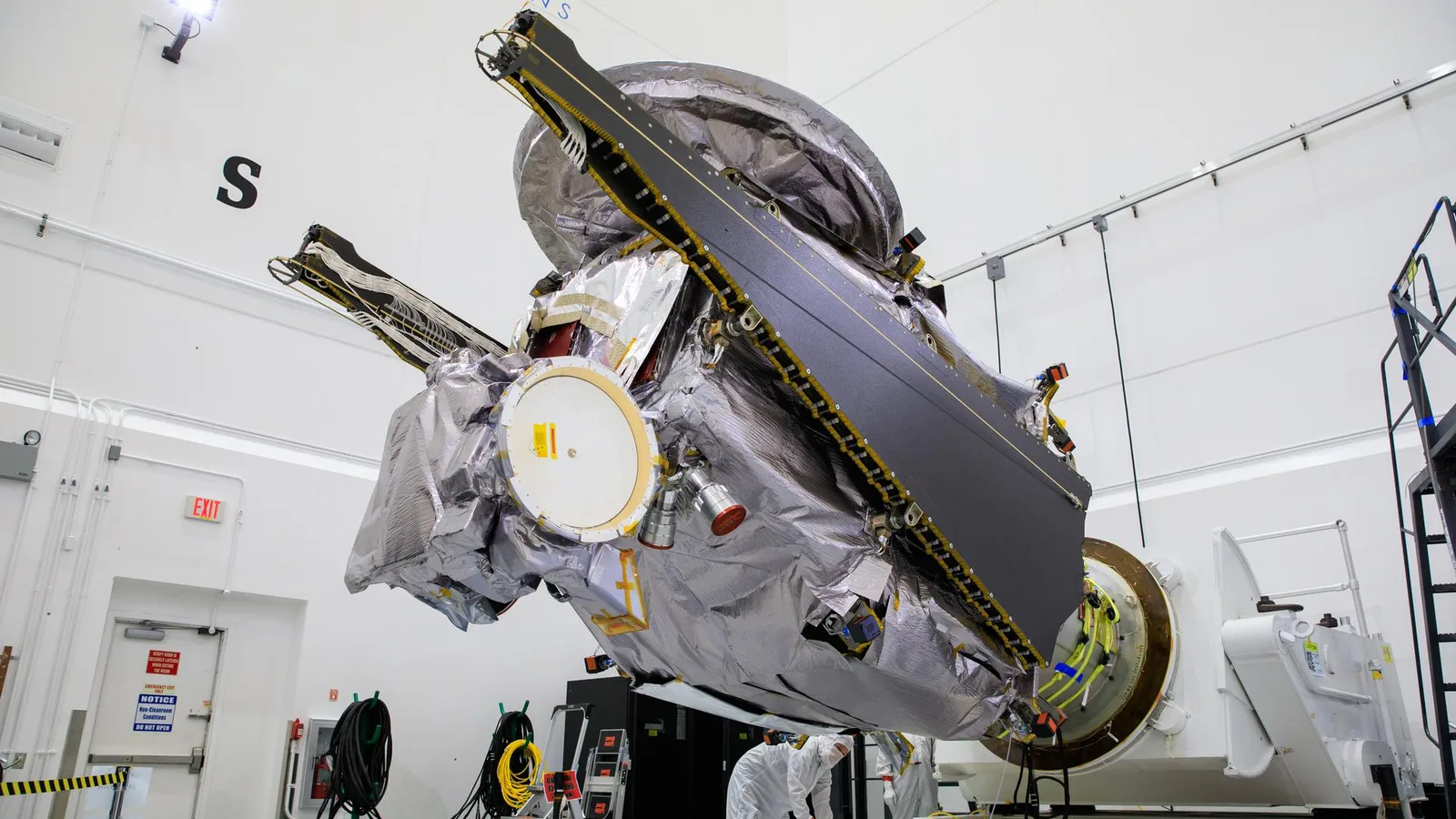
After 5 Years and 2.2 Billion Miles, NASA's Lucy Is the First Spacecraft Ever to Reach Jupiter's Trojan Asteroids
NASA said on Oct. 28, 2026, that its Lucy spacecraft has entered the Jupiter Trojans, a swarm of thousands of ancient asteroids sharing Jupiter's orbit. Its first close flyby, of the asteroid Eurybates, is set for Aug. 11, 2027.
So basically: NASA’s Lucy spacecraft just got somewhere no spacecraft has ever been. After five years and more than 2.2 billion miles, it has entered the Jupiter Trojans, a huge swarm of ancient asteroids that ride along in Jupiter’s orbit around the Sun.
NASA shared the news on Oct. 28, 2026.
What the Trojans are
Jupiter is so big that its gravity, mixed with the Sun’s, creates two calm “parking spots” in its orbit. Scientists call them Lagrange points. Thousands of asteroids have piled up in those two spots over billions of years.
- One group travels ahead of Jupiter, around a spot called L4
- The other group trails behind Jupiter, around L5
NASA calls them “islands of stability.” They’re about as far from Jupiter as Jupiter is from the Sun, roughly 484 million miles.
Lucy is now heading into the group in front, around L4.
Why no one’s been there before
Plenty of spacecraft have flown past Jupiter. Some have even used Jupiter’s gravity to slingshot farther out. But none of them ever went to the Trojans, because they’re nowhere near the planet itself. You have to want to go there on purpose.
Lucy is the first mission built just for that.
It’s emptier than you’d think
When you hear “swarm of asteroids,” you probably picture something from Star Wars, rocks everywhere, dodging left and right.
Not even close. NASA says the Trojans are on average more than 6 million miles apart. To Lucy, they’ll look like tiny dots of light moving against the stars until it gets right up close to one.
Out there it’s also cold and dim. Lucy is more than five times farther from the Sun than Earth is. NASA says the spacecraft has adjusted to the cooling and the low light, and everything is working as expected.
The tour schedule
Lucy isn’t stopping at one asteroid. It’s doing a whole road trip:
- Eurybates on Aug. 11, 2027, the first Trojan flyby
- Polymele in September 2027
- Leucus in April 2028
- Orus in November 2028
- Then back past Earth in 2030 for one last gravity boost
- And finally the pair Patroclus and Menoetius, two asteroids orbiting each other in the trailing group, in March 2033
That’s a mission running more than ten years from launch to its last stop. Each close flyby only lasts a few hours, so NASA’s team is already planning exactly how to use that time at Eurybates.
Why scientists care
The Trojans are thought to be leftovers from when the planets were forming about 4.5 billion years ago. They’ve been sitting out there, mostly untouched, the whole time.
Studying them up close should help scientists figure out how our solar system’s planets formed and how they ended up where they are today. It’s kind of like finding a time capsule that never got opened.
Fun fact: the mission is named after Lucy, the famous fossil of an early human ancestor. The idea is the same. Old bones tell you where people came from, and old asteroids tell you where planets came from.
What it’s done so far
Lucy already did some warm-up flybys of regular asteroids on the way out. In 2023 it flew past a small asteroid named Dinkinesh and found it had a little moon nobody knew about. In 2025 it passed another one named Donaldjohanson. Those were practice runs. The Trojans are the main event.
My take
I love missions like this because they’re so patient. Lucy launched in October 2021, and its big moment isn’t until August 2027, with the last stop in 2033. Somebody planned every one of those flybys years before any of it happened, and it’s all working. Getting to a place no spacecraft has ever been, 2.2 billion miles later, with everything still running, is about as cool as space gets.
So basically — pass it on.
Daily Updates
Get new stories in your inbox
Near-future tech when it moves. Robots, space, EVs, AI. No spam.