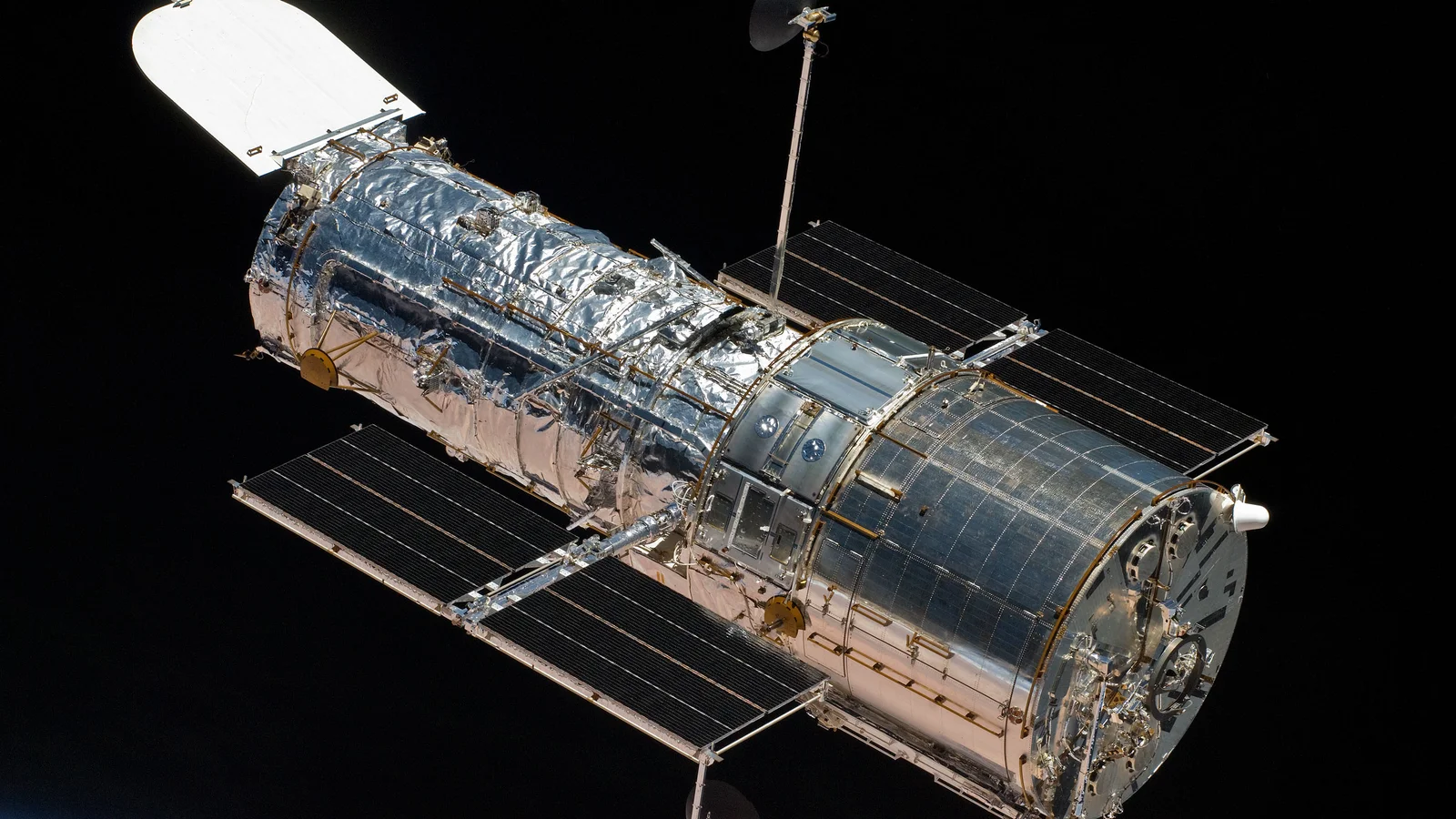
NASA Wants a Company to Give Hubble a Push Before It Falls Out of the Sky
NASA put out a Request for Information on Oct. 29, 2026 asking companies how they could boost the Hubble Space Telescope to a higher orbit, service it, or bring it down safely. Hubble is expected to re-enter around 2033 to 2034, so a mission would need to fly by 2032.
So basically: The Hubble Space Telescope is slowly sinking, and NASA just asked private companies to pitch ideas for saving it. On Oct. 29, 2026, NASA put out what’s called a Request for Information, basically a public “what could you do for us?” to the space industry.
NASA wants to hear about three possible jobs:
- Boost Hubble to a higher orbit so it can keep doing science longer
- Service Hubble to make it better than it is now
- Or, when the time comes, bring it down safely with a controlled re-entry or move it out of the way
Why Hubble needs help in the first place
Here’s the part a lot of people don’t know. Hubble has no engine. It can’t push itself back up. Every satellite in low orbit drags through a tiny bit of air up there, and over time that drag pulls it lower and lower.
The space shuttle used to fix that. Astronauts flew up five times to repair and upgrade Hubble, and the shuttle could give it a boost while it was there. The last of those trips was in May 2009. The shuttle retired in 2011, and nobody has touched Hubble since.
NASA’s own math says Hubble will likely fall back into the atmosphere somewhere in the 2033 to 2034 window. So if anybody is going to boost it, NASA says the mission would need to happen by 2032. That’s about six years away, which is not a lot of time in the space world.
What NASA is saying
NASA Administrator Jared Isaacman said Hubble “still has important science ahead of it” and that if there are “innovative and cost-effective ways” to keep an asset that’s already up there working, “we owe it to the American taxpayer” to look at them.
That’s not a random opinion from him either. Before he ran NASA, Isaacman pushed hard for a private mission to boost Hubble using a SpaceX Dragon. NASA passed on that idea back in 2024. Now he’s the one running the agency and the question is back on the table, this time open to any company.
Nicky Fox, who runs NASA’s science division, said commercial companies have “rapidly evolved” when it comes to catching and servicing satellites in orbit. That’s true. A few years ago a robot spacecraft docking with an old satellite was a big headline. Now it’s a real business.
How long companies have
The Request for Information stays open until 3 p.m. EST on Monday, Nov. 30, 2026. This isn’t a contract yet. It’s NASA gathering ideas and seeing who’s actually capable before it decides anything.
Why this matters
Hubble has been up there for more than 35 years. It launched in 1990 and it’s still making new discoveries. Just this week NASA and the European Space Agency put out a picture of the Cat’s Head Nebula using Hubble and Webb together.
People think Webb replaced Hubble, but they don’t really do the same job. Webb mostly sees in infrared. Hubble sees visible light and ultraviolet, the kind of light our eyes understand. Losing Hubble would leave a hole until NASA’s next big flagship telescope is ready, and that’s still a long way off.
There’s also the safety side. Hubble is about the size of a school bus. If it can’t be saved, NASA still needs a plan to bring it down in a controlled way instead of letting it fall wherever it wants.
My take
I love this. Hubble is one of the coolest things humans ever built, and it’s wild to me that the only reason it might die is that it’s slowly drifting down with no way to push back up. Somebody flying up there and giving it a shove sounds like a movie, but the tech to do it is real now. Six years isn’t much time, though. I hope a company steps up fast, because I’d rather see Hubble get another 10 years than watch it burn up over the ocean in 2033.
So basically — pass it on.
Daily Updates
Get new stories in your inbox
Near-future tech when it moves. Robots, space, EVs, AI. No spam.