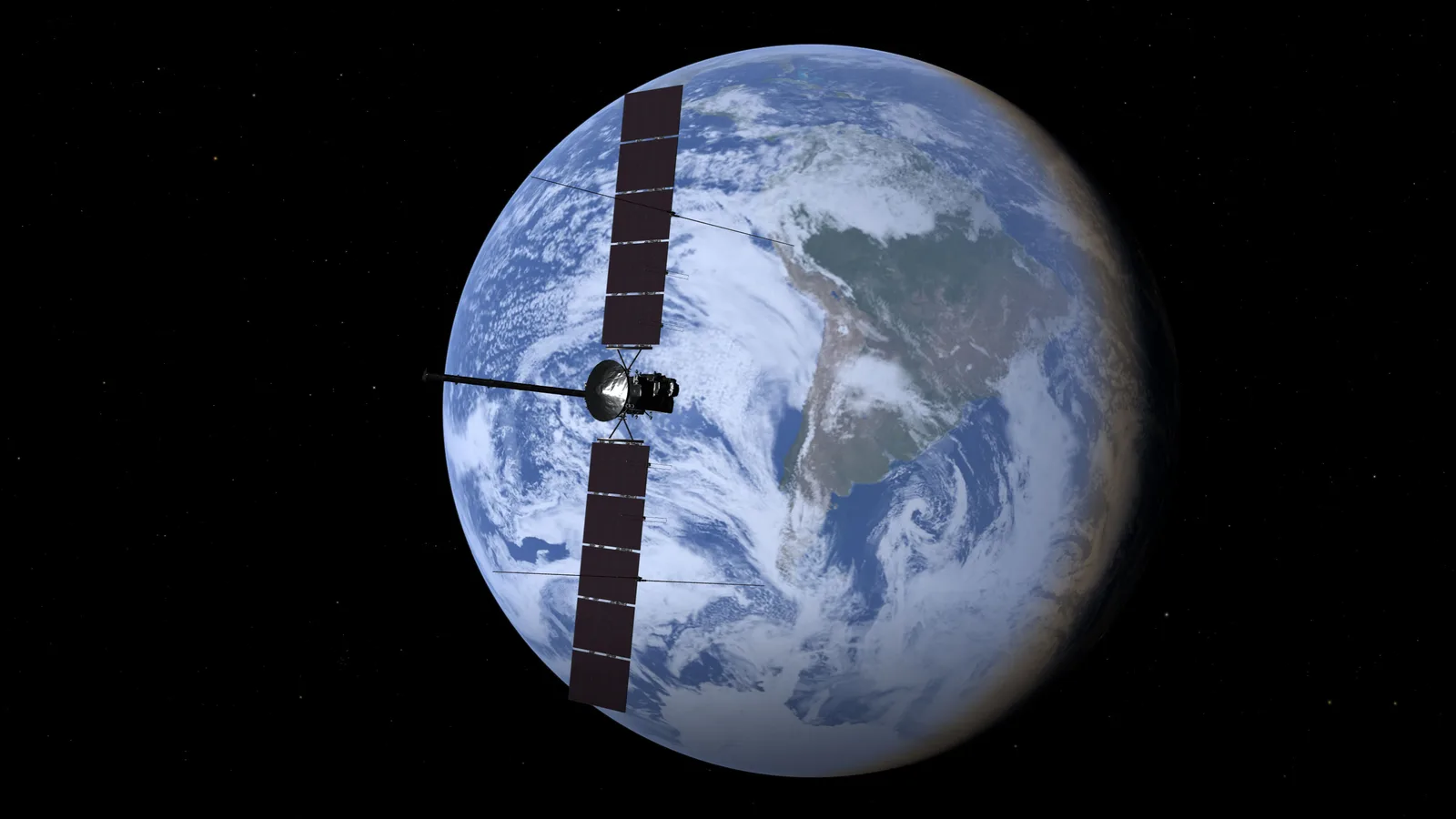
NASA's Biggest Deep Space Probe Is Coming Back Past Earth on Dec. 3
Europa Clipper will pass about 1,950 to 2,133 miles from Earth on Dec. 3, 2026, using our gravity to slingshot toward Jupiter. All nine science instruments will be on, and people in southern Europe and Africa with big hobby telescopes may be able to spot it.
So basically: NASA’s Europa Clipper, the biggest spacecraft NASA has ever sent into deep space, is swinging back past Earth next week. On Thursday, Dec. 3, it’ll come within about 1,950 to 2,133 miles of us, with closest approach west of Africa at 3:14 p.m. EST. Earth’s gravity will fling it toward Jupiter, where it’s supposed to start orbiting in April 2030.
Why it’s coming back
Europa Clipper launched on a SpaceX Falcon Heavy in October 2024. Even with that much rocket, it couldn’t go straight to Jupiter with enough speed. So NASA planned a long looping path that uses planets to steer it.
This trick is called a gravity assist. The spacecraft dips into a planet’s gravity, follows the curve, and shoots back out on a new path, moving faster than before. It saves a huge amount of fuel.
Europa Clipper already did one of these at Mars in March 2025, passing just 550 miles above the surface. That one slowed it down and reshaped its orbit around the Sun. This time Earth speeds it up.
”We’re coming down into the gravity well of Earth, following its curve, and shooting out again,” said Robert Pappalardo, the mission’s project scientist at NASA’s Jet Propulsion Laboratory.
The numbers
- The whole trip to Jupiter is about 1.8 billion miles
- The spacecraft weighs about 12,800 pounds
- Its solar arrays stretch about 100 feet tip to tip, longer than an NBA court
- All nine science instruments will be on during the flyby
Earth is the test run
NASA isn’t wasting the pass. The team will point the instruments at Earth and compare what they see to data we already have. If a reading is off, they can fine tune it now instead of finding out at Jupiter.
That matters most for the magnetometer. At Europa, it’ll measure how Jupiter’s magnetic field interacts with the moon. That’s how scientists hope to confirm there’s a huge salty ocean under Europa’s ice. Earth’s magnetic field is well known, so it’s a perfect way to calibrate it.
The E-THEMIS heat camera will scan Earth every eight hours on the way in. At Europa, it will hunt for warm spots where liquid water could be close to the surface, or may have even broken through.
The ultraviolet instrument will also look at the outer edge of Earth’s atmosphere while NASA’s Lunar Reconnaissance Orbiter looks at the same region from the Moon. Europa has its own thin layer of escaping gas, so it’s practice for doing the same thing at Jupiter.
Can you see it?
Maybe, if you’re in the right spot with the right gear. NASA says it should be visible with relatively large hobby telescopes for people near the closest approach path, mostly in southern Europe and Africa. For most of us in the U.S., the NASA updates will be the way to follow it.
What happens at Jupiter
When it gets there in 2030, Europa Clipper will use a pass by Ganymede, Jupiter’s biggest moon, to slow down and get captured into orbit. Then it will fly past Europa dozens of times. The goals are to measure how thick the ice shell is, figure out what Europa is made of, and map its surface.
It’s not looking for life directly. It’s checking whether that hidden ocean has what life would need: water, energy and the right chemistry.
My take
I love that NASA basically uses planets as free boosters. The spacecraft left Earth two years ago, went out to Mars, and now it’s coming right back past us to grab more speed. That’s some serious math working perfectly.
And Europa is one of the best shots we have at finding a place where life could exist today, not billions of years ago. If that ocean is real and has the right ingredients, it changes how we think about the whole universe. Dec. 3 is the last time this spacecraft will be anywhere near home, so it’s a cool one to follow.
So basically — pass it on.
Daily Updates
Get new stories in your inbox
Near-future tech when it moves. Robots, space, EVs, AI. No spam.