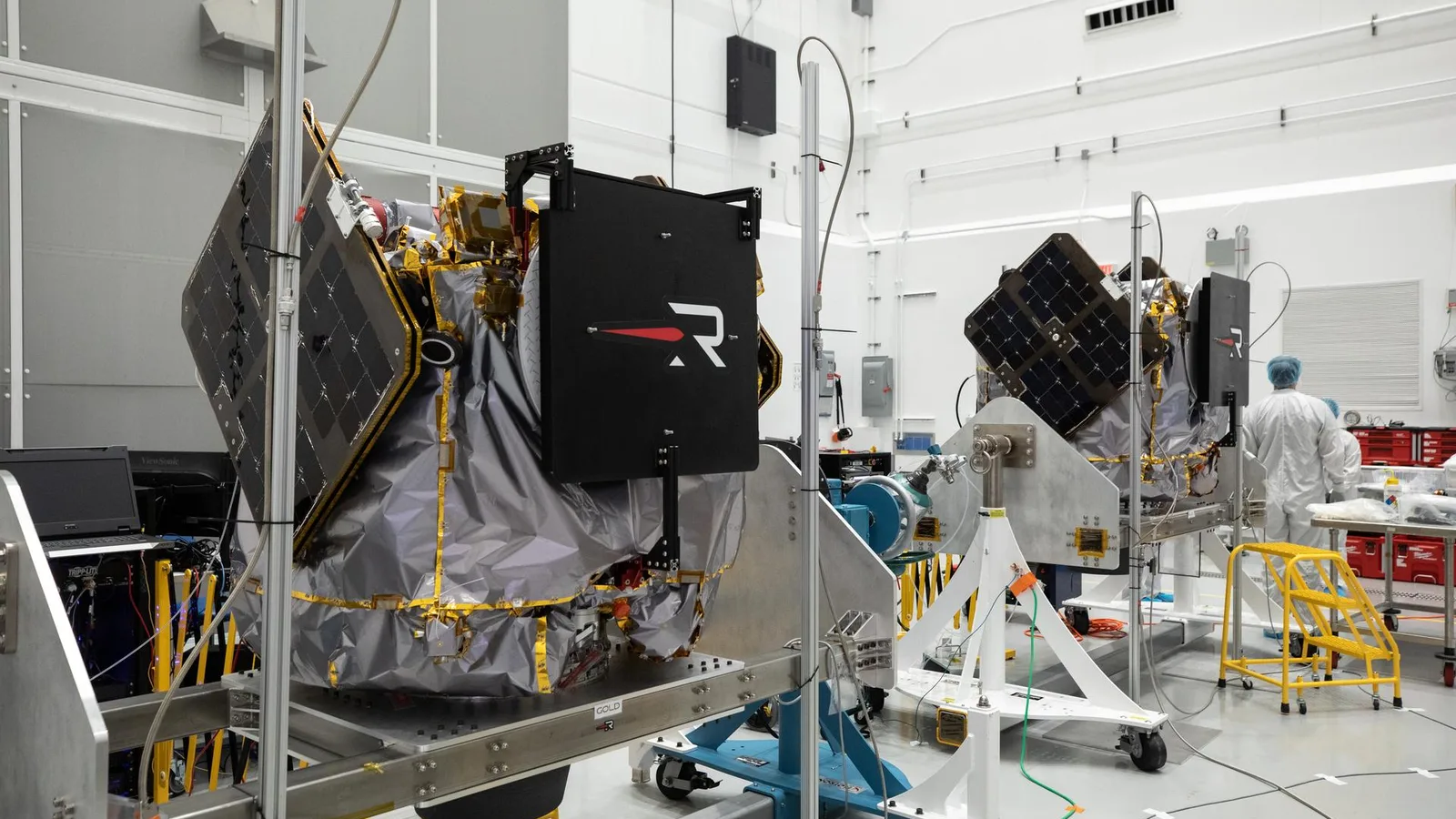
NASA's Twin ESCAPADE Spacecraft Are About to Do Something No Mars Mission Has Done: Fire Their Engines While Swinging Past Earth
On Nov. 7 and Nov. 9, 2026, NASA's two ESCAPADE spacecraft will fly 600 to 1,100 miles above Earth and burn their engines for about 9 minutes each, using a powered flyby to slingshot toward Mars. They're due at Mars in September 2027.
Update, Nov. 17: Both burns worked. Blue fired on Nov. 7 and Gold on Nov. 9, and both spacecraft are now headed for Mars, due in September 2027. (NASA)
So basically: NASA has two small spacecraft called ESCAPADE heading back toward Earth right now, on purpose. This weekend they’ll swing past our planet, fire their engines at the closest point, and use the combo to fling themselves toward Mars.
NASA says no Mars-bound spacecraft has ever pulled off a move like this before.
When it happens
There are two spacecraft, and each one gets its own turn:
- Spacecraft one: engine burn starts around 4:51 a.m. EST on Saturday, Nov. 7
- Spacecraft two: engine burn starts around 5:51 a.m. EST on Monday, Nov. 9
Each burn lasts about 9 minutes. Both happen while the spacecraft are flying over southern Australia.
At closest approach, they’ll be somewhere between 600 and 1,100 miles above the surface. That’s higher than most satellites in orbit around Earth.
What a “powered flyby” means
Spacecraft use planets as slingshots all the time. You fly close, the planet’s gravity speeds you up and bends your path, and you head off somewhere new without burning much fuel.
ESCAPADE is doing that plus firing its engine right at the closest point. Rocket scientists call this an Oberth maneuver. An engine burn gives you more of a boost when you’re already moving super fast deep in a planet’s gravity, so it’s the best possible time to fire.
Here’s what NASA says the burn will do:
- Speed each spacecraft up by more than 1,000 miles per hour
- Take them from about 6.3 miles per second to about 6.7 miles per second
- That’s roughly Mach 30 to Mach 31
NASA’s comparison: at that speed, you could fly from Washington, D.C., to San Francisco in less than 7 minutes.
Why they took the long way
Normally, Mars missions launch when Earth and Mars line up just right, which only happens about every 26 months. That gives you the shortest trip and burns the least fuel.
ESCAPADE didn’t do that. It launched in November 2025, when Earth and Mars were on opposite sides of the Sun. So instead of heading straight to Mars, the pair flew a big kidney bean shaped loop around a spot in space called Earth-Sun Lagrange point 2, about a million miles out, and then came back home.
Now the planets are lined up again, and the spacecraft are right where they need to be to use Earth as a launch ramp.
Bonus: that loop took them through a far part of Earth’s magnetotail, the part of our planet’s magnetic bubble that gets stretched out by the solar wind. NASA says no spacecraft had directly explored that region before, and the team saw some interesting activity they plan to share soon.
What they’ll do at Mars
After the flybys, it’s about a 10 month cruise. The arrival dates are Sept. 7 and Sept. 9, 2027.
Once there, ESCAPADE becomes the first mission to fly more than one spacecraft in formation around Mars. The goal is to study how the solar wind, a stream of material blasting off the Sun at about a million miles per hour, hits Mars and strips away its atmosphere over time.
Mars used to have a thicker atmosphere and probably liquid water. Figuring out how it lost all that is one of the biggest questions about the planet. Two spacecraft watching from two spots at once can see things one spacecraft can’t.
Can you see it
Kind of. Each spacecraft is about the size of a refrigerator, so you’ll need a telescope. NASA says they should be visible over the western U.S. in the hours before each burn. The first should be brightest between midnight and 1 a.m. PST on Nov. 7, and the second between 1 and 2 a.m. PST on Nov. 9. NASA’s JPL Horizons system can give you exact sky positions.
After the burns, the team will spend several days checking the aim, then make small course corrections on the way.
My take
I love that this mission basically missed its normal launch window and NASA said fine, we’ll go park in space for a year and come back. Using Earth as a slingshot and firing the engine at the perfect moment is a new trick for Mars missions, and if it works, it means future missions don’t have to sit on the ground waiting 26 months for the planets to line up. I’ll be watching for the “burn complete” update Saturday morning.
So basically — pass it on.
Daily Updates
Get new stories in your inbox
Near-future tech when it moves. Robots, space, EVs, AI. No spam.