NASA's Titan Drone Just Got Its Eyes: Seven Cameras Built for a Moon at Minus 290 Degrees
NASA's Dragonfly rotorcraft now has all seven of its DragonCam science cameras installed. They'll photograph Saturn's moon Titan from the air and the ground, including through nights that last almost eight Earth days. Dragonfly launches in July 2028 and gets to Titan in late 2034.
So basically: NASA is building a nuclear powered drone the size of a car to fly around Saturn’s biggest moon, Titan. This week it got its eyes. All seven of Dragonfly’s science cameras, called DragonCam, are now installed and tested on the rotorcraft. They have to work at about minus 290 degrees Fahrenheit, and through Titan nights that last almost eight Earth days. Dragonfly launches in July 2028 and gets to Titan in late 2034.
What Dragonfly is
Dragonfly is a rotorcraft lander. Think of a giant drone with eight rotors that can land, sit and study the ground, then take off and fly to the next spot. It’s being built at the Johns Hopkins Applied Physics Laboratory (APL) in Laurel, Maryland.
Titan is a weird place to fly, but in a good way. Its atmosphere is a lot thicker than Earth’s and its gravity is way weaker, so flying there takes less effort than it does here. The surface has dunes, lakes of liquid methane and a lot of organic chemistry, which is why scientists want to get up close and grab samples.
The seven cameras
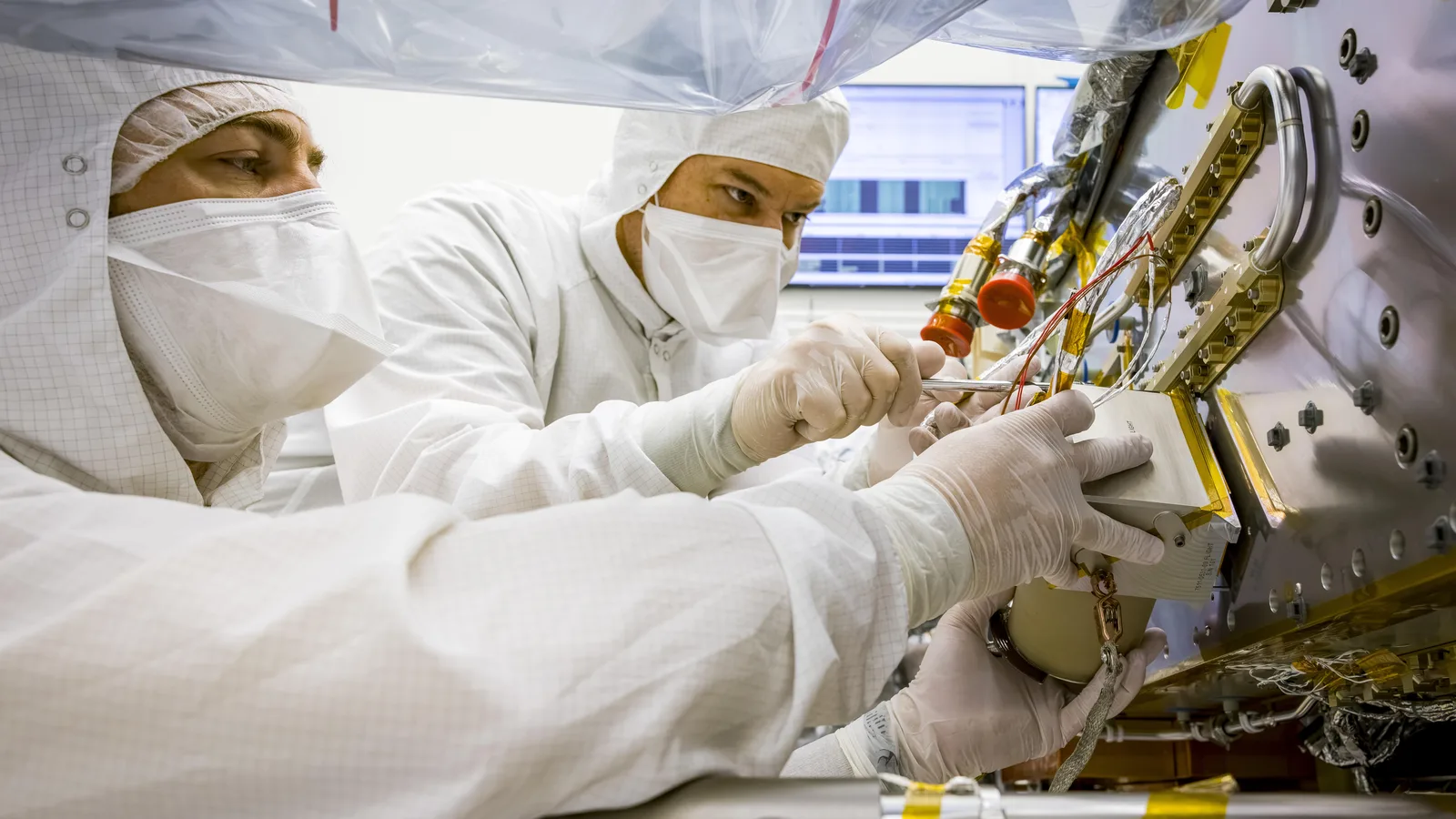
DragonCam was built by Malin Space Science Systems, the same company behind cameras on a long list of Mars missions. By mid November, all seven cameras had been put in their insulated housings, tested and added to the rotorcraft. Each one looks out through a window in a foam enclosure that keeps the cold out of the cameras and the rest of the vehicle.
Here’s how they’re split up:
- Two forward cameras, a wide angle with a 90 degree view and a medium angle that zooms in on part of that view. Together they give a 3D look at what’s in front of Dragonfly.
- Two side cameras that help build full panoramas of the landscape.
- Two downward cameras that check whether a landing spot is safe for the drill and the seismometer.
- One microscopic imager aimed at the drill site, sharp enough to pick out sand grains a millimeter across.
Dragonfly also has two navigation cameras from the same company that were installed over the summer to help it fly.
Lights for the long night
Titan is dark a lot of the time, and even daytime is dim because of the thick haze. So APL built an LED light array that covers everything from infrared to ultraviolet.
The lights do a few jobs. They show the real color of the ground at a sampling site, which helps scientists guess what it’s made of. They also let the team see Titan the way a human eye would. And under ultraviolet light, some organic molecules glow. NASA says that during those eight day nights, DragonCam might be able to spot them that way.
The first test pictures are already in. The wide angle cameras shot a panorama of the APL cleanroom on Nov. 9, right after they were installed. The images have a yellow tint because the cameras see light differently than we do.
What’s next
DragonCam was the first science instrument to arrive. The rest are coming over the next several months:
- DrACO, the drill that grabs surface samples
- DraMS, a mass spectrometer that figures out what the samples are made of
- DraGNS, a gamma ray and neutron spectrometer that reads the ground’s chemistry without touching it
- DraGMet, a weather and seismology package
Dragonfly is scheduled to launch in July 2028 on a SpaceX Falcon Heavy. The trip takes about six years, so it won’t reach Titan until late 2034.
”These will be our eyes to see and explore this whole new world,” said Michael Ravine of Malin Space Science Systems, who leads DragonCam’s development.
My take
I love this mission. We flew a tiny helicopter on Mars with Ingenuity and everybody lost their minds, and now NASA is sending something the size of a car to a moon where it rains methane. The part that got me is the eight day night. Imagine designing a camera that has to sit in minus 290 degree darkness for over a week and then wake up and work. The cameras being done this early is a good sign too. A lot of big missions slip because parts show up late, so seeing the first instrument installed almost two years before launch makes me feel better about that July 2028 date. It’s a long wait until 2034, but I’ll be watching.
So basically — pass it on.
Daily Updates
Get new stories in your inbox
Near-future tech when it moves. Robots, space, EVs, AI. No spam.