NASA's New Gamma Ray Telescope Is Going After a 50 Year Antimatter Mystery
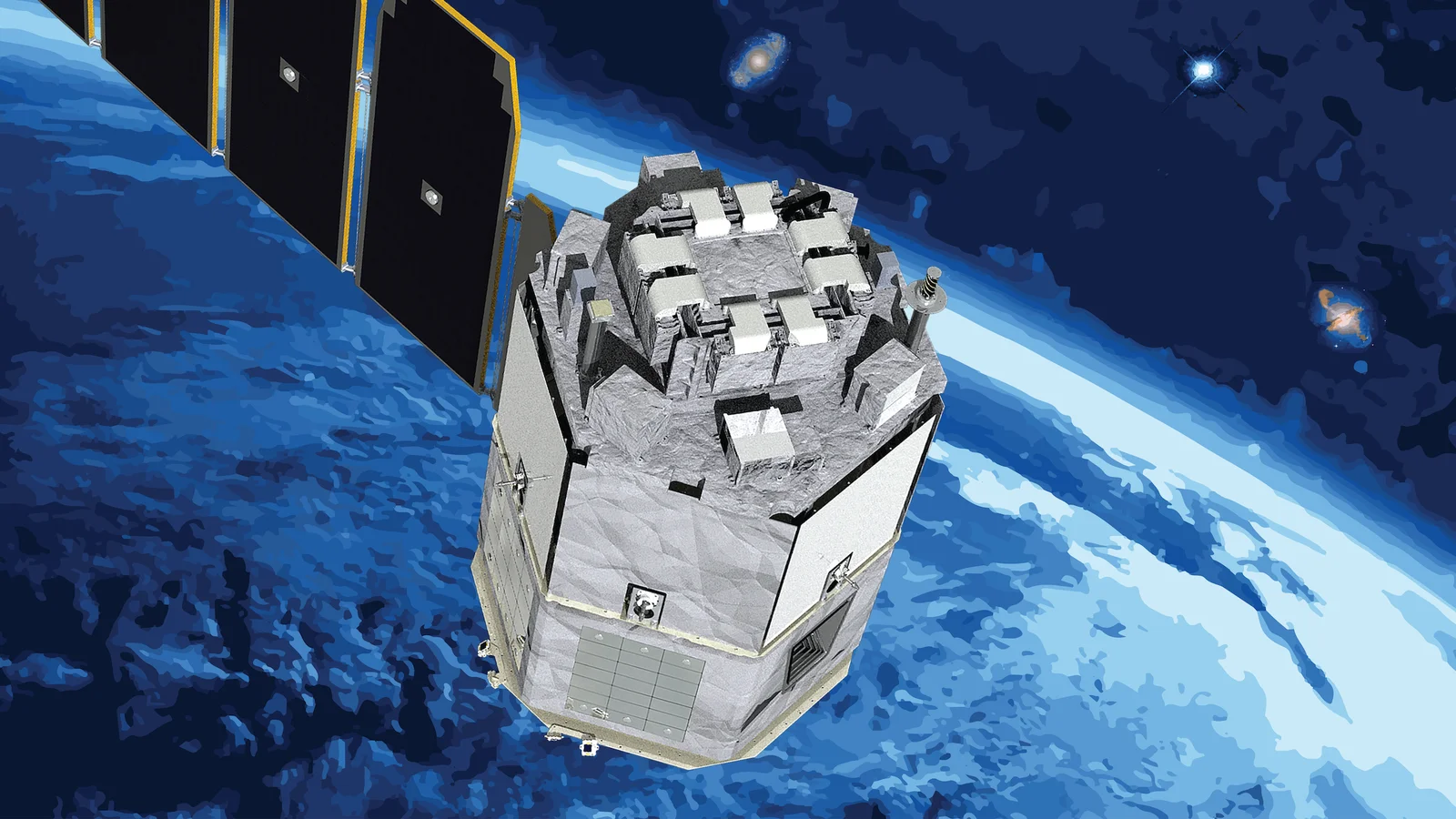
The science payload for NASA's COSI mission just arrived at Northrop Grumman in Virginia to be bolted onto its spacecraft. The telescope launches on a SpaceX Falcon 9 in August 2027 to find out where the antimatter near the center of our galaxy comes from.
So basically: Something near the center of the Milky Way is making antimatter, and nobody knows what. Astronomers have seen the signal since the 1970s. NASA’s next telescope built to solve it, COSI, just took a big step. Its science instrument arrived at Northrop Grumman’s satellite factory in Sterling, Virginia, where it’ll get attached to the spacecraft before launching on a SpaceX Falcon 9 in August 2027.
What’s the antimatter mystery?
Every normal electron has an antimatter twin called a positron. When an electron and a positron meet, they wipe each other out in a flash of gamma rays at one very specific energy, 0.511 MeV.
Telescopes have picked up that exact flash coming from the middle of our galaxy for about 50 years. That means positrons are being made out there, a lot of them, all the time. What’s making them is still an open question. It could be exploding stars, black holes, neutron stars, or something nobody has thought of yet.
COSI’s job is to map where that glow is actually coming from, sharply enough to start pointing at suspects.
What COSI actually is
COSI stands for Compton Spectrometer and Imager. It’s a gamma ray telescope, and gamma rays are the highest energy kind of light there is. COSI looks at a band between 0.2 and 5 MeV, which is up to millions of times more energetic than the light your eyes can see.
You can’t focus gamma rays with a mirror like a normal telescope. They just punch right through. So COSI uses a different trick. Inside it are 16 germanium crystals, each about the size of a coaster. When a gamma ray hits, it bounces around inside the crystals like a pool ball. COSI records where each bounce happened and how much energy it dropped, then works backward to figure out where in the sky the gamma ray came from.
Those crystals only work when they’re freezing cold, almost minus 200 degrees Celsius. Older instruments did that with liquid nitrogen, which eventually runs out. COSI uses a mechanical cooler instead, so it doesn’t have a tank to run dry.
It also sees a huge chunk of sky at once, about 25% of it.
The other stuff it’ll look for
The antimatter question is the headline, but COSI has a few more jobs:
- Find where new elements are being made in the galaxy, using the gamma ray glow from radioactive atoms left over from exploding stars
- Measure gamma rays coming off black holes in a way no telescope has done before
- Catch short gamma ray bursts and tell other telescopes where to look, which helps when something like a gravitational wave shows up
Where it is right now
The COSI team packed the instrument up at the University of California, Berkeley’s Space Sciences Laboratory, and it was loaded on a truck on November 2. Now that it’s at Northrop Grumman, engineers will mount it on a LEOStar-2 spacecraft and run it through vibration and thermal tests, basically shaking and baking it to make sure it survives launch and space.
The numbers
- About $145 million mission cost, not counting launch
- About $69 million for the SpaceX launch contract
- Picked by NASA in 2021 out of 18 proposals
- Originally planned to launch in 2025, now set for August 2027
The team also spent decades testing earlier versions on giant science balloons, most recently in 2016.
My take
I love missions like this. It’s not flashy like a Moon landing, but it’s going after a question that’s been sitting there unanswered since before I was born. Something in our own galaxy is cranking out antimatter and we still can’t say what. The detector design is clever too. Instead of trying to focus gamma rays, it just watches them ricochet and does the math. If COSI can finally point at the source, that’s a real answer to a 50 year old riddle for a pretty small price tag by NASA standards.
So basically — pass it on.
Daily Updates
Get new stories in your inbox
Near-future tech when it moves. Robots, space, EVs, AI. No spam.