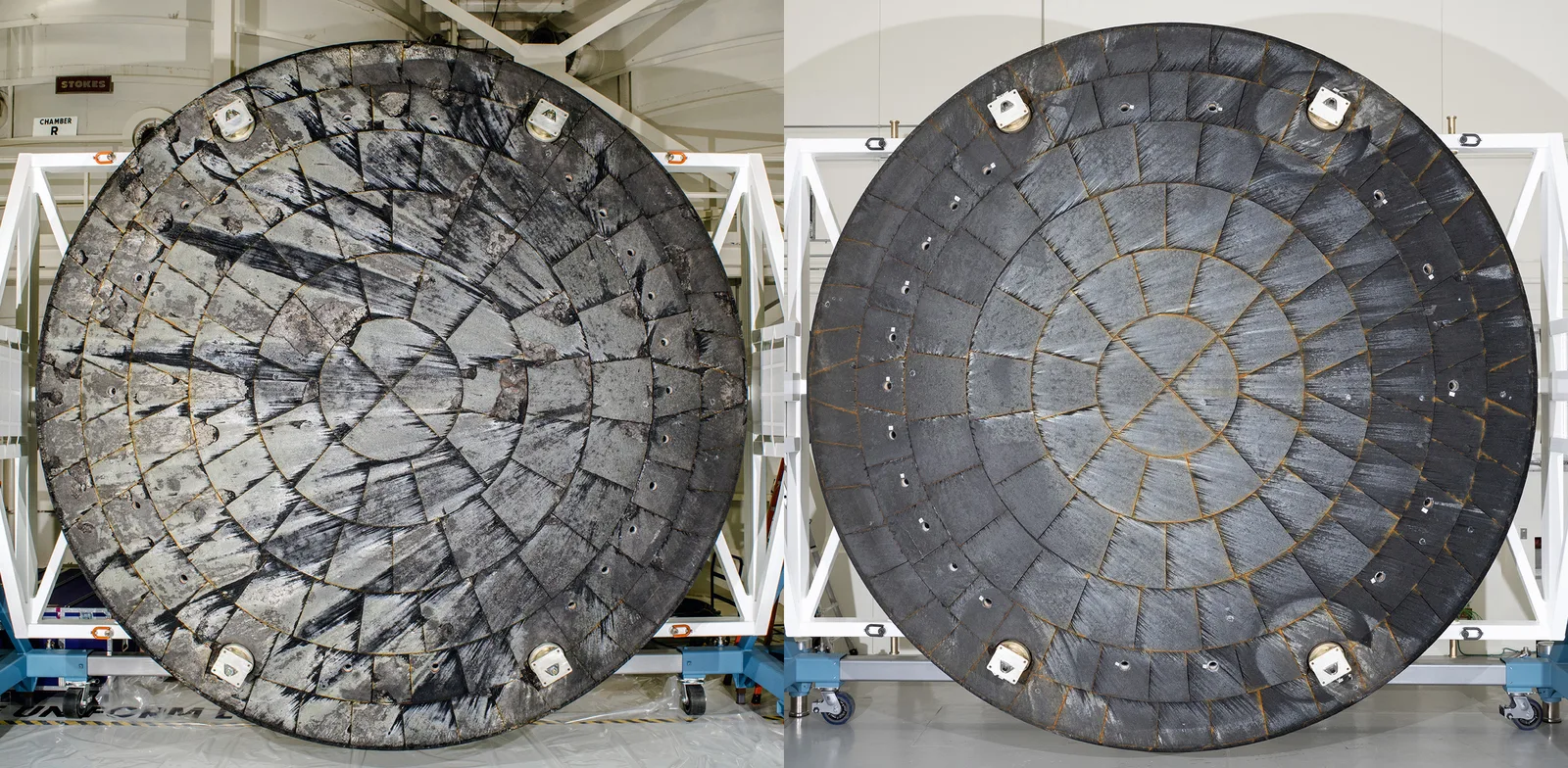
NASA's Artemis II Heat Shield Came Back With 9 Damaged Spots. Artemis I Had 103
NASA finished its deep dive on Orion's heat shield after Artemis II. A shorter reentry path cut cracking and char loss by a factor of ten, and the cabin stayed in the mid 70s while the outside topped 4,000 degrees.
So basically: NASA says the heat shield on Orion did its job when the Artemis II crew came home from the Moon in April. After months of scanning it and cutting samples out of it, engineers found just 9 spots where pieces of the charred outer layer came off. On Artemis I, the uncrewed test flight in 2022, there were 103. NASA posted the results on Oct. 15.
This was the biggest worry going into Artemis II, so it’s a real relief.
Why everyone was nervous
When Orion came back from Artemis I, the heat shield looked rough. It’s built from blocks of a material called Avcoat that is supposed to slowly char and burn away as it heats up. That part is normal. What wasn’t normal was chunks cracking and breaking off in spots instead of wearing down smoothly.
NASA spent a long time figuring out why, including a lot of testing in the arc jet facilities at Ames Research Center in California, which blast material samples with superheated gas. Instead of building a brand new heat shield for Artemis II, NASA kept the design and changed how Orion comes home. They shortened how far the capsule is allowed to travel between hitting the atmosphere and splashing down. Less distance means less time sitting in the temperature range where the Artemis I damage happened.
Some outside critics thought that was a risky call with four astronauts on board. So this report was the one a lot of people were waiting on.
What the reentry looked like
From NASA’s numbers:
- Orion hit 39 times the speed of sound
- The outside got hotter than 4,000 degrees Fahrenheit
- Inside, the cabin stayed in the mid 70s
- It hit the atmosphere within 192 feet of its target point
- It splashed down 0.59 miles from where NASA predicted, off San Diego
The 192 feet figure stands out. That’s a capsule coming back from the Moon and hitting its mark closer than the length of a football field.
How they checked it
Divers took photos of the heat shield right after splashdown, and the recovery ship crew looked it over too. Then it went back to Kennedy Space Center in Florida, and later to Marshall Space Flight Center in Huntsville, Alabama. Since August, engineers there have been pulling samples and running X-ray scans to see inside the material.
The shield is made of 186 separate Avcoat blocks. NASA says the seams between those blocks and the areas around the big bolts held up the same way they did on Artemis I, which is what you want.
The backshell, the sloped sides of the capsule covered in about 1,300 ceramic tiles, showed no signs of overheating. That includes the spots around the windows, vents, thrusters, and side hatch, which are the usual weak points.
NASA isn’t totally done. They’re comparing laser scans of the surface from before and after the flight to measure exactly how much material burned away, and they’ll check that against their predictions.
What changes for Artemis III
The Artemis III heat shield is already a little different. NASA changed how the Avcoat blocks are made so they’re more uniform and let gas escape more evenly, which ties back to what went wrong on Artemis I. That shield was attached to the new Orion in early July, and the capsule has now been powered up for the first time.
Artemis III flies next year, but it’s not a Moon landing anymore. It stays in low Earth orbit. NASA astronauts Randy Bresnik, Frank Rubio, and Andre Douglas, plus ESA’s Luca Parmitano, will practice meeting up with lander test versions from SpaceX and Blue Origin. The first landing is now planned for Artemis IV in 2028.
My take
I honestly thought there was a decent chance we’d get a report that said it held, but barely. Going from 103 damaged spots to 9 just by changing the flight path is a big deal. It means NASA’s fix actually worked and they didn’t just get lucky.
The detail I keep coming back to is the cabin. Normal room temperature inside while the outside was over 4,000 degrees, on the way home from the Moon.
Artemis III stays close to Earth, so the next real Moon return is Artemis IV. But the scariest open question from the last few years now has a pretty good answer.
So basically — pass it on.
Daily Updates
Get new stories in your inbox
Near-future tech when it moves. Robots, space, EVs, AI. No spam.