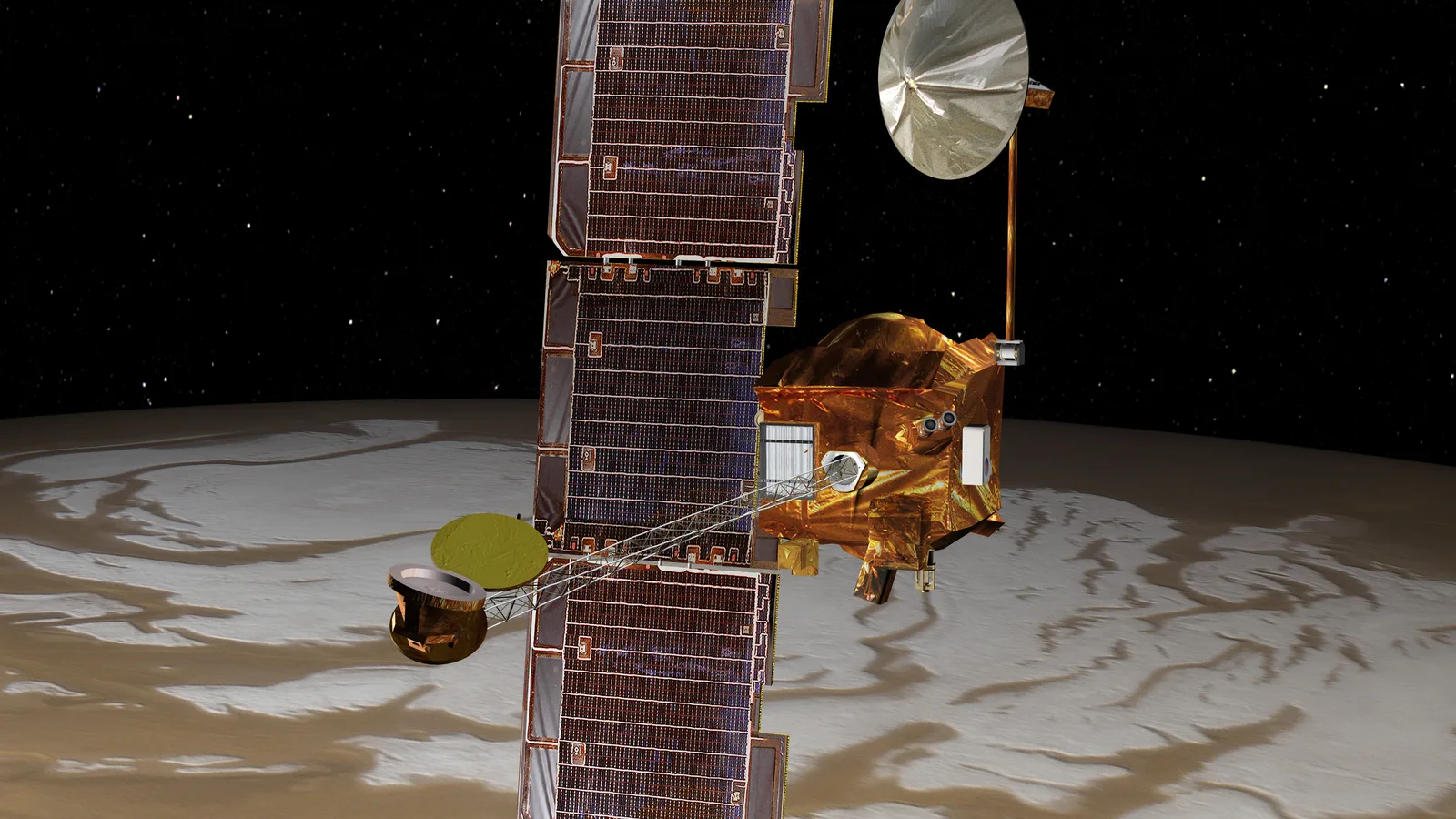
NASA's 25-Year-Old Mars Orbiter Just Lost Another Wheel and Has Maybe Two Months of Fuel to Spare
One of the three working reaction wheels on NASA's 2001 Mars Odyssey stopped spinning in early November. Without it, the orbiter only has enough hydrazine to point itself for one to two months. Separately, Perseverance paused science after both of its UHF radios acted up.
So basically: NASA’s 2001 Mars Odyssey, the longest-running spacecraft ever at Mars, has a broken reaction wheel. It needs three working wheels to point itself, and now it might be down to two. Without that third wheel, it has to steer with its thrusters, and NASA says it only has enough fuel to do that for one to two months. On the same day, NASA said Perseverance has paused science because both of its main data radios are acting up.
What a reaction wheel does
Spacecraft don’t have anything to push against, so they turn themselves with spinning wheels inside the body. Speed a wheel up one way and the whole spacecraft slowly turns the other way. That’s how Odyssey keeps its solar panels on the Sun, its antenna on Earth and its cameras on the ground.
Odyssey launched with four wheels. One died back in 2013. It needs at least three to stay steady, so it’s been running with zero spares for years.
Between Nov. 4 and 6, the orbiter dropped into safe mode, which is when a spacecraft shuts off everything it doesn’t need and waits for help. When the team dug in, they found one of the three remaining wheels had stopped spinning.
Why the fuel number matters
Without that wheel, Odyssey has to hold its position by firing small hydrazine thrusters. That works, but it burns fuel, and after 25 years at Mars there isn’t much left. NASA’s estimate is one to two months of pointing on thrusters alone. They’re still working to refine that number.
There’s some hope. During one test, the wheel actually moved when they told it to. Now they’re running more tests to see if it can be trusted again. Odyssey is out of safe mode, but its science instruments are off for now. The goal is to have it back doing science and relay work in the last week of November.
Odyssey was only supposed to last 2.5 years
This is the part that gets me. Odyssey launched in April 2001 and reached Mars in October 2001. The plan was a mission of just over 2.5 years. It’s now been there about 25.
In that time it made the first global maps of what the Martian surface is made of. It mapped water in the top 3 feet of the ground, including buried ice that future astronauts could use. It helped pick safe landing sites. And it relayed the first pictures after landing from the Phoenix lander and the Spirit, Opportunity and Curiosity rovers. A lot of what we know about Mars came through this one orbiter.
Perseverance hit its own problem
Separately, NASA has paused science on the Perseverance rover. On Oct. 30, when the rover woke up for the day, its main UHF radio stopped sending its regular heartbeat signal to the rover’s computer. After 25 missed heartbeats, about 100 seconds of silence, the rover switched to its backup radio and put itself into safe mode, just like it’s built to do.
Then engineers found a second problem. The backup radio was only putting out about half its normal power. So they stopped using both.
Those UHF radios are how Perseverance sends big batches of data up to orbiters passing overhead, which then forward it to Earth. Right now the rover is talking straight to NASA’s Deep Space Network over its high-gain antenna instead. That link is a lot slower, so the team stopped science to save bandwidth for troubleshooting. That’s also why new raw photos stopped showing up on the mission website. The rover itself is stable, and NASA hopes it’s back to science by the end of November.
My take
I don’t want to make this sound worse than it is. Nobody’s saying Odyssey is dead. But the fuel number is real, and one to two months is a short clock. If that wheel can’t be trusted again, this could be the start of the end for one of the best bargains in the history of space. A mission built for 2.5 years gave us 25. The Perseverance issue is more of a hiccup since it can still talk to Earth directly. But it shows how much we depend on a handful of aging orbiters to get data home from Mars, and how few backups there are right now.
So basically — pass it on.
Daily Updates
Get new stories in your inbox
Near-future tech when it moves. Robots, space, EVs, AI. No spam.