South Korea Opened a Factory Where the Product Is Robot Training Data. People Drive 12 Humanoids Through Chores So They Can Learn
On Nov. 3, 2026, South Korea's KIMM opened the country's first AI Humanoid Data Factory in Daejeon. Operators remotely control 12 humanoid robots through tasks like emptying a fridge and handling laundry, and every move gets recorded to train the robots.
So basically: South Korea just opened a factory, but it doesn’t make robots. It makes the data robots need to learn how to do stuff. People stand there remotely controlling 12 humanoid robots through everyday chores, and every single movement gets recorded so the robots can eventually do those chores by themselves.
It’s called the AI Humanoid Data Factory, and it officially opened on Tuesday, Nov. 3, 2026.
Who built it
The factory belongs to KIMM, the Korea Institute of Machinery and Materials. That’s a government funded research institute that’s been around since 1976. They built it with ETRI, Korea’s big electronics and telecom research institute.
It sits inside a KIMM building at the institute’s headquarters in Daejeon, spread across two floors and about 1,000 square meters. That’s roughly 10,800 square feet, about the size of four or five average American houses put together.
KIMM says it’s the first facility in Korea built just to produce training data for two-legged humanoid robots.
How it works
This is the part I think most people don’t realize about humanoid robots. They don’t just come out of the box knowing how to fold a shirt. Somebody has to show them, over and over.
Here’s the loop KIMM described:
- A human operator remotely controls a humanoid through a task
- The robot’s movements and everything about the task get recorded
- That recording is used to train AI models that run the robots
- The trained model gets put back on a real robot to see how it does
- Whatever happens in that test gets fed back into the next round of training
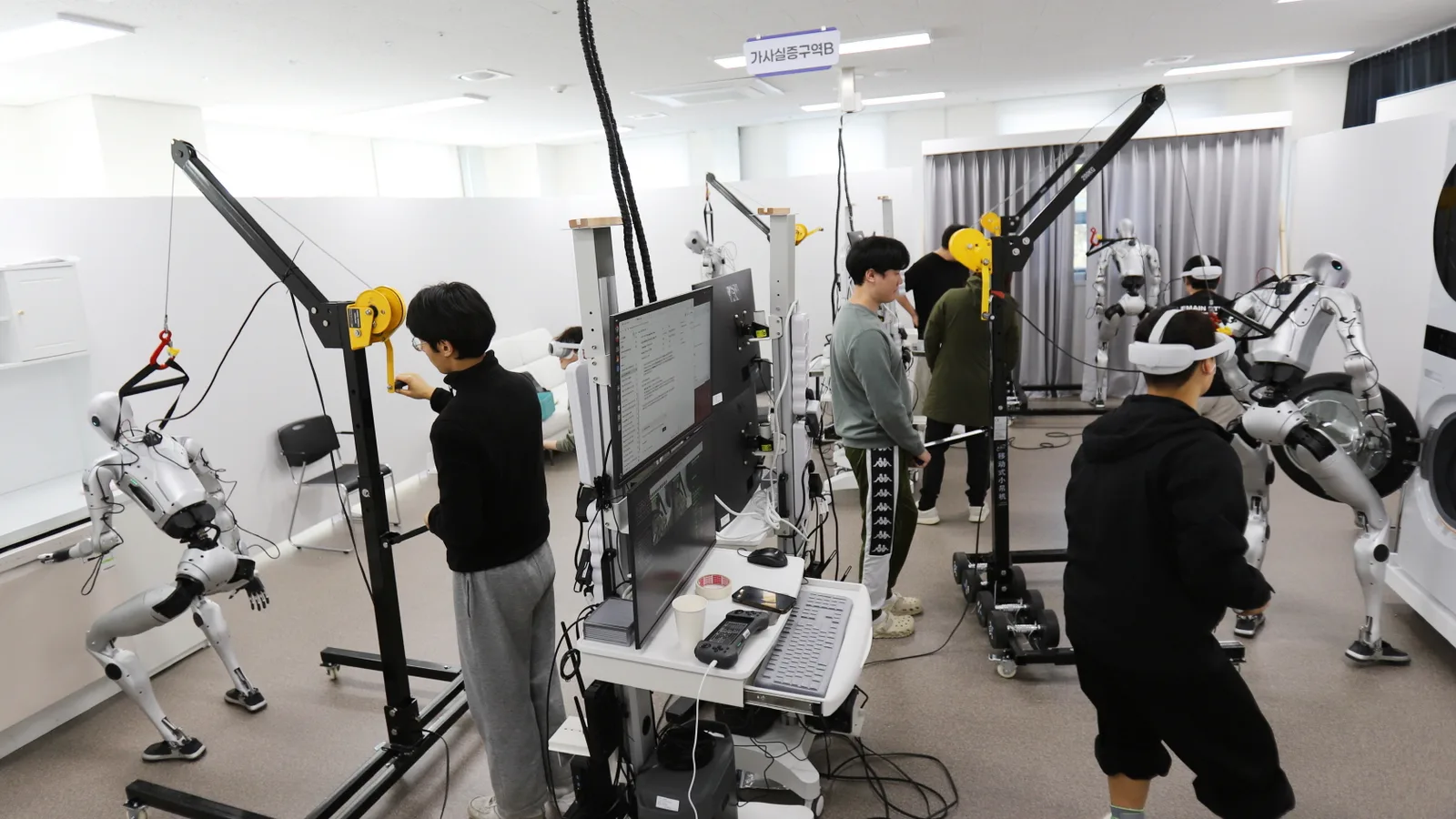
The photo at the top shows what that looks like. Operators wear headsets, the robots hang from support stands so they don’t crash to the floor, and there are real appliances, like a washing machine, right there in the room.
What the robots were doing
At the opening ceremony, the robots showed off a mix of house chores and work tasks:
- Taking items out of a refrigerator
- Handling laundry
- Tidying up a sofa
- Working the buttons and levers inside a car
KIMM also showed KAIROS, a humanoid robot developed in Korea, doing precise object handling and copying a person’s full body movements.
The bigger plan
This isn’t a one-off. According to Aju Press, the factory plans to grow from 12 robots to 25.
KIMM says it will start opening the factory to companies, universities and other research institutes in stages beginning at the end of 2027. The first version of KAIROS is due in April 2027.
There’s real money behind this too. Aju Press reported that Korea’s Ministry of Planning and Budget set aside 2.3 trillion won, about $1.7 billion, through 2030 to grow the country’s humanoid industry. That plan includes buying 1,080 Korean-made humanoids and raising the share of core robot parts made in Korea to 80 percent, up from about 45 percent.
KIMM’s president, Seog-Hyeon Ryu, said securing large amounts of high quality robot task data is “essential to national technological competitiveness.” The institute says this should cut Korea’s reliance on foreign data and AI models.
Why data is the big deal
Everyone’s racing to build humanoid robots right now. The hardware is getting good fast. The hard part is teaching them, because there’s no internet full of robot movements to learn from the way there’s an internet full of text and pictures.
So countries and companies are basically building robot schools. Rooms full of real objects, real furniture, real appliances, and people patiently walking robots through the same jobs thousands of times.
My take
I think this is one of the most honest looks at where humanoids really are. Behind every cool robot video, there’s a room like this with people in headsets doing laundry through a robot, one move at a time. It’s not flashy, but it’s the work that actually gets robots useful. Korea building a public version and opening it up to other companies is a smart move, because whoever has the best training data is probably going to have the best robots.
So basically — pass it on.
Daily Updates
Get new stories in your inbox
Near-future tech when it moves. Robots, space, EVs, AI. No spam.