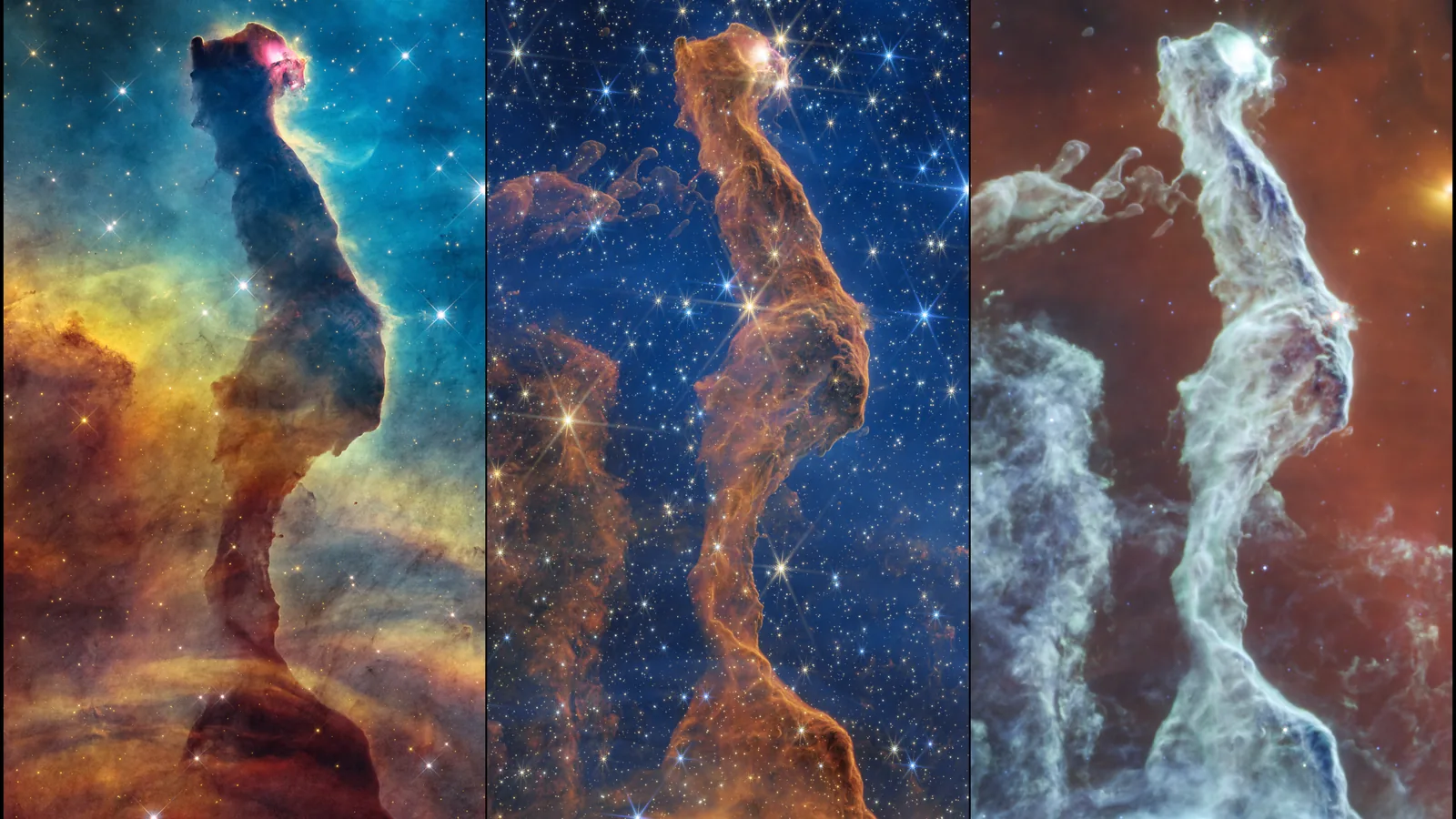
Hubble and Webb Found a Space Cloud Shaped Like a Cat, Glowing Eye and All
NASA and ESA released new Hubble and Webb pictures on Oct. 29, 2026 of the Cat's Head Nebula, a dark pillar of dust in the Carina Nebula about 7,500 light-years away. The cat's glowing eye is most likely a baby star still wrapped in dust.
So basically: Two of the most famous telescopes ever built, Hubble and Webb, both pointed at the same little patch of space and found a giant cloud of dust that looks like a cat sitting with its back to you, head turned to the side, with one glowing eye. NASA and ESA released the pictures on Oct. 29, two days before Halloween, and I don’t think that timing was an accident.
They’re calling it the Cat’s Head Nebula.
Where this cat lives
The cat is a small piece of something much bigger called the Carina Nebula, a massive cloud of gas and dust about 7,500 light-years from Earth. Carina is basically a star factory. New stars are being born all over it, and some of them are huge, hot and really bright.
The “cat” itself is a tall, skinny pillar of dust. In the pictures it runs from the bottom almost to the very top, with a lump at the top that looks like a head turned to the right and a long stretch at the bottom that looks like a tail.
What the glowing eye actually is
This is the coolest part to me. The eye isn’t just a lucky bright spot. Scientists say it’s most likely a young star that’s still partly buried in the dust, basically a baby star that hasn’t fully hatched yet.
Webb’s near infrared picture also caught a faint jet coming off the cat’s belly. That kind of jet usually means there’s another young star nearby, either inside the cat or just to the right of it, blowing material out as it forms.
Why it’s shaped like that
Nobody carved this thing on purpose, obviously. The big, hot stars around it put out a ton of ultraviolet light and stellar wind, and over a long time that slowly eats away at the gas and dust around them. The cat is a spot where the dust is thicker, so it’s holding out while everything around it gets blown away.
You can actually see that happening in Hubble’s picture. There’s a hazy yellow glow running along the right edge of the cat. That’s gas getting heated up by all that ultraviolet light and basically evaporating off the pillar. So this cat is slowly melting, and ESA says the whole scene will eventually break apart.
Why two telescopes and three pictures
The release has three versions side by side, and they all show different things:
- Hubble, visible light: This is closest to what your eyes would see. The cat is a dark brown shape blocking the glowing gas behind it, and the eye shows up red.
- Webb, near infrared: Infrared light goes right through a lot of dust, so the cat looks more see through, the background fills up with stars, and you can even spot a few faint galaxies way behind it.
- Webb, mid infrared: This one shows warm dust and carbon based molecules lit up by starlight. The cat turns a ghostly blue gray, which honestly looks the most Halloween of the three.
Hubble has been up there since 1990. Webb launched in 2021 and is the biggest, most powerful telescope ever sent to space. Putting their views together is like taking a normal photo and a thermal camera shot of the same thing. You learn way more than you would from either one alone.
Why scientists care
Star formation is messy. Gas and dust collapse, baby stars switch on, and those new stars start blasting the cloud they came from. Pillars like this one are where you can catch that whole process in the act. Every detail, like where the jet is, which parts are getting eaten away, and which stars are still buried, helps astronomers figure out how stars like our Sun got started.
My take
I know it’s “just” a pretty picture, but I love these. Two telescopes that cost billions of dollars, one of them 36 years old, and they turn up a cat with a baby star for an eye right before Halloween. What gets me is that it’s temporary. This thing has been slowly melting for who knows how long and it won’t last forever, and we just happened to have cameras good enough to catch it. If you want to see it for yourself, the NASA video that zooms into it is worth a minute of your time.
So basically — pass it on.
Daily Updates
Get new stories in your inbox
Near-future tech when it moves. Robots, space, EVs, AI. No spam.