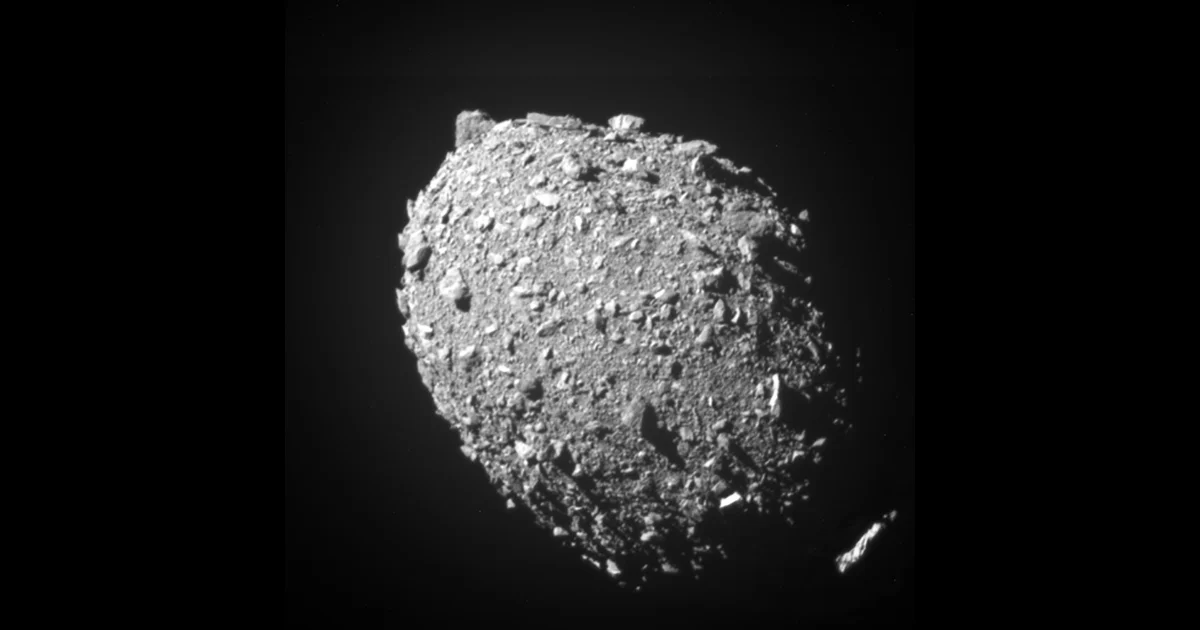
Four Years After NASA Smashed Into an Asteroid, Europe's Hera Is About to See the Damage
ESA's Hera probe starts braking toward the Didymos and Dimorphos asteroids on Oct. 15 to find out what NASA's DART crash actually did.
Update, Nov. 17: ESA said Nov. 11 that Hera has arrived. It’s now flying around the asteroid pair about 25 to 30 km out and moves in closer in December. (ESA)
So basically: In 2022 NASA flew a spacecraft straight into an asteroid on purpose to see if we could knock one off course. It worked. But nobody has actually seen the crash site up close. Starting tomorrow, Oct. 15, Europe’s Hera spacecraft begins slowing down to go take a look.
Quick recap of what NASA did
The mission was called DART, short for Double Asteroid Redirection Test. On Sept. 26, 2022, it slammed into a small asteroid called Dimorphos. Dimorphos is a moonlet. It circles a bigger asteroid called Didymos.
Neither rock was ever a threat to Earth. That was the point. It was a safe target to practice on.
The goal was to see if hitting an asteroid could change its path. It did. The hit shortened the time Dimorphos takes to go around Didymos by about 33 minutes. That was way more than the minimum NASA was hoping for.
This was the first real test of what’s called planetary defense, basically the plan for what we’d do if a big rock were actually headed our way.
Why go back
Since the crash, scientists have only been able to watch from far away with telescopes. They know a lot of material got blasted off. They know the orbit changed. But there’s a lot they don’t know.
- How big is the crater?
- Did the hit rearrange the whole asteroid?
- Is Dimorphos now tumbling?
- Did material move over to Didymos?
Even the orbit change turned out to be weird. The time it took Dimorphos to circle Didymos kept changing for about six months after the impact, and nobody’s totally sure why.
Hera’s lead scientist, Patrick Michel, said Hera is like a detective going back to the crash scene.
The plan
Hera is a European Space Agency mission. It launched on a SpaceX Falcon 9 in October 2024. Here’s the timeline:
- Oct. 15: The first of three braking burns to slow down and approach the asteroids.
- Early November: It gets within about 20 miles of the pair and starts science work.
- Early December: It moves in even closer.
- January: It releases two tiny cubesats it brought along.
One cubesat, Milani, will figure out what the asteroid is made of. The other, Juventas, will use radar to look inside Dimorphos. That has never been done on any asteroid. Juventas will finish its mission by landing on it. Milani might try to land too.
The main spacecraft is supposed to keep working until at least September 2027.
They’ll also look for any leftover pieces of DART. The team doesn’t expect much, since it hit really fast and probably shattered or melted. The only long shot is part of a solar panel that may have snapped off.
Why it matters
If we ever spot an asteroid actually headed for Earth, the question won’t be “can we hit it.” DART already showed we can. The question will be how hard, how early and what happens to the rock when we do. A loose pile of rubble reacts very differently than a solid chunk.
That’s the stuff Hera is going to measure. It turns one cool experiment into something we could actually use when it counts.
My take
I love this one. Most space news is about who’s launching what. This is just a plain “we hit it, now let’s go see what happened.” And the answer could literally be part of how we save the planet someday.
The part I’m most excited for is the first close-up photo. One of the scientists said it’s like visiting a new world, because nobody knows what the crash site looks like now. Is it a big crater? Is the whole thing reshaped? We find out in a few weeks.
Would you trust a plan to knock an asteroid off course, or does that still sound like a movie to you?
So basically — pass it on.
Daily Updates
Get new stories in your inbox
Near-future tech when it moves. Robots, space, EVs, AI. No spam.