Hera Shows DART Left a Stadium-Sized Crater on Dimorphos and Sent It Tumbling
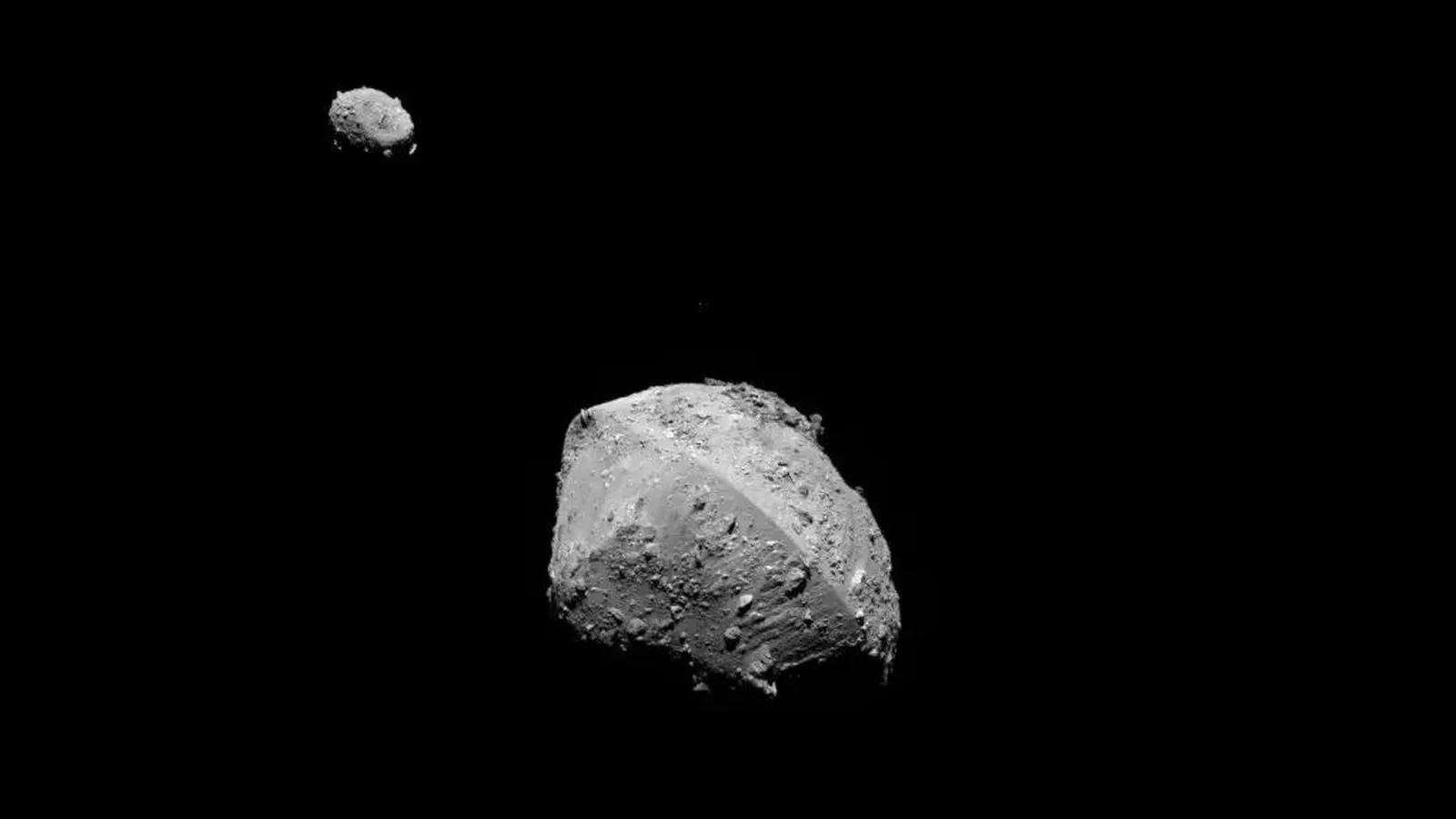
ESA's Hera spacecraft sent back its first close look at the asteroid NASA's DART probe hit in 2022. One whole side is flattened into a crater as wide as the asteroid, the moonlet is tumbling, and hundreds of boulders are circling the pair.
So basically: Four years ago NASA slammed a spacecraft called DART into a small asteroid named Dimorphos to see if we could knock a space rock off course. It worked. Now the European Space Agency’s Hera spacecraft has finally shown up to look at the damage, and the first pictures are wild. One whole side of the asteroid got flattened into a crater the size of a sports stadium, and the thing is now tumbling through space.
What Hera found
ESA released the first images on Nov. 25, 2026. Dimorphos is a little moonlet about 151 meters wide that orbits a bigger asteroid, Didymos, which is about 730 meters across. The pair is roughly 193.5 million kilometers from Earth right now.
Here’s what Hera saw:
- The face DART hit is now one big flat crater that stretches across the entire width of the asteroid
- The rest of Dimorphos looks basically the same as it did in DART’s 2022 photos, with the same boulder fields
- Dimorphos is no longer spinning in a neat, steady way. ESA says it’s tumbling wildly in its orbit
- Hundreds of boulders, each just a few meters across, are now circling the two asteroids
Scientists had argued for years about whether DART left a crater, changed the asteroid’s shape, or did nothing to it. Hera principal investigator Patrick Michel put it this way: “Much to our surprise the answer turns out to be all three at once!”
Why this matters
DART hit Dimorphos on Sept. 26, 2022. Telescopes on Earth showed it shortened the moonlet’s orbit around Didymos by 33 minutes, which was a lot more than expected. What nobody could see from Earth was what the hit did to the rock itself.
That’s the part that matters if we ever have to do this for real. If an asteroid is headed our way, we need to know how hard to hit it and how it will react. A loose pile of rubble acts very differently than a solid rock. Hera is the follow up that turns one lucky test into something engineers can actually plan around.
ESA unveiled the pictures in the dinosaur hall of the Museum für Naturkunde Berlin. Mission manager Ian Carnelli pointed out that an asteroid changed life on Earth 66 million years ago, and this is the first time humans are testing a way to stop that from happening again.
How Hera works
Hera is about the size of a small car. Right now it’s flying about 25 to 30 kilometers from the asteroids, using its thrusters to fly box-shaped loops around them at an average speed of just 12 centimeters per second. That’s slower than a slow walk.
It’s using three instruments: a black and white camera, a camera that sees in 25 colors at once, and a heat sensing camera from Japan’s space agency, JAXA. All those new boulders are a real problem now, because the team has to steer around them as Hera moves in.
What happens next
- December: Hera moves in to about 13 kilometers for sharper pictures
- January 2027: Hera releases two shoebox-sized CubeSats called Juventas and Milani that will fly even closer
After that, ESA has another mission lined up called Ramses, built with JAXA. It’s going to the asteroid Apophis, which will pass about 32,000 kilometers above Earth’s surface on Friday, April 13, 2029. That’s closer than a lot of our satellites, and it’s completely safe, but scientists want to watch how Earth’s gravity shakes it up.
My take
This is one of my favorite stories of the year. We hit an asteroid on purpose, moved it, and now we’ve got a camera sitting next to it showing exactly what we did.
The tumbling and the cloud of boulders tell me these rocks are a lot looser than people assumed. That’s good to know now and not when one is actually coming. Asteroid defense used to sound like a movie plot to me. Seeing these pictures, it feels like something we’re really building. I’m looking forward to the closer shots in December.
So basically — pass it on.
Daily Updates
Get new stories in your inbox
Near-future tech when it moves. Robots, space, EVs, AI. No spam.