This Swiss Humanoid Skips Legs, Learns on the Factory Floor and Hits 98% on Cable Jobs
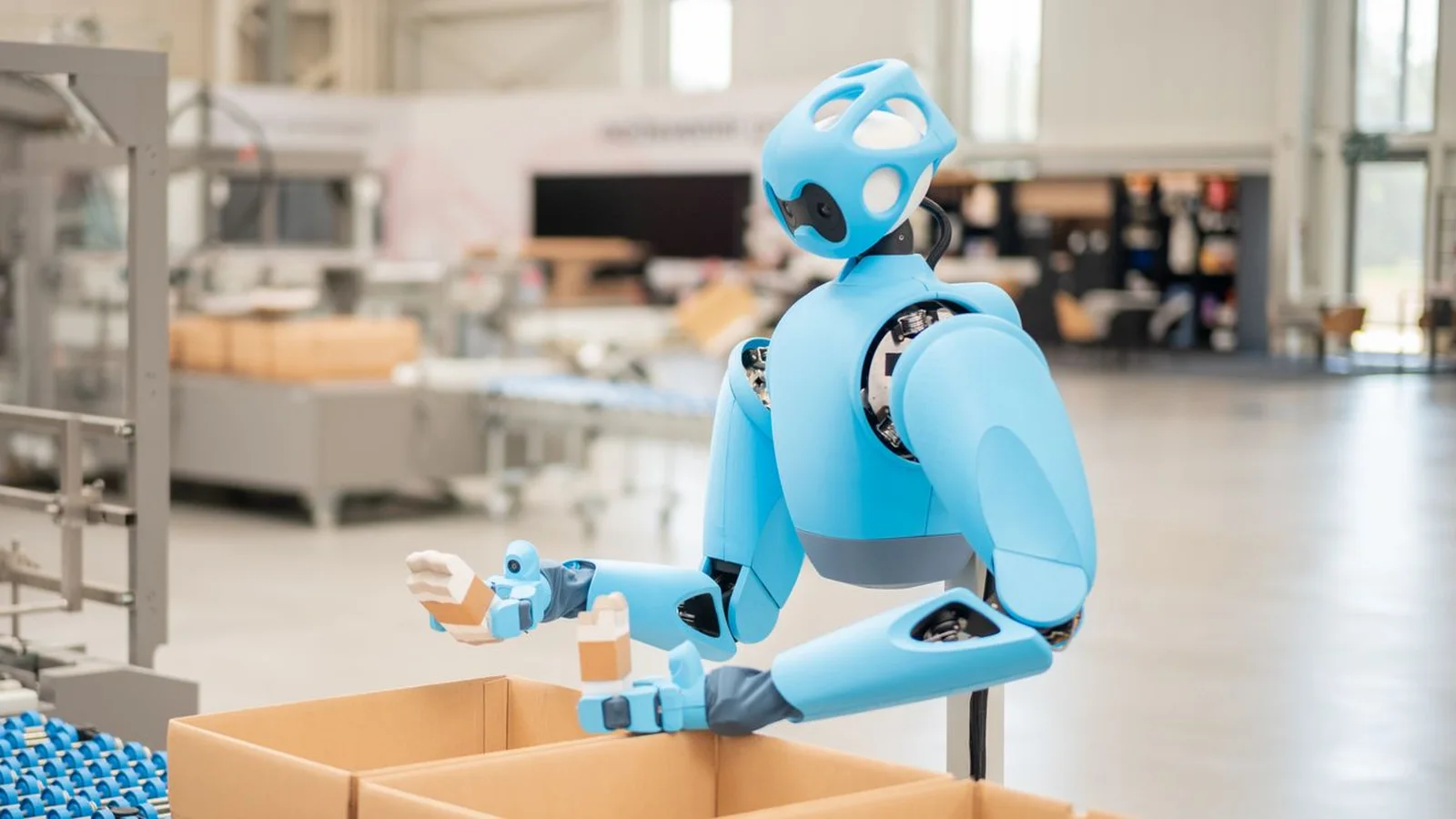
Swiss startup Embodied AI unveiled AIR, a wheeled, tendon driven humanoid built to work beside people without a safety cage. It learns a task from human operators in about a month and hits 98% reliability on cable handling.
So basically: A Swiss startup called Embodied AI just showed off its first commercial humanoid robot, AIR, at Humanoid Europe 2026. It doesn’t have legs. It rolls around on wheels, its arms are soft and light on purpose, and it learns jobs right on the factory floor. The company says it already hits 98% reliability on cable handling work on live production lines.
Who’s behind it
Embodied AI is based in Lausanne, Switzerland. It was started by three robotics PhDs from EPFL, ETH Zurich and Cambridge, and the team also includes people from TU Delft, Oxford and MIT. The CEO is Francesco Stella.
The company says it went from a research prototype to a robot with signed contracts from manufacturers in just nine months. Its Series A was led by a firm called Faber, though the amount wasn’t shared.
Why no legs
Most humanoid companies are chasing robots that walk like people. Embodied AI went the other way. Factory floors are flat, so wheels are simpler, steadier and use less energy than walking.
The arms are where it gets interesting. AIR uses tendons, kind of like the cables in your own arm, with the motors and gearboxes tucked inside the torso. That keeps the arms light, so if one bumps into a person, it gives instead of shoving back.
The company says its arm is a soft manipulator with 9 or more joints of movement, which lets it do fiddly work like picking, placing and plugging things in.
Built to work without a cage
Most factory robots work behind fences because they can hurt someone. AIR is built to a standard called ISO/TS 15066, which covers robots that share space with people without a cage. Embodied AI plans to get CE marking in 2027, which it needs to sell AIR more widely in Europe.
Stella put it this way: “Hallucination of AI models is acceptable in the digital space. In robotics, however, incorrect actions have immediate and irreversible physical consequences.”
How it learns
This is the part that sets it apart. Instead of training the robot in a simulation and hoping it works on a real line, a human operator guides AIR through the job right there in the factory. After about a month, it can run the task with less help. Operators still watch over it and can step in anytime.
Here’s how the numbers stack up:
- 98% reliability on cable handling
- 90% is the level the company says manufacturers usually want before they trust a robot with a task
- About 1 month to learn a new job on site
- No changes needed to the factory layout
Cable handling sounds boring, but it’s actually hard for robots. Cables are floppy and never sit the same way twice.
Why companies care
Embodied AI points to projections of up to 1.9 million unfilled U.S. manufacturing jobs by 2033. Factories can’t find enough people for repetitive assembly work, and most can’t afford to rebuild their lines around big caged robots.
It’s also a different bet than the big players. Apptronik and Chinese makers like AgiBot and UBTech are building walking robots meant to do almost anything. Embodied AI is going narrower: a safe robot that gets good at a few specific jobs fast.
My take
I honestly think this is a smart approach. Walking robots look amazing in videos, but a lot of real factory work happens standing in one spot at a table. Wheels and soft arms make a ton of sense there. The “learn it on the actual line” idea also solves a real problem, since robots trained somewhere else tend to struggle with a real factory’s mess. The big question is whether they can grow past cable jobs into lots of different tasks. If they can, this little Swiss company could be a sleeper in the humanoid race.
So basically — pass it on.
Daily Updates
Get new stories in your inbox
Near-future tech when it moves. Robots, space, EVs, AI. No spam.