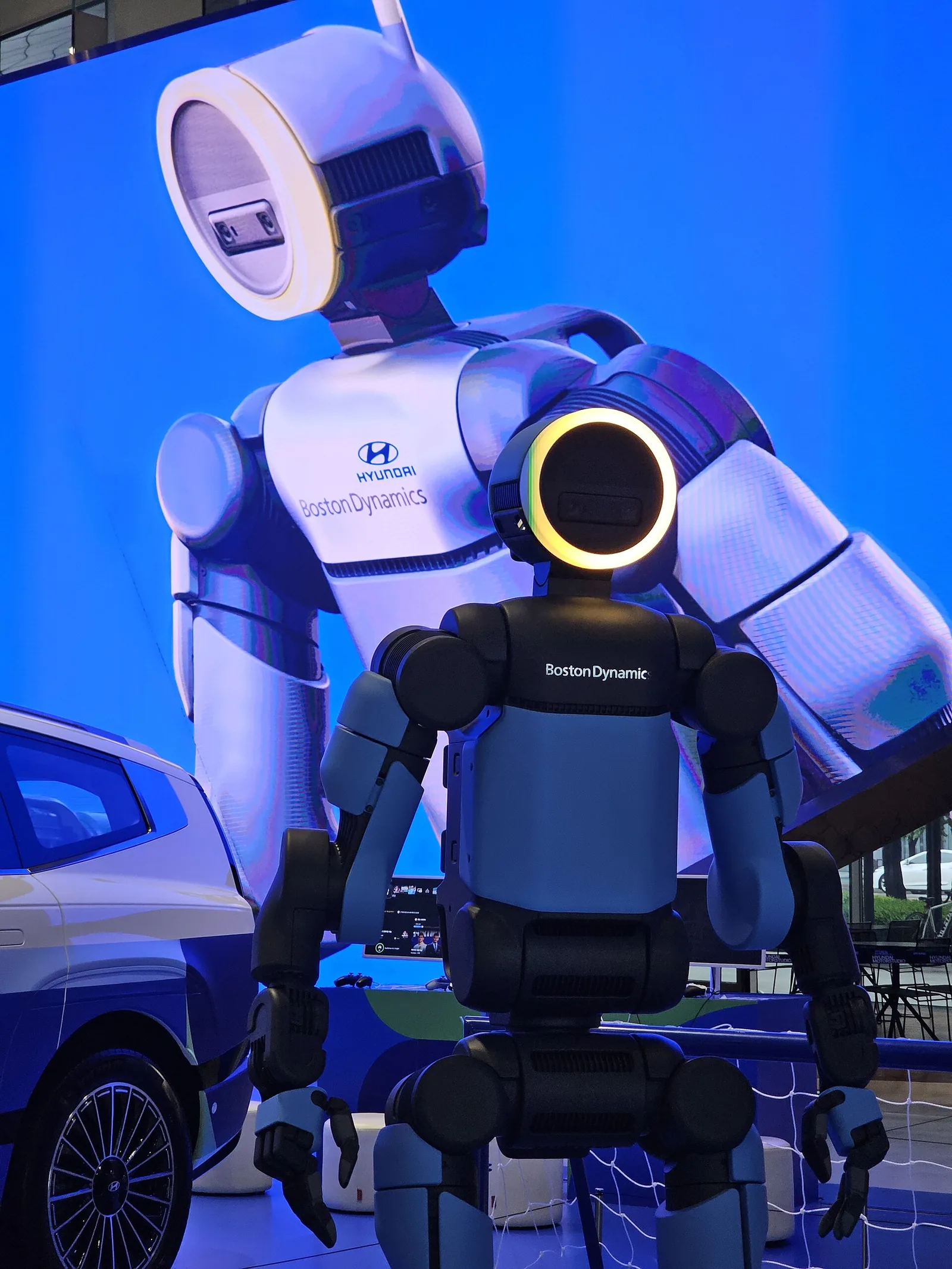
Boston Dynamics Can Build an Atlas in About a Day. They Want That Down to One Hour
A new Boston Dynamics video says Atlas assembly on the Waltham prototype floor is down to roughly one day, with a 2027 push toward one-hour builds.
So basically: Boston Dynamics just put a real number on something robot companies usually keep vague. On their Waltham, Massachusetts prototype floor, they say they can assemble one Atlas humanoid in about a day. A year ago it took multiple days. The new target is one hour by 2027, and eventually minutes.
Why a build-time number matters
For years the humanoid race was about backflips and demos. Now it is about how fast you can make the things without them falling apart.
Boston Dynamics published a roughly six-minute video called “Machine, Assemble, Repair: How We Build Atlas.” Sr. Technical Program Manager Katie Conner walks through the progression: multi-day builds, then about a day, then the one-hour ambition.
That one-day figure is per robot, start to finish on the prototype floor. It is not the same as a factory line pumping out one finished robot every hour while a dozen units sit at different stations.
Shop floor next to the engineers
The Waltham setup sounds less like a car plant and more like a machine shop glued to a design lab.
They cut gears in-house. They keep tight-tolerance parts under the same roof as the people designing them. An engineer can walk downstairs, talk to a machinist, and sometimes have a revised part the same day or the next. Then they watch that part move in a walking robot upstairs.
They say the loop can go from a Monday idea to hardware in the robot by the end of the same week. Robotic arms help with sub-assembly too, so the robots being built are already hanging out with the tools that build them.
Do not mix up the metrics
Figure AI said its BotQ plant in San Jose hit one robot per hour earlier this year. That is line throughput: how many robots leave the line each hour. BotQ is aimed at about 12,000 humanoids a year.
Boston Dynamics is talking about how long one Atlas takes to assemble on a prototype floor. Different yardstick. Both matter. They just are not the same number.
Tesla has been reported building Optimus units by the hundreds per week for internal use. Chinese makers are racking up cumulative unit counts across whole product lines. Everybody is suddenly bragging about manufacturing because capability alone stopped being enough.
Price and who gets the 2026 robots
Atlas is often estimated around $140,000 to $150,000 per unit. Boston Dynamics has argued customers can get payback in about two years on factory jobs.
This year’s whole output is already spoken for. Parent company Hyundai Motor Group and Google DeepMind get the robots. DeepMind is using them for Gemini Robotics work. Hyundai has talked about Atlas starting parts-sequencing work at its Ellabell, Georgia plant in 2028, then heavier assembly later.
Boston Dynamics has also floated a future factory aimed at about 30,000 Atlas units a year. That is the volume story. The one-day / one-hour talk is the speed story.
What one hour would actually mean
Going from a day to an hour is roughly a 24x speedup. You do not get that by yelling at technicians. You get it with purpose-built tooling, less hand work, more automated sub-assembly, and designs that are easier to put together.
They already went all-electric on Atlas in 2024, ditching the old hydraulic system. Fewer fluid circuits means fewer assembly headaches. The recent four-finger hand was also sold as a balance of dexterity, cost, and repairability. Faster builds make those hardware bets cheaper to test.
My take
I trust Boston Dynamics more than most of these humanoid startups when they talk hardware. They have been embarrassing other robots for decades.
But a one-day prototype build is still a lab flex, not a factory. One hour in 2027 is the real claim, and they framed it as an ambition, not a promise.
If they hit anything close to that, Atlas stops being a museum piece for Hyundai and DeepMind and starts looking like something you can actually order in volume. Until then, I will enjoy the video and wait for the hour timer.
So basically — pass it on.
Daily Updates
Get new stories in your inbox
Near-future tech when it moves. Robots, space, EVs, AI. No spam.