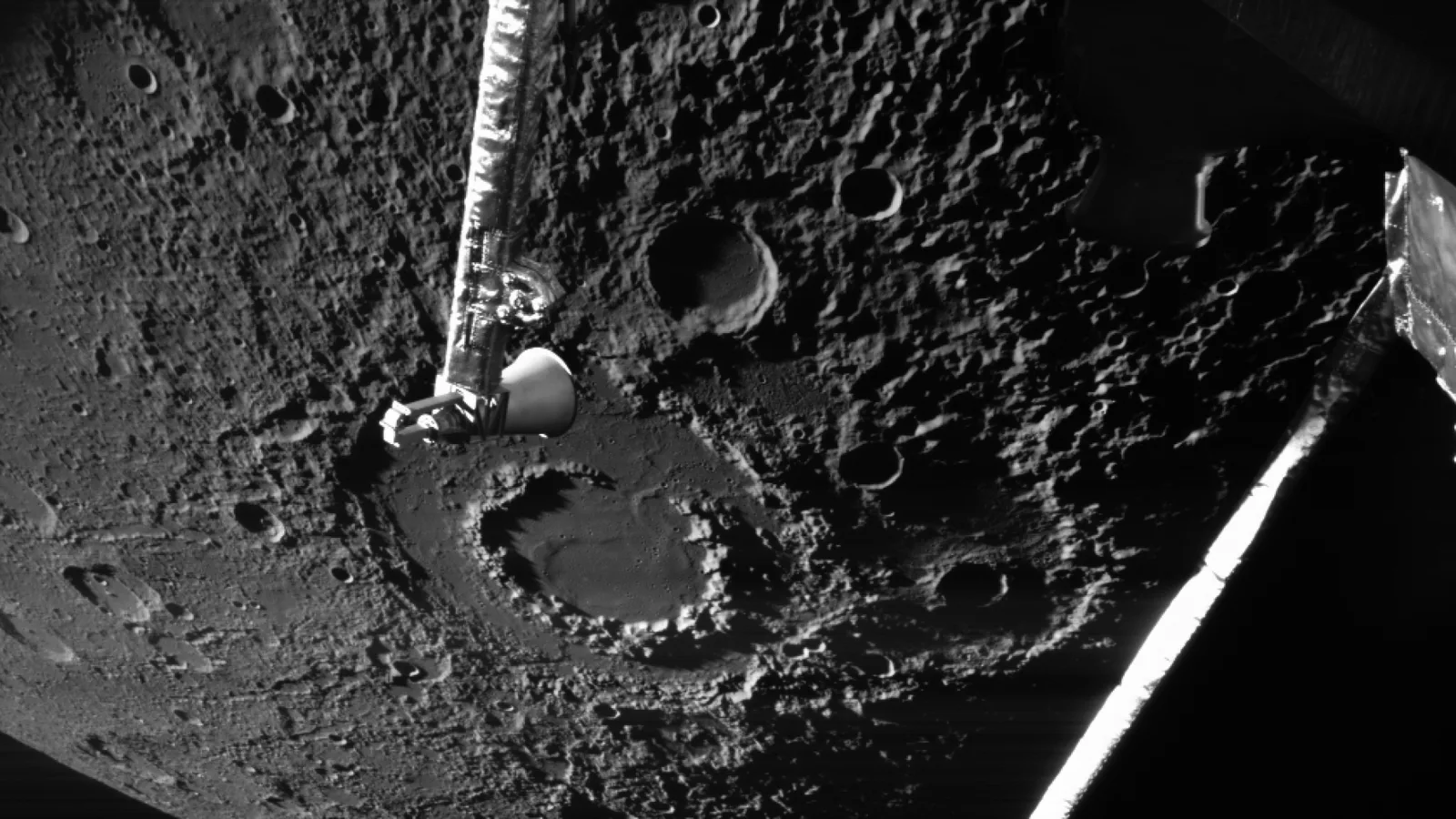
BepiColombo Is Finally in Orbit Around Mercury After 8 Years, 9 Flybys and Almost 10 Billion Kilometers
The European and Japanese BepiColombo mission fired four thrusters for 37 minutes on November 21 and got captured by Mercury. It's only the second spacecraft ever to orbit the planet, and next month it splits into two orbiters that will work at the same time.
So basically: A spacecraft that left Earth in October 2018 just got into orbit around Mercury. It’s called BepiColombo, it’s a joint mission from the European Space Agency (ESA) and Japan’s space agency (JAXA), and on November 21 it fired four thrusters for about 37 minutes so Mercury’s gravity could catch it. It’s only the second mission ever to orbit Mercury, and in a few weeks it’s going to split into two separate spacecraft.
Why this took eight years
Mercury is the closest planet to the Sun, so you’d think getting there would be easy. It’s actually the opposite.
As you fall toward the Sun, you speed up. A lot. So the hard part isn’t reaching Mercury, it’s slowing down enough to stop there instead of flying right past it. Emma Bunce, one of the mission’s lead scientists, told Nature that “it takes more energy to go to Mercury than to go to the outer Solar System.”
To get around that, BepiColombo used planets as brakes. It did nine flybys on the way:
- One past Earth
- Two past Venus
- Six past Mercury itself
All in, it traveled close to 10 billion kilometers, about 6.2 billion miles. The trip also got pushed back about a year after a problem with its solar panels cut the power to its electric thrusters, according to Space.com.
What happened on November 21
BepiColombo is really a stack of spacecraft. Back in September, it dropped the Mercury Transfer Module, the part that carried everything there with its electric engines. That left two science orbiters stuck together:
- MPO, the Mercury Planetary Orbiter, built by ESA
- Mio, the Mercury Magnetospheric Orbiter, built by JAXA, riding on top inside a sunshield
On November 21, four of MPO’s thrusters fired to slow the stack down as it came in near Mercury’s south pole, approaching from the planet’s night side. ESA’s mission control team in Darmstadt, Germany confirmed the capture after the signal came back and they checked the data.
The first orbit is a long, stretched out loop. MPO still has a bunch more burns to do to tighten it up.
What happens next
ESA laid out the schedule:
- December 9 to 10: MPO and Mio separate. From then on, BepiColombo becomes the first mission with two spacecraft orbiting Mercury at the same time.
- March 2027: MPO reaches its final science orbit, a lot closer to the surface than Mio.
- April 2027: Science work officially starts for both.
The two orbiters split the job. Mio swings out on a wide loop to study Mercury’s magnetic field and how it fights with the solar wind coming off the Sun. MPO stays closer and maps the surface, the interior and what the planet is made of.
Why Mercury is weird
Mercury has a few things that don’t add up:
- It’s tiny but has a big iron core and its own global magnetic field. Besides Earth, it’s the only rocky planet with one.
- Its surface can hit around 450°C, but the shadowed craters near its poles look like they hold water ice.
- The only spacecraft to orbit it before was NASA’s MESSENGER, from 2011 to 2015.
MPO also carries an X ray camera called MIXS, which Bunce says is the first X ray imaging device sent on an interplanetary mission. During the cruise, the team tested it by pointing it at the Crab Nebula, the leftovers of a star that blew up and was seen from Earth in the year 1054.
My take
Eight years is a long time to wait on one thing. When this launched in 2018, almost nobody was paying attention, and it’s been out there doing laps around Venus and Mercury the whole time. What gets me is that the closest planet to the Sun is one of the hardest places to park a spacecraft. You’d think it would be the easy one. The part I’m waiting on is December, when the two orbiters split up and go their own ways. If that goes clean, we get two spacecraft watching Mercury from two different angles, and that’s never happened before. Science doesn’t start until April, so this is one to check back on in the spring.
So basically — pass it on.
Daily Updates
Get new stories in your inbox
Near-future tech when it moves. Robots, space, EVs, AI. No spam.