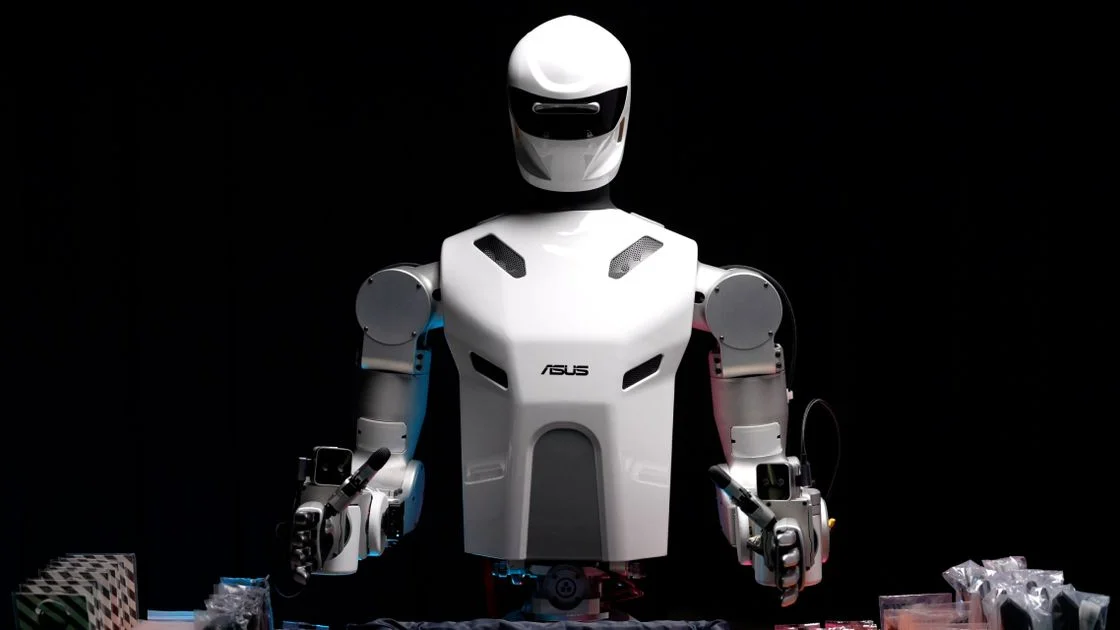
ASUS Built a Humanoid Robot, and Its First Job Has to Be 99.5% Perfect
ASUS's first humanoid robot, Gallop, is learning to pack motherboard accessories in an ASUS group factory and has to hit 99.5% success in 20 seconds per board, the same standard as a person.
So basically: ASUS, the company that makes a lot of the laptops and motherboards people use, has built its first humanoid robot. It’s called Gallop. Its first job is packing motherboard boxes in one of ASUS’s own factories, and it has to get it right 99.5% of the time.
The job
Gallop is working a real packing station at an ASUS group electronics factory. Not a staged demo.
Here’s what the station looks like. Every motherboard box gets 15 small parts. Screws, cables, little accessories. A lot of them come in thin, clear plastic bags, which are a pain for robots because they’re floppy, slippery and hard for cameras to see.
A person does one board in about 20 seconds. ASUS’s target for Gallop is 99.5% success within 20 seconds. That’s the exact same standard it holds its human workers to.
ASUS says it picked this station on purpose because it’s hard. If a simple gripper could do it, they wouldn’t need a humanoid.
How it learns
This part is actually kind of clever. ASUS says teaching Gallop works a lot like training a new hire:
- It starts from open AI models that already understand how hands and objects move
- Experienced workers wear a small head camera, with their permission, so the robot can see how the job is really done
- A computer simulation makes slightly different versions of each example, so small changes on the line don’t throw it off
- An operator wearing a VR headset and gloves guides the robot through the task by hand
- Once it’s working, everything it does on the job goes back into training
ASUS says its edge isn’t having more data. It’s having the right data. Real station, real parts, real quality rules.
What’s inside
Gallop runs on a single Nvidia Jetson AGX Thor computer inside the robot. ASUS describes its brain in four layers. One plans the job and breaks it into steps. A second AI watches every step and re-plans if something goes wrong. Another layer handles reaching, grabbing and placing. The last one moves the arms and hands and stops instantly if anything’s off.
The layers are built so ASUS can swap in a better AI model without rebuilding the robot. That matters, since new models are coming out every few months.
ASUS designs the body and the hand itself. The hand is the hardest part of any humanoid, and ASUS says good ones are still scarce worldwide, so it’s building its own with a sense of touch.
Right now Gallop sits on a fixed base with two arms. No legs, no wheels yet.
The timeline
The program only started in early 2026. Here’s the plan from here:
- Add ASUS’s own hand and put Gallop on wheels over the next year
- Show it to customers at Computex 2027
- Run customer pilots in 2027
- Start selling it in the second half of 2028
Electronics factories come first. ASUS says hospitals and service jobs could come later, since a lot of jobs share the same pick and place skills.
The jobs question
ASUS says Gallop isn’t meant to replace workers. It’s aimed at the repetitive, physically tough stations that are hardest to keep staffed. The workers who teach it move into setting up and supervising the robots.
That’s the company’s word on it, so we’ll see how it plays out. But the head camera idea does make the workers the teachers.
My take
What I like here is the honesty. A lot of humanoid companies show you a robot folding a shirt once and call it a day. ASUS is basically saying, here’s one boring station, here’s the number it has to hit, and we’ll tell you how close we get. A 99.5% target on floppy little plastic bags is a real test. If Gallop passes it, that’s worth more than a hundred dance videos.
So basically — pass it on.
Daily Updates
Get new stories in your inbox
Near-future tech when it moves. Robots, space, EVs, AI. No spam.