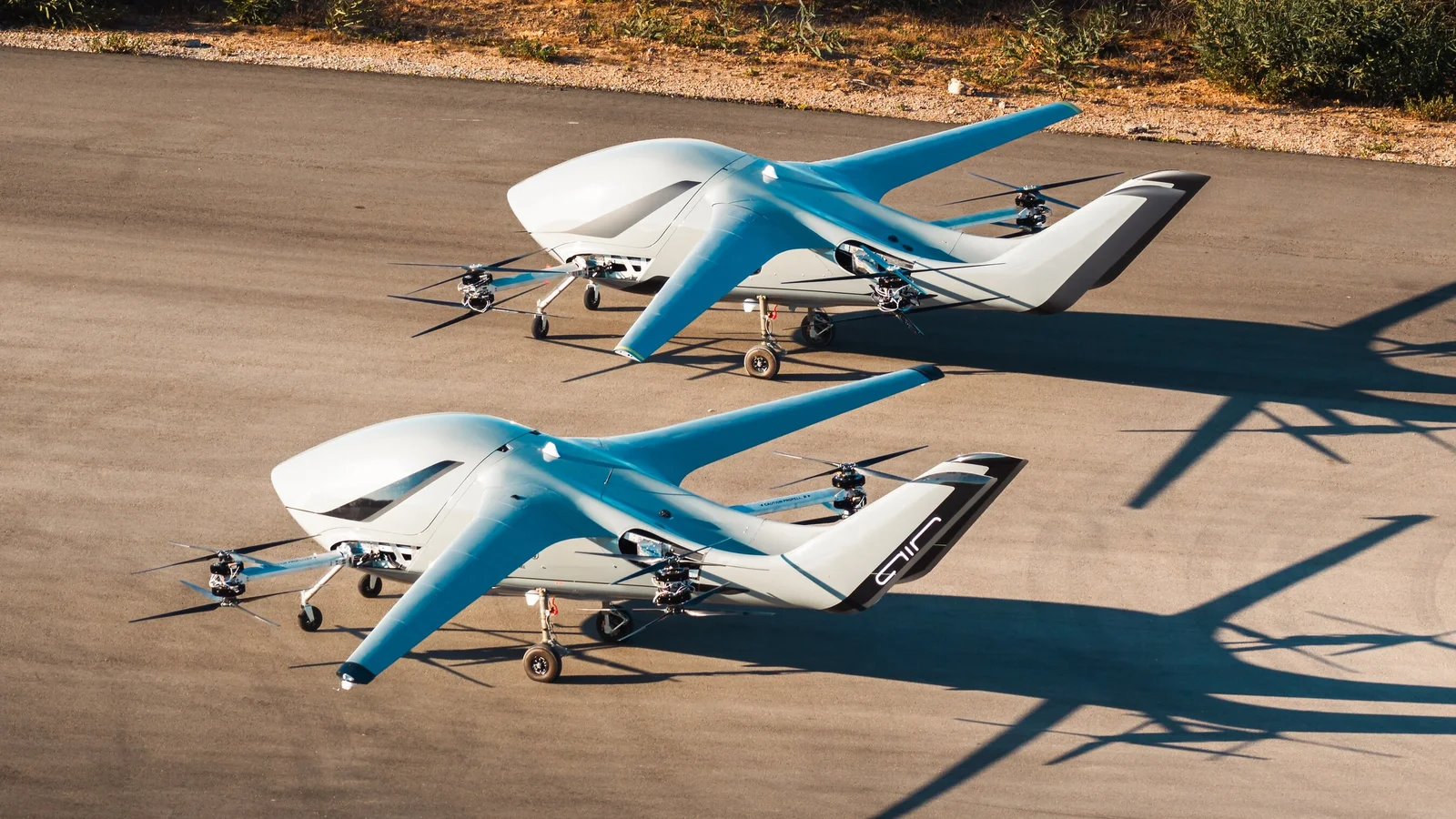
This Pilotless Cargo eVTOL Just Landed in Florida to Prove It Can Haul 550 Pounds
AIR, the eVTOL company behind the AIR ONE, shipped its first AIR 120D autonomous cargo aircraft to its Florida headquarters for U.S. flight demos. It carries about 550 pounds, needs no runway and has no one on board.
So basically: AIR, an eVTOL startup that started in Israel and now has its headquarters in Florida, just shipped its first AIR 120D to the U.S. It’s a cargo aircraft with no pilot on board. It takes off straight up like a drone, flies like a plane, and carries about 550 pounds of cargo. Now it’s going to fly demos at the company’s Florida base to show what it can do.
What is the AIR 120D?
Think of it as a delivery van that flies itself. It has a bunch of electric rotors for lifting off and landing vertically, plus wings for flying forward efficiently.
Here’s what AIR lists for its cargo aircraft:
- About 550 pounds of payload
- A 70 cubic foot cargo bay
- About 1 hour of flight time
- A cruise speed of 115 knots, which is about 132 mph
- No runway needed
That cargo bay is a little bigger than a box 4 feet long, 4 feet wide and 4 feet tall. Not huge, but plenty for medical supplies, spare parts or a pile of packages.
Who would actually use it?
AIR is pitching it for a few different jobs:
- Remote resupply, like getting parts to a job site with no road
- Maritime logistics, like flying gear out to ships
- Mid mile delivery, the trip between a warehouse and a local hub
- Humanitarian aid after disasters
- Military logistics
On the military side, the AIR 120D falls into what the U.S. Department of War calls Group 4, the drone class for big unmanned aircraft over 1,320 pounds. That’s a big deal for sales, because militaries are hungry for small autonomous cargo planes that can move supplies without putting a crew at risk.
It’s not a brand new idea for them
This isn’t a paper airplane. AIR says the cargo program has more than two years of development and hundreds of flights behind it, plus customer deliveries. It flew the production version of the cargo aircraft for the first time in April 2026.
The company also makes the AIR ONE, a two seat personal eVTOL it’s working to certify with the FAA as a Light Sport Aircraft. In August, AIR announced a partnership to set up its U.S. headquarters in Florida, working with the Florida Department of Transportation. The plan is to eventually build aircraft there, not just fly them.
CEO Rani Plaut said bringing the 120D to Florida “is a concrete step toward putting that infrastructure to work.”
Cargo drones are having a week
The timing is interesting. Just two days before AIR’s announcement, a Chinese startup called Air White Whale flew its W5000 for the first time, on November 14. That’s a pilotless twin turboprop cargo plane built to carry 5 metric tons, which the company calls the largest uncrewed cargo aircraft in the world. It only flew a basic 30 minute test, and its service date has already slipped to the end of 2027.
So the two ends of the market are showing up at once. Small electric aircraft like the AIR 120D that skip the runway, and big pilotless freighters that need one.
Meanwhile, the U.S. Air Force doesn’t have an official cargo drone program yet. Its chief of staff, Gen. Kenneth Wilsbach, said in September there’s “no program of record just yet.”
My take
I like this one because it’s a real job for an eVTOL, not a flying taxi that needs a ton of new rules for passengers. Hauling 550 pounds of parts or supplies where there’s no runway and no road is useful today. One hour of flight time is the weak spot, so this is a short hop machine, not a long haul one. But if AIR can show it flying reliably in Florida, I could see cargo being where these electric aircraft actually make money first, way before air taxis full of people do.
So basically — pass it on.
Daily Updates
Get new stories in your inbox
Near-future tech when it moves. Robots, space, EVs, AI. No spam.